
The chatbot was never the endpoint.
It was the easiest surface to ship.
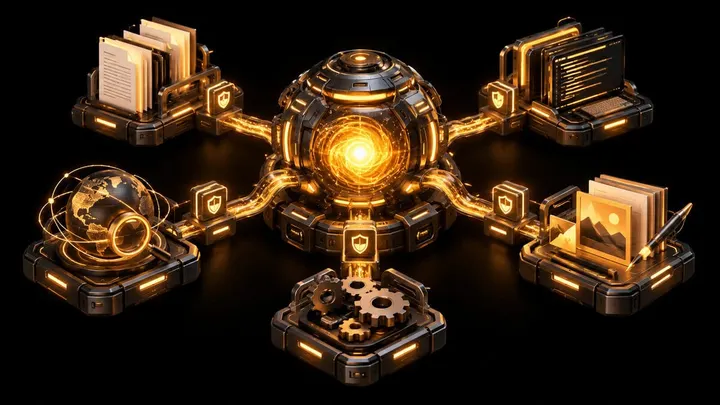
The more important shift begins when an AI system stops living only inside a text box and starts living across messages, files, tools, memory, sessions, workflows, and approval boundaries. That is where the assistant becomes something closer to a personal operating layer.
OpenClaw is a useful signal because it makes that shift visible. Its official documentation describes it as a self-hosted gateway connecting chat apps and channel surfaces to AI coding agents. Its homepage is even more direct: the system is meant to clear inboxes, send emails, manage calendars, and respond through WhatsApp, Telegram, or other chat apps people already use.
That sounds like convenience. It is more than that.
Once an assistant can act through channels you already trust, remember context across sessions, use tools, and wait for or request permission, the product is no longer only a model. It is a control layer around delegated action.
That is the real OpenClaw signal.
The next AI interface is not a better prompt box. It is the place where memory, tools, identity, permissions, messaging, and human control meet.
The chatbot was never the endpoint
Chat made AI usable because it gave people a familiar interface.
It also trained people to misunderstand the system.
A chatbot feels like a conversation partner. It answers, drafts, summarizes, explains, and occasionally fabricates with confidence. That can be harmful, but the blast radius is usually bounded by the response itself. The system can mislead you. It usually cannot act without another layer doing the work.
Agents change that boundary.
An agentic system can plan, choose tools, read files, call APIs, update state, hand off tasks, and continue across multiple steps. OpenAI's Agents SDK documentation describes this loop plainly: the system calls a model, receives output, executes tool calls or handoffs when needed, appends results, and keeps running until it reaches a final output or a limit. Anthropic makes a similar architectural distinction between workflows and agents: workflows follow predefined code paths, while agents dynamically direct their own process and tool use.
That distinction matters because the failure surface moves.
The central question is no longer "Did the answer sound right?" It becomes "What did the system do after deciding the answer was good enough?"
That is why the chatbot frame is too small. It hides the action layer.
A personal agent does not become important because it imitates a person. It becomes important because it starts occupying the parts of software where decisions turn into changes.
OpenClaw turns chat into an operating surface
OpenClaw's most interesting idea is not that it has another chat interface.
It is that chat becomes the remote control for a local agent system.
The official docs describe OpenClaw as a gateway across Discord, iMessage, Matrix, Microsoft Teams, Signal, Slack, Telegram, WhatsApp, Zalo, WebChat, mobile nodes, and other channel surfaces. The GitHub repository frames the gateway as the control plane. The product is not the gateway itself. The product is the assistant that can be reached through whichever communication surface is already part of someone's day.
That is a different kind of interface.
Most software asks users to come to it. A personal agent comes through the channels where the user already lives. It turns Telegram, WhatsApp, Slack, Discord, or a local dashboard into a command surface for work that might touch files, calendars, code, documents, reminders, messages, or web pages.
The practical consequence is obvious. A person does not need to open a special app, remember a dashboard, or sit in front of one machine. They can ask from a phone. The agent can continue in a session. The gateway can route the request. The system can use tools.
The deeper consequence is less obvious.
Messaging becomes an operating surface.
That does not mean chat is the best interface for everything. It often is not. Chat is weak for precise editing, visual comparison, dense configuration, and high-risk approvals. But chat is powerful for intent capture. It lets a user declare a goal in the moment of need, from the device they already have, without navigating software first.
That is why OpenClaw points beyond the chatbot era. It treats messaging not as the product, but as an input layer for a broader agentic environment.
The mechanism is memory, tools, sessions, and permission
The model is not the product by itself.
The product is the system around the model.
For personal agents, four layers matter most: memory, tools, sessions, and permission.
Memory gives the system continuity. It lets an agent remember preferences, operating rules, recent decisions, project context, and recurring constraints. Without memory, the assistant is trapped in the present prompt. With memory, it becomes more useful and more dangerous at the same time.
Tools give the system reach. A model can reason about an inbox, but a tool can actually search it. A model can suggest a file edit, but a tool can patch the file. A model can draft a calendar change, but a calendar connector can turn that draft into a real event. Tool access is where language becomes action.
Sessions give the system shape across time. A one-off reply is not enough for serious work. Agents need task state, routing, recovery, and sometimes resumable execution. A personal agent that loses its thread every time a message ends is still mostly a chatbot with better branding.
Permission gives the system legitimacy. This is the layer that decides which actions are allowed, which require review, which are blocked, and which must leave an audit trail. OpenAI's human-in-the-loop documentation is blunt about the need to pause execution until a person approves or rejects sensitive tool calls. That pattern is not a detail. It is one of the main ways agentic systems avoid turning convenience into uncontrolled authority.
OpenClaw matters because it brings these layers into a personal setting.
Enterprise AI governance often sounds abstract because it happens behind procurement language and compliance diagrams. In a personal agent, the same problem becomes intimate. The system might know the user's writing style, calendar patterns, files, private messages, publishing workflows, and social context. It might also have access to tools that can send, change, schedule, delete, publish, or expose.
That combination is powerful.
It is also exactly why the architecture matters more than the mascot, the model, or the demo.
Autonomy is the wrong success metric
The lazy version of the agent story treats autonomy as progress.
That is a bad metric.
More autonomy is not always better. Better-scoped delegation is better.
Anthropic's agent guidance makes the practical version of this point: developers should use the simplest solution that works, because agentic systems often trade latency and cost for task performance. Workflows provide predictability for well-defined tasks. Agents are better when flexibility and model-driven decisions are genuinely needed.
That tradeoff becomes sharper for personal agents.
An agent that can draft an email and wait for approval is useful. An agent that can send every email without asking is faster. It may also be reckless. An agent that can inspect a codebase and propose a patch is useful. An agent that can push unreviewed changes to production is a different risk class. An agent that can summarize tomorrow's schedule is helpful. An agent that can reschedule meetings on a vague instruction can quietly create social damage.
The best personal agent is not the one that does the most without asking.
It is the one that knows where not to continue.
That means personal agent design needs action classes. Reading is different from drafting. Drafting is different from sending. Sending is different from publishing. Publishing is different from deleting. Every serious agent system should know those differences and treat them differently.
This is where OpenClaw's broader category becomes important. A personal agent is not just a productivity tool. It is an authority management system.
The system needs to understand which tasks are reversible, which are public, which expose private data, which spend money, which affect another person, and which could damage reputation.
That is not a philosophical issue. It is product design.
Personal agents make governance domestic
Governance usually sounds like a boardroom word.
Personal agents make it domestic.
NIST's AI Agent Standards Initiative frames the agent frontier around security, interoperability, identity, authentication, and trusted protocols. Its NCCoE concept paper on software and AI agent identity and authorization makes the risk concrete: giving agents access to diverse data sets, tools, and applications requires identification and authorization controls.
That is normally discussed for enterprises.
The same logic now applies to a single person's digital life.
Who is the agent acting as? Which accounts can it access? Which messages can it read? Which channels can it answer in? Which files can it edit? Which tools can it call? Which actions need explicit approval? What is logged? What can be rolled back? What happens if the agent follows a malicious instruction embedded in an email, a web page, a document, or a message from someone else?
Those questions are not optional once the agent has tools.
They become the personal version of infrastructure governance.
This is why the phrase "AI assistant" now hides too much. An assistant sounds subordinate and harmless. But a tool-using assistant with memory and credentials can become an actor inside someone's operational life. It may still be bounded. It may still ask permission. It may still be carefully designed. But it is no longer merely conversational.
The risk is not that the agent becomes conscious.
The risk is that it becomes authorized.
Once it can act with delegated authority, identity and permission become central. A personal agent needs an owner, a scope, an audit trail, and visible limits. It needs to know when it is speaking as itself, when it is drafting for a human, and when it is performing an approved action on behalf of that human.
This is especially important in messaging channels. A reply in a direct chat is one thing. A reply in a group channel is another. A message to a customer, editor, client, colleague, friend, or public audience carries different consequences. The agent's social context matters.
That is where personal agent governance becomes more subtle than enterprise governance.
A company can write a policy. A person has a life.
What remains unproven
OpenClaw is a signal, not proof that every user will run a personal agent.
There are still hard open questions.
The first is mainstream usability. Self-hosted systems appeal to developers and power users because control is worth the setup cost. Ordinary users may prefer hosted assistants, even if those assistants offer less local control. Convenience usually wins until the cost becomes visible.
The second is security hygiene. A personal agent that can touch email, files, calendars, chats, code, and web tools inherits the risks of every connected surface. Users may not understand which permissions they have granted, which memories persist, or which tool calls happened in the background.
The third is memory quality. Persistent memory is useful only when it is inspectable, correctable, and bounded. A system that remembers the wrong lesson can become worse over time. A system that remembers too much can become invasive. A system that remembers in hidden ways can become impossible to trust.
The fourth is attention cost. Proactive agents can help by checking, monitoring, and surfacing important events. They can also become a new notification tax. The agent that interrupts too often is not helpful. The agent that stays silent at the wrong moment is also not helpful.
The fifth is legal and social responsibility. If a personal agent sends a bad message, misses a deadline, changes a file, leaks private information, or acts on manipulated instructions, responsibility does not disappear. The human still absorbs the consequence. The product design only determines whether the failure was preventable, visible, and reversible.
None of this means personal agents are a bad idea.
It means the serious version has to be built around limits.
Why This Matters
Personal AI agents matter because they move AI from the edge of work into the control layer of work.
A chatbot helps with language. A personal agent can help with execution. It can route tasks, use tools, keep context, coordinate through messaging, and operate across surfaces that already matter to a person. That gives individuals more leverage. It also concentrates risk in a new place.
The most important question is not whether the agent feels intelligent.
The important question is what the agent is allowed to do.
That is why OpenClaw is worth watching. It reveals the product shape that comes after chat: not one giant autonomous machine, but a personal operating layer made of memory, tools, sessions, channels, skills, approvals, logs, and human judgment.
The near future of AI may not look like a robot assistant waiting in a polished app.
It may look like a message you send from your phone to a local system that knows your context, has access to your tools, understands your rules, and stops before it crosses a line.
That sounds smaller than artificial general intelligence.
It may be more important.
Because the first truly consequential AI agents will not be the ones that claim to replace human judgment.
They will be the ones that quietly reorganize where human judgment is applied.
Read Next
Start with What Is Agentic AI? for the foundation layer.
Then read Agentic AI Governance Is the Architecture of Delegated Power for the control problem and Memory Policy Is Not UX for the question of what agents are allowed to remember.
For the broader 2026 context, read AI Predictions 2026: Why Memory and AI Agents Matter More Than AGI.