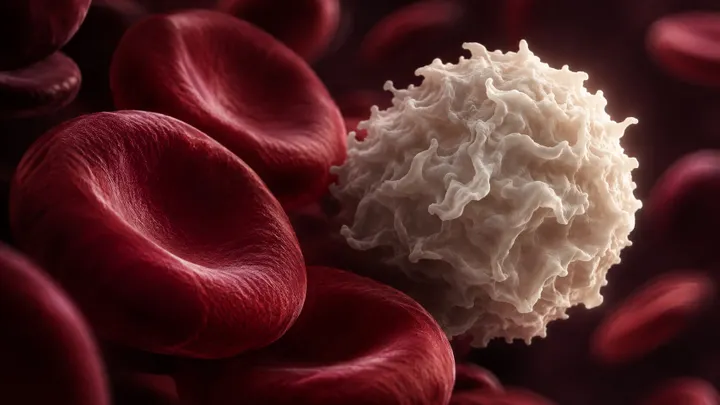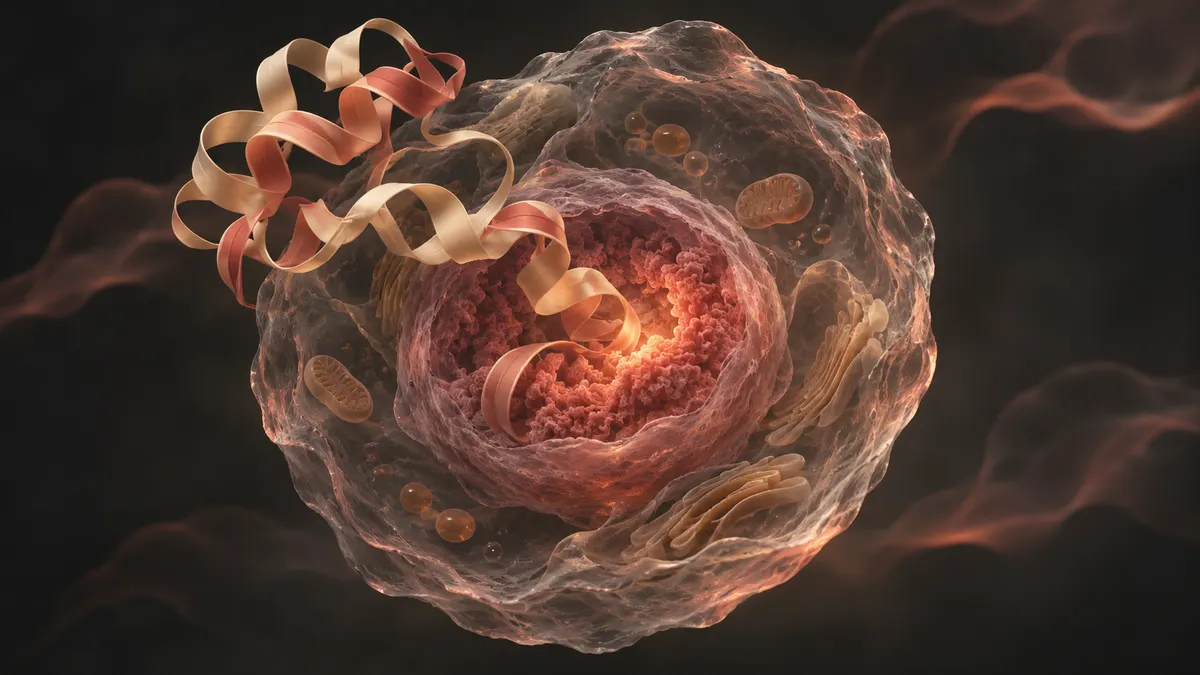
An AI model proposes a protein sequence. Scientists make the biological instructions, put them into cells and watch what changes. In the collaboration between OpenAI and Retro Biosciences, that chain led to a striking result: redesigned proteins that performed better at helping mature cells return to a stem-cell state.
The joint report, published in August 2025, described more than a 50-fold increase in certain markers of stem-cell reprogramming. Those are laboratory measurements, not years of life gained. But the underlying achievement opens an intriguing possibility: the proteins used to change cell identity can themselves be redesigned.
That makes this an engineering story with a medical destination. If researchers can build better molecular tools, they may be able to produce useful cells more reliably or gain finer control over how existing cells behave. The interesting question is what AI changes about that work, from the first proposed sequence to the cells that emerge at the end.
Natural Proteins Are a Starting Point
The biological foundation is an extraordinary discovery in its own right. Shinya Yamanaka’s team showed in 2006 that a small combination of genes could return mature mouse cells to a pluripotent state: capable of developing into the different cell types of the body. These induced pluripotent stem cells, or iPSCs, helped earn Yamanaka and John Gurdon the 2012 Nobel Prize in Physiology or Medicine.
A patient’s accessible cells could now become starting material for studying other tissues. That opened a route to modeling disease and, potentially, making replacement cells. The conversion process became a tool worth improving.
The classic four factors are OCT4, SOX2, KLF4 and MYC. These proteins influence which genes cells use. Researchers were already engineering them before today’s generative AI. A 2018 study called DERBY-seq created libraries of altered SOX proteins, introduced them into mouse cells and selected variants associated with successful reprogramming. Several engineered SOX2 variants outperformed the natural protein.
The study also makes the size of the search easy to grasp. Allowing 20 amino acids at each of three selected positions creates 8,000 combinations. Add a fourth position and there are 160,000. The researchers chose the smaller libraries so they could investigate that set of possibilities experimentally.
That is the problem AI can help address. A laboratory has finite time and capacity. Its next experiment has to be chosen from a huge set of possible molecules. An effective model could make those choices more productive, directing attention toward candidates worth building.
From Thousands of Sequences to Hundreds of Experiments
OpenAI built GPT-4b micro for protein engineering. A January 2026 account of the project describes training that combined protein sequences, structural information, evolutionary relationships, protein interactions and scientific text. The aim was to give the model useful context about how proteins work together.
For Retro, the model generated thousands of candidate sequences. Researchers filtered these to preserve essential regions and retain diversity, then narrowed the collection to a few hundred variants. Retro made DNA encoding the candidates and introduced it into human fibroblasts, cells found in skin and connective tissue. After roughly 10–14 days of reprogramming, markers and sequencing helped identify promising variants.
This is a concrete division of labor. The model proposes alternatives; experimental design determines which alternatives get a fair test; cells reveal what actually works. The quality of the whole process depends on all three.
AI protein design already has a wider experimental foundation. In 2023, the team behind RFdiffusion reported generating protein structures from molecular requirements and experimentally characterizing hundreds of designed assemblies, binding proteins and other molecules. Their paper in Nature showed how generative models could produce functional candidates, rather than only predictions about existing proteins.
For cell reprogramming, this shifts the research question. Alongside deciding which existing factors to use, scientists can investigate what a factor’s sequence should be. The possible improvement sits inside the molecule itself.
The Promising Designs Made Substantial Changes
Retro’s targets were SOX2 and KLF4. The company calls its redesigned versions RetroSOX and RetroKLF. It reports that more than 30% of the model’s SOX2 designs beat the natural protein in its screen, even though the sequences differed by more than 100 amino acids on average. The best combinations produced the reported increase of over 50-fold in stem-cell reprogramming markers. Retro’s scientific summary says the result was reproduced across donors, cell types and delivery methods.
The sequence changes are noteworthy because the model was proposing substantial rewrites while retaining useful activity. For protein engineering, finding a productive region of that enormous search space is itself valuable.
What matters next is how those candidates compare under the same conditions. A high hit rate is useful when it means more laboratory effort is spent investigating productive molecules. It also provides several alternatives to study, rather than leaving a team dependent on one promising candidate.
In the joint report, researchers went beyond early markers: they described derived stem-cell lines able to develop into all three primary germ layers and showing normal chromosome patterns. A separate stress experiment found lower levels of a DNA-damage marker. The report also discloses that Sam Altman is an investor in Retro. These are findings reported by the collaborating organizations.
The distinction between the tests is essential. Stem-cell markers, developmental potential, chromosome checks and DNA-damage signals each tell the researchers something different. Together they make a candidate more interesting; they do not collapse into a single measure of how much younger a body becomes.
Better Reprogramming Could Improve Cell Manufacturing
The most direct application is making cells outside the body. If a research team wants to study a disease or develop a cell therapy, reprogramming is one stage in a longer production process. The desired output is a consistent population of cells that can do a defined job.
A historical clinical example makes this route tangible. A 2017 report in The New England Journal of Medicine described transplanting a sheet of retinal pigment epithelial cells made from a patient’s own reprogrammed cells. The patient had advanced age-related macular degeneration. After a year, the transplanted sheet remained intact and visual acuity was unchanged. It was a feasibility study of a specific cell product.
Consider the sequence of tasks that represents: obtain starting cells, reprogram them, guide their development, test the resulting product and deliver it to the right place. A better reprogramming factor would improve one part of that chain. Whether it earns a place in production depends on the quality and consistency of everything downstream.
That gives protein designers a useful target. The winning molecule need not produce the most spectacular headline number. It should help make the required cells predictably, with results that hold across the starting material a process will actually encounter.
Renewing a Tissue Requires a Different Kind of Control
Rejuvenating cells inside an organ poses a different challenge. The aim is to recover useful functions while preserving the cells’ specialized roles. Researchers call approaches that stop short of complete conversion partial reprogramming.
In a 2016 study in Cell, short, repeated activation of reprogramming factors improved aging-related features and extended life in mice with a premature-aging condition. Different activation levels and durations also produced harmful outcomes, including tumors. The experiments made control over the process a central part of the therapeutic problem.
A protein that excels at making stem cells may therefore need a different design for renewing an existing tissue. Stronger activity alone is not the goal. The desired effect must occur in the right cells and stop at the right point.
For the measurement side of this problem, read Vastkind’s explanation of skin cells that tested 30 years younger. Our guide to the experimental ER-100 eye therapy follows the separate challenge of establishing a useful benefit in people.
The Next Design Goal Is a More Usable Tool
As of November 2026, Retro lists its AI-designed protein therapeutics program at the proof-of-concept stage. The company says it is designing factors that could be administered as proteins, allowing repeat dosing without a viral vector. That direction puts delivery and control alongside molecular activity as design goals.
It is a useful way to understand the broader significance of the work. Researchers are beginning to treat the proteins that change cell state as objects they can systematically improve. A better tool could make an experiment easier to repeat, a cell product more practical to manufacture or a biological question easier to answer.
The route to medical benefit remains specific: produce the cells a treatment needs, restore a function a tissue has lost, or gain enough control to investigate a promising mechanism safely. AI expands the set of molecular possibilities researchers can test. The decisive progress happens when one of those possibilities becomes a reliable capability in living cells.
Sources
- OpenAI and Retro Biosciences: Accelerating Life Sciences Research — August 22, 2025.
- OpenAI: AI as a Scientific Collaborator — January 2026, RetroBio section.
- Retro Biosciences: Science and Program Status — accessed November 28, 2026.
- Nobel Committee: 2012 Physiology or Medicine Prize — October 8, 2012.
- Veerapandian et al.: Directed Evolution of Reprogramming Factors — Stem Cell Reports, 2018.
- Watson et al.: Protein Design With RFdiffusion — Nature, 2023.
- Ocampo et al.: Partial Reprogramming and Aging-Associated Features — Cell, 2016.
- Mandai et al.: Stem-Cell-Derived Retinal Cells for Macular Degeneration — The New England Journal of Medicine, 2017.