
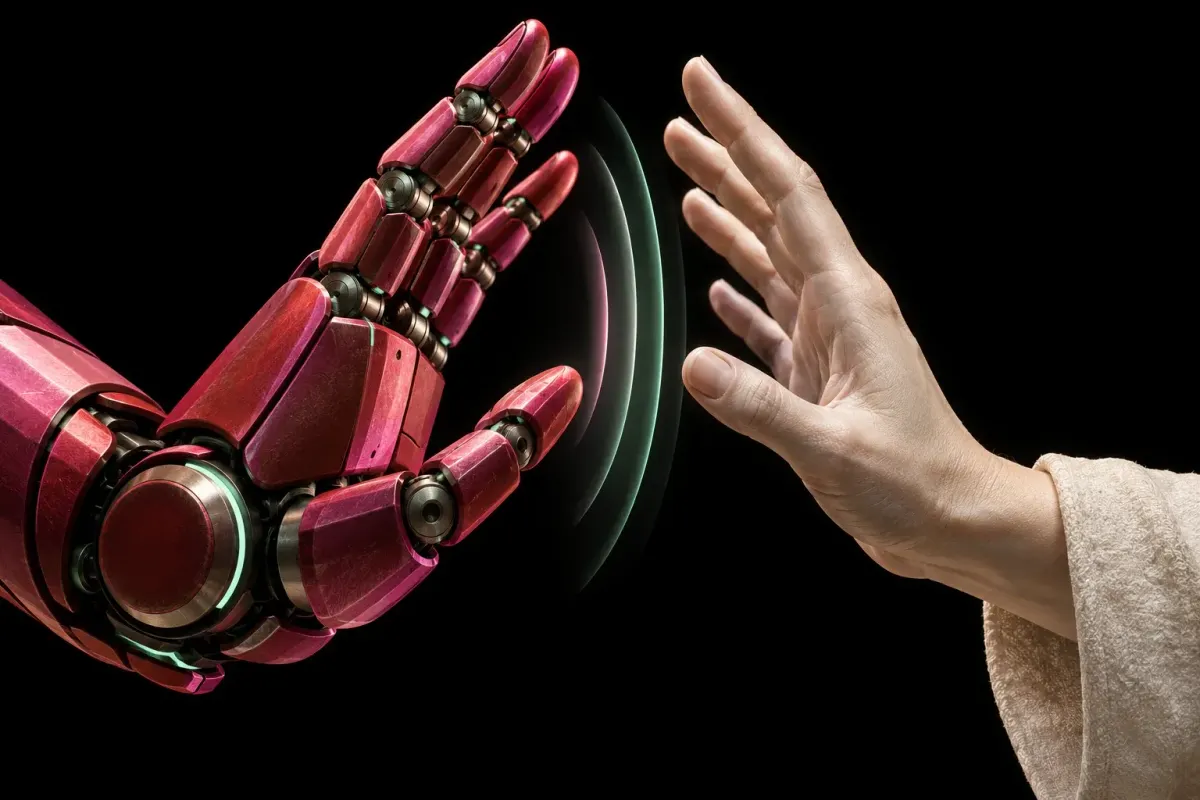
A worker steps into a robot’s path. The impressive response may be to stop, change direction or sit down. A machine that can lift a box but cannot handle that interruption remains an awkward colleague.
Agility Robotics unveiled Digit 5 on 15 September with that problem at the center of its pitch. The company says its next humanoid is designed to operate close to people without traditional external barriers. Early access is planned for the first half of 2027, followed by general availability near the end of that year. This is a product announcement, not evidence of a new robot already completing unrestricted shifts. Agility’s announcement.
Intelligence needs a separate brake
According to Agility, human-detection software helps Digit respond to nearby people, while a separate safety controller can intervene when someone gets too close. Proposed responses include stopping and sitting. That separation is the significant design idea: the system deciding what to do is accompanied by another layer that can constrain its motion. Safety architecture.
Consider a narrow aisle. A robot might correctly identify every person and still make the work frustrating if it stops so often that colleagues must route around it. Conversely, moving quickly is no achievement if people cannot predict when it will yield. Safety and usefulness have to be evaluated in the same workflow.
That is why removing a fence is an operational ambition rather than a universal permission slip. The object being carried, the space available and the behavior of nearby workers all belong in the assessment. A demonstration of one routine cannot establish how every other routine will behave.
The specifications behind the promise
Agility’s product page lists a roughly 23-kilogram payload, 2.2-meter reach and a ten-to-one ratio of running time to charging time. It also describes interchangeable grippers and integration with warehouse and fleet-management systems. These are manufacturer specifications and design claims, not independently measured results from a typical customer shift. Digit 5 specifications.
Each addresses an ordinary source of friction. Reach affects which shelves are usable. A gripper determines which objects can be handled. Charging interrupts availability. Integration determines whether the next task reaches the robot at the right time. The robot’s body is only one part of the service an employer would be buying.
The product page also cites 65,000 hours of operational data behind the system. That describes the experience informing development; it should not be read as 65,000 hours already completed by this newly announced model. Likewise, projected work hours are a target for the product, not a substitute for observing it on a busy floor. Development background.
The revealing customer evidence will include interrupted tasks, recoveries and the help people must provide. How often does someone have to rescue the robot? How much work continues while it charges? Do colleagues understand its next move? If those answers improve, the gain will be visible in a workplace that functions more smoothly—not merely in a more agile machine.
AI-assisted. Sources checked.