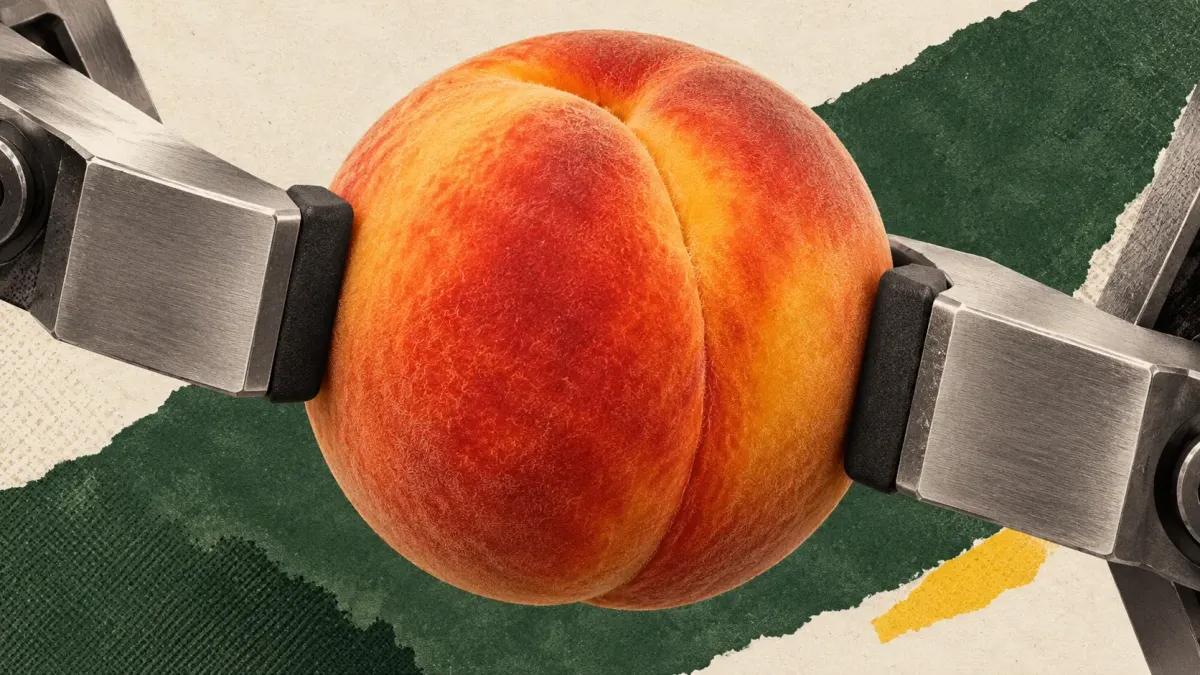
A peach can stay safely between a robot’s fingers and still come away bruised. If the test only asks whether the robot picked it up, squeezing too hard looks like success.
That is the problem behind How Firm Should a Grasp Be?, research from Columbia University now posted to arXiv. The team combines sight, touch and a model of an object’s physical properties to adjust grip strength while the robot is already grasping. The aim is not simply to hold on. It is to use little more force than this particular object needs.
A peach is not a material specification
Recognizing a peach gives the robot a useful starting point. It does not tell it how heavy, slippery or soft that peach is. Two pieces of the same fruit can behave differently, particularly as they ripen.
The researchers built Squash, a dataset of 270 individual fruits and vegetables across 52 categories. They paired 3D scans with measurements of mass, elasticity and friction. Those measurements supplied starting distributions for different kinds of produce and supported simulated grasps used to train the system.
During a real grasp, tactile sensors and force measurements refine that first guess. As the gripper closes, deformation helps reveal softness. As it lifts, the changing forces help refine estimates of mass and friction. The controller repeatedly adjusts the force instead of treating the category average as the final answer.
There is a useful physical detail here. A softer surface can spread against the gripper, increasing the contact area. Under the study’s contact model, that can help support the object without simply squeezing harder. Gentleness depends on how these two surfaces interact, not just on deciding that fruit is fragile.
The strongest grip won the wrong contest
The real-robot evaluation used 29 fruits and vegetables, with three grasping trials per object at different positions. The researchers compared their adaptive method with a fixed force of 3 newtons per gripper jaw and a method based on average properties for the object’s category.
The adaptive method’s mean absolute difference from the experimentally determined minimum force was 0.21 newtons per jaw. That compared with 0.46 newtons for the category-based method and 1.99 newtons for the fixed-force baseline. These are errors relative to the minimum, not the total force of each grasp.
But the fixed-force baseline held onto its objects in 100% of the reported tests. The adaptive method achieved 97%, while the category-based method reached 72%. Success here meant the object did not fall from the gripper after lifting.
That trade-off is the revealing result. A pickup score alone would favor the strong fixed grip. Measuring how much force the task actually requires makes the adaptive approach valuable for a different reason: it comes much closer to a sufficient grip while retaining a high holding-success rate.
Less force is not yet a damage guarantee
The study uses excess force as a quantitative proxy for damage risk. It also shows qualitative examples: imaging of an apple’s subsurface after gripping and a banana inspected a day later. Those examples favor the adaptive approach, but they are not a broad measurement of bruising rates, shelf life or commercial food waste.
The robot also receives a suitable grasp position. It has not solved where to pick up every awkward object. The work uses a two-jaw gripper, relies on tactile sensing and category information, and assumes the object’s material properties do not vary across its surface. Extending it to unfamiliar objects or dexterous hands requires further validation.
There is a connection to research on quieter robots: completing a movement is only part of doing it well around people and their belongings. Noise, contact and damage can matter even when the robot reaches the right destination.
For a peach, the meaningful achievement is not a tighter grip. It is a robot learning enough about what it is holding to know when tighter would be worse.
Further reading: Full paper and methods · More robotics reporting.