When the cooling-tower circuit at a supercomputing center in Golden, Colorado, needed a repair, the engineers picked a cold day. A second cooler on the roof could carry the heat away on its own. The tower went offline. The computers kept running. The lab’s account of the repair
Data centers use water because it can carry a lot of heat through a small pipe. Some also use a second property of water. When it evaporates, it takes heat with it, cooling the water left behind. The first job can use the same water over and over. The second requires replacement water. A building can do either job, both, or neither. That distinction changes the answer to almost every question about its environmental footprint.
Where does the heat from a server go?
Picture a processor running a weather forecast. Nearly all the electricity it draws ends up as heat. A rack drawing 100 kilowatts from the wall therefore has roughly 100 kilowatts of heat to shed while it runs. The calculation itself can be valuable. Forecast centers run multiple versions of the atmosphere to see how likely heavy rain or dangerous winds might be. All of those possible futures warm up a real machine. How ensemble forecasts work
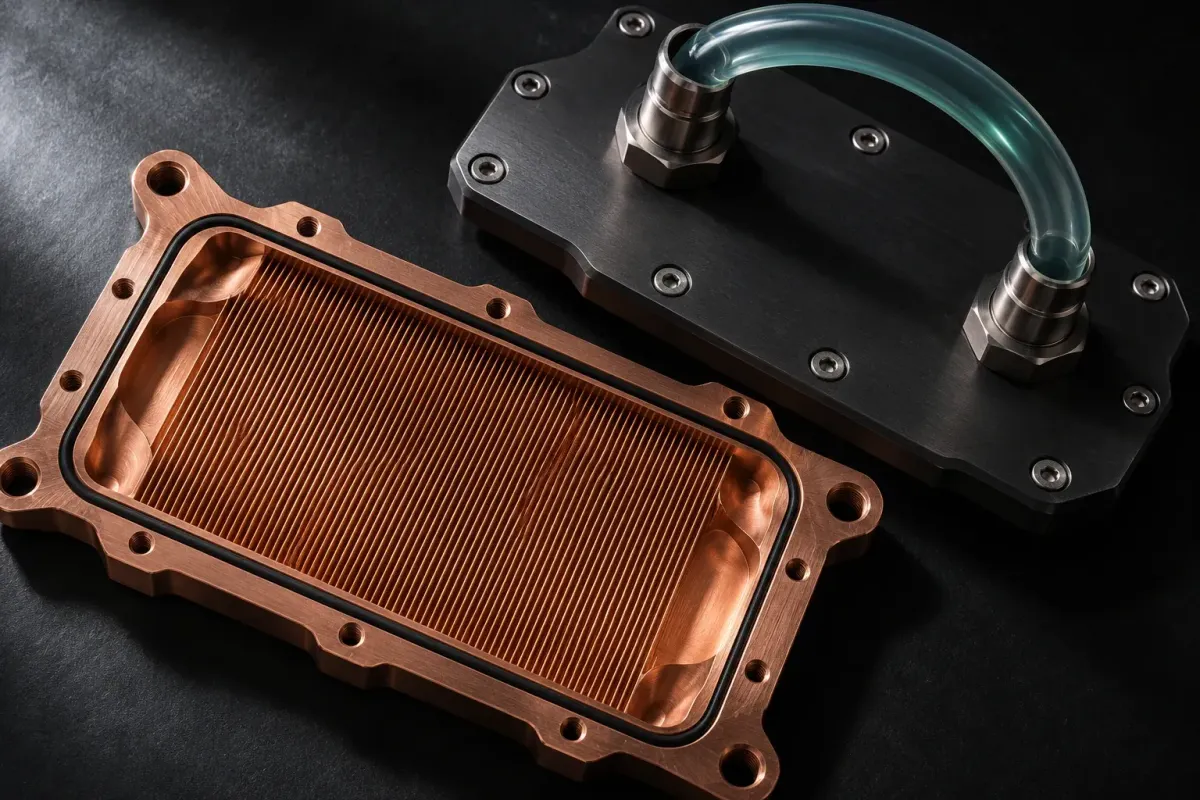
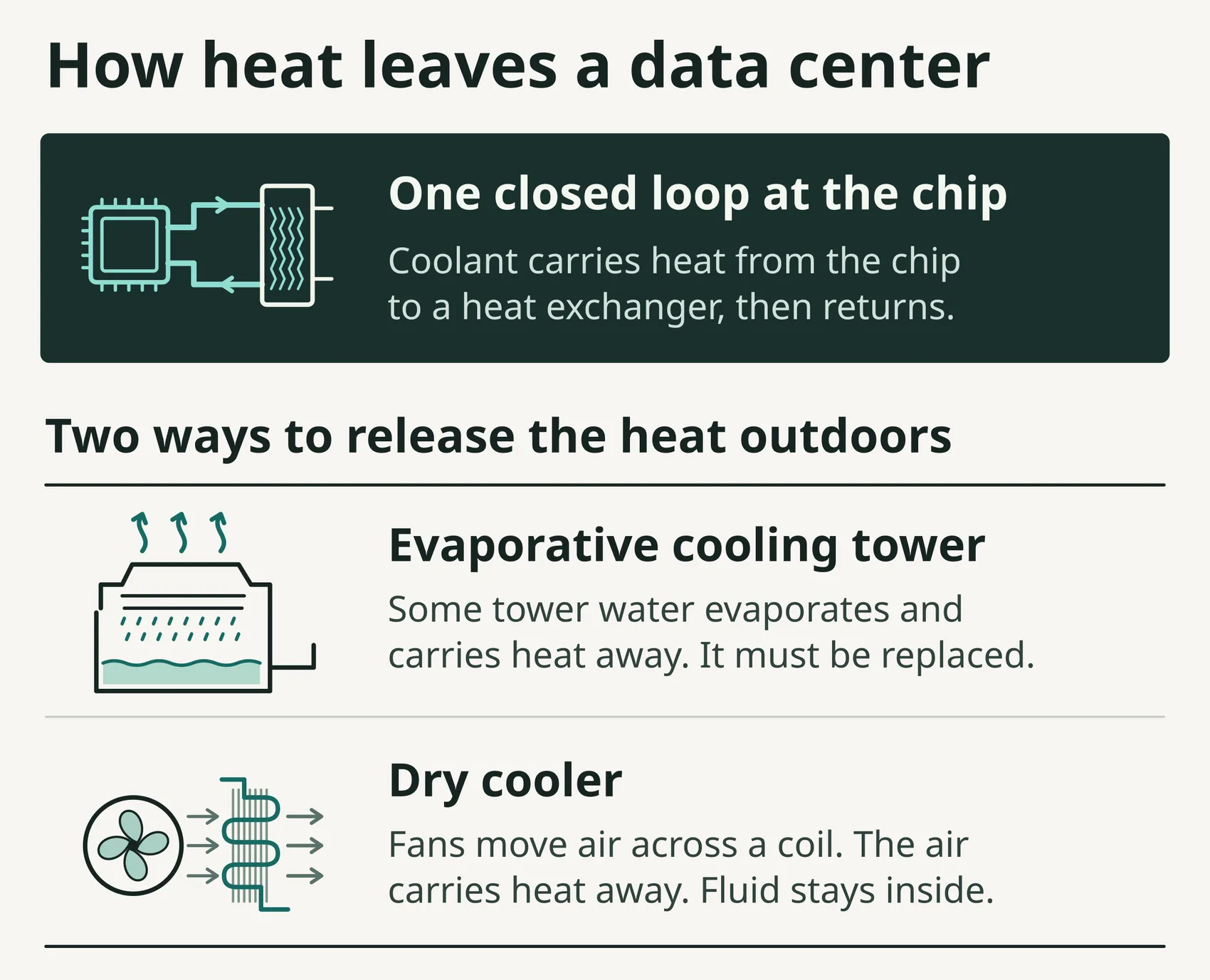
Inside an air-cooled server, fans push air across metal fins attached to the chip. In a liquid-cooled server, a metal plate pressed against the chip has tiny channels inside it. Coolant flows through, warms up and carries the heat away. At a heat exchanger, that energy can pass through a metal wall into a second circuit. The fluids stay on their respective sides. U.S. Department of Energy design guide
If cooling water is recycled, where does it go?
In an evaporative cooling tower, warm water spreads over a large surface while air passes through. Some water leaves as vapor. The rest falls into a basin, now cooler, ready for another trip. You already know how effective this can be if you have ever climbed out of a pool into a breeze. Your skin keeps cooling after you leave the water.
Here is the size of that effect. Warming a liter of water by 10°C takes about 42 kilojoules of heat. Evaporating a liter at around 30°C takes about 2,430 kilojoules, nearly 60 times as much. That comparison explains the appeal of a cooling tower. That vapor may eventually fall as rain somewhere else. The tower still needs another liter from a source available today. European Commission reference on industrial cooling, Annex I
Why can’t the tower keep all the remaining water?
Evaporation leaves dissolved minerals behind, much as boiling a kettle can leave scale. Operators periodically drain some concentrated water and replace it. Engineers call the drained portion blowdown. It is still liquid, which makes treatment and reuse possible. Department of Energy guide to cooling-tower water
In Quincy, Washington, the mineral buildup became visible. In summer, deposits formed a crust in basins the city used to return treated water to the ground. Quincy and Microsoft built a utility to remove minerals from the data center’s spent cooling water and pipe the treated water back. The system began operating in 2021. The U.S. Environmental Protection Agency estimates it saves 522 million liters of drinking-quality groundwater a year. The tower still evaporates water. Each liter the utility can recover is one less it needs to draw from the aquifer. EPA’s Quincy case study
Why not cool every data center with air?
A dry cooler works on the same principle as a car radiator. Fluid stays inside a coil. Fans pull outside air across it and the air carries the heat away. On a cold Colorado morning, the temperature difference does much of the work. On a hot afternoon, if the air approaches the temperature of the fluid, even a powerful fan has very little to work with.
A designer has several choices. A larger coil gives the heat more surface to cross. Equipment that tolerates warmer coolant can use outdoor air for more of the year. A refrigeration compressor can keep cooling on hot days, at a cost in electricity. A hybrid system can run dry much of the time and turn to evaporation during the difficult hours. Humidity matters too. Evaporation works especially well in dry air, including places where water may be scarce. Department of Energy design guide, cooling systems
What changed on the roof in Colorado
The Golden team added a dry cooler to a building that already recovered some waste heat and had working cooling towers. The new equipment gave the operators another place to send heat whenever the weather cooperated. During the first year, the site used 0.70 liters of water per kilowatt-hour of IT electricity. The researchers estimated that the original setup would have used 1.27 liters for the same amount of computing electricity.
Over the first two years, the team estimated the system saved 7.95 million liters while maintaining the facility’s energy efficiency. This was an especially promising result for an existing building. The lab could keep its investment in the towers, cut the hours it needed them and gain an extra way to keep the computers running during a repair. Golden’s two-year operating results
How much water does a data center actually use?
Start with two words often buried in a utility report. Withdrawal is the water a facility takes from a source. Consumption is the share that does not return to that water system, usually because it evaporates. Two sites can withdraw the same volume and have very different effects. One might return much of it warmer. Another might evaporate much of it during the driest weeks of the year. USGS water-use definitions
For an individual site, look for its water usage effectiveness, or WUE. The site metric divides annual site water use in liters by the electricity used by the IT equipment in kilowatt-hours. For illustration, a steady 1-megawatt IT load uses 24,000 kilowatt-hours a day. At 0.70 liters per kilowatt-hour, that works out to 16,800 liters per day on average. A water utility planning for August also needs the hottest day’s demand and the source of the water. Neither appears in that annual ratio. How the site metric is defined
The water beyond the fence
In its World Energy Outlook 2026, the International Energy Agency estimated that data centers and their supply chains consumed 885 billion liters worldwide in 2025. About 240 billion liters, or 27%, were consumed at the facilities themselves. Nearly 40% of the total was associated with generating electricity. Chip manufacturing and the supply of fuels accounted for the remainder. The same report places about 30% of existing and planned global data center capacity in areas with high water stress. IEA estimates and system boundaries, Box 1.10
That is why an operator can report almost zero water for cooling on site and still depend on water elsewhere. If dry cooling takes extra electricity on a hot day, its wider water and carbon costs depend partly on which generators supply that power. A gas plant burns additional fuel to supply an extra kilowatt-hour. Wind turbines generate electricity without burning fuel or running a cooling tower. A liters-per-AI-prompt figure would need even more information, including which machine did the work, where it ran and how much electricity the answer took. Berkeley Lab on the water and emissions associated with electricity
What does the cooling system mean for nature?
In Hamina, Finland, an old paper mill offered something a new data center would otherwise have had to build. It already had a route for drawing in cold seawater. Google adapted it to cool its servers. Heat crosses an exchanger, keeping seawater separate from the data center’s freshwater circuit. The sea provides cooling, and some of the heat now has a customer. Hamina’s energy utility says its main district heating network began using data center waste heat in late 2025. How Hamina’s seawater cooling works · Haminan Energia’s operating update
A heating network can use warmth that would otherwise leave the site. The bay has a different interest. In reviewing a proposed expansion in 2024, the regional environmental authority found that the assessment had omitted what the heat discharged into the water might mean for aquatic habitats and species. It asked for that analysis to be completed. The open question was a practical one. How warm would the receiving water get, over what area and for how long? Regional authority’s assessment, pp. 15–16
Three questions worth asking about the next project
Where will the water come from on the hottest day? Ask for peak demand, the share supplied by drinking water or reclaimed water, and what the operator will do during a drought.
What goes back to the watershed? Ask how much returns, at what temperature and with what treatment. This is where a good cooling design can make a difference to a river, a bay or an aquifer.
Where else can the heat go? A nearby heating network with customers, a climate suited to dry cooling or a local water-treatment plant can each change the design worth building. How communities weigh new data centers
The most hopeful detail in Hamina is an ordinary one. On a cold day, someone can turn up the heat and use warmth a server had to shed anyway. Getting more of those outcomes starts early, when the engineers can still choose where the pipes go.