
A robot can put a mirror in the right place and still leave an optical experiment completely dark. With light, position is only part of the job. Tiny changes in angle can determine whether a carefully assembled system works at all.
An MIT team has built a robot that tackles both problems: it assembles an optical setup, then uses measurements of the light to adjust it and recover from disturbances. MIT’s 17 September account describes a laser-cavity demonstration involving roughly 50 maneuvers over about 30 minutes. The underlying paper was first posted on 23 March; the September institutional report provides the occasion for this explanation, not the discovery date.
Putting parts down is not the finish line
A laser cavity uses carefully arranged optical components to sustain the light’s repeated passage through the system. It is a demanding test because a setup can look almost right while failing its physical purpose. A camera that recognizes a mirror is not necessarily telling you whether the beam is doing what you need.
In plain English
Think of assembling a musical instrument and tuning it as separate jobs. This robot does both for an optical experiment. Cameras help it place components. Measurements of the light then tell it which small adjustments improve the result. It can return to those adjustments when the setup is knocked out of alignment.
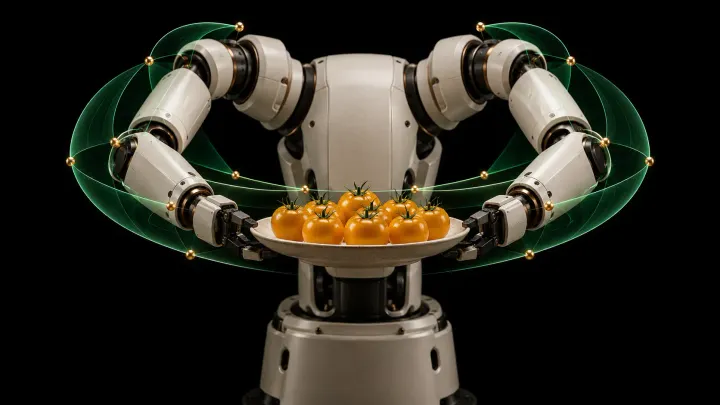
The researchers’ framework combines a seven-joint arm, several camera systems and standardized housings for the optical parts. Markers identify components, magnetic bases hold them, and a motorized tool turns fine-adjustment knobs. The system uses different feedback for coarse placement and precise optical alignment.
That division is the mechanism worth noticing. A broad view of the table gets the robot close. A measurement of the beam tells it whether the placement is actually useful. The robot can make a small change, observe the response and choose another change. Engineers call this a closed loop: the outcome feeds back into the next action.
The paper reports successful angular alignment from ten tested starting positions. It also demonstrates recovery after induced displacement and drift. These are bounded experimental results, not a guarantee that an arbitrary laboratory can run unattended.
Reliability might matter more than spectacle
The interesting possibility is not merely replacing a hand with a gripper. If adjustments become explicit, measurable procedures, another researcher could in principle repeat them more consistently. A remotely requested experiment would also need a way to notice that its physical setup has stopped behaving as intended.
That is our interpretation of the result’s importance, rather than an outcome the team has demonstrated at scale. The value of a future shared laboratory would depend on how often it produces usable measurements, how it handles unfamiliar failures and how much specialist intervention remains necessary. A successful assembly video cannot answer those questions.
MIT describes a graphical interface for arranging an experiment and discusses future remote access. A cloud-accessible optical laboratory is therefore an ambition, not a service this demonstration establishes. The current system also relies on specially prepared components and a structured workspace. The surrounding engineering is part of the achievement; leaving it out would make the robot seem more general than the evidence supports.
The scientist still defines success
Self-recovery is not scientific independence. A machine can optimize a chosen signal without deciding whether that signal answers a worthwhile research question. Someone still selects the experiment, sets the objective and judges what the measurements mean.
That leaves a concrete test for the next stage: can the same assembly-and-feedback approach support substantially different optical experiments without a fresh round of bespoke engineering each time? If it can, the gain would be more than a robot turning knobs. It would be specialist laboratory work becoming easier to reproduce and share.
Keep reading
- What a missed pick reveals — recovery is a capability in its own right.
- Digit 5’s stopping problem — useful autonomy includes controlled limits.
- The lab decides what works — experimental validation remains distinct from automated proposal.
AI-assisted. Sources checked.