

To pass the test, participants had to walk 400 meters at their usual pace in less than 15 minutes. They could not sit down, stop for more than a minute, or use a walker. A straight cane was allowed. Everyone entering SPRINTT could complete the walk. The question was whether they would still be able to do it as time passed.
The randomized European trial, published in 2022, offers a concrete way to think about healthy aging: measure a physical ability people retain, not just a laboratory number that moves. It found a benefit from a supported exercise-and-nutrition program in a defined group of frail older adults. The result was useful, but it came with a complication that matters just as much: more participants in that group reported falls.
The Program Was More Than a Walk
SPRINTT enrolled 1,519 adults aged 70 or older at 16 centers in 11 European countries. They had physical frailty and low muscle mass but could still complete the walking test. The main comparison was specified in advance for 1,205 participants with poorer scores on a battery of balance, walking-speed, and chair-rise tests.
The program combined aerobic activity, strength, balance and flexibility work, nutrition counseling, and activity monitoring. It included supervised sessions at a center and activities at home. The comparison group received healthy-aging education and brief stretching, rather than being asked to do nothing.
That distinction changes how the result should be read. SPRINTT tested a package of activity and support, not a wearable, a dietary ingredient, or an instruction to take more walks. Its design cannot tell us which component produced how much of the benefit.
About Six Fewer Events per 100 Participants
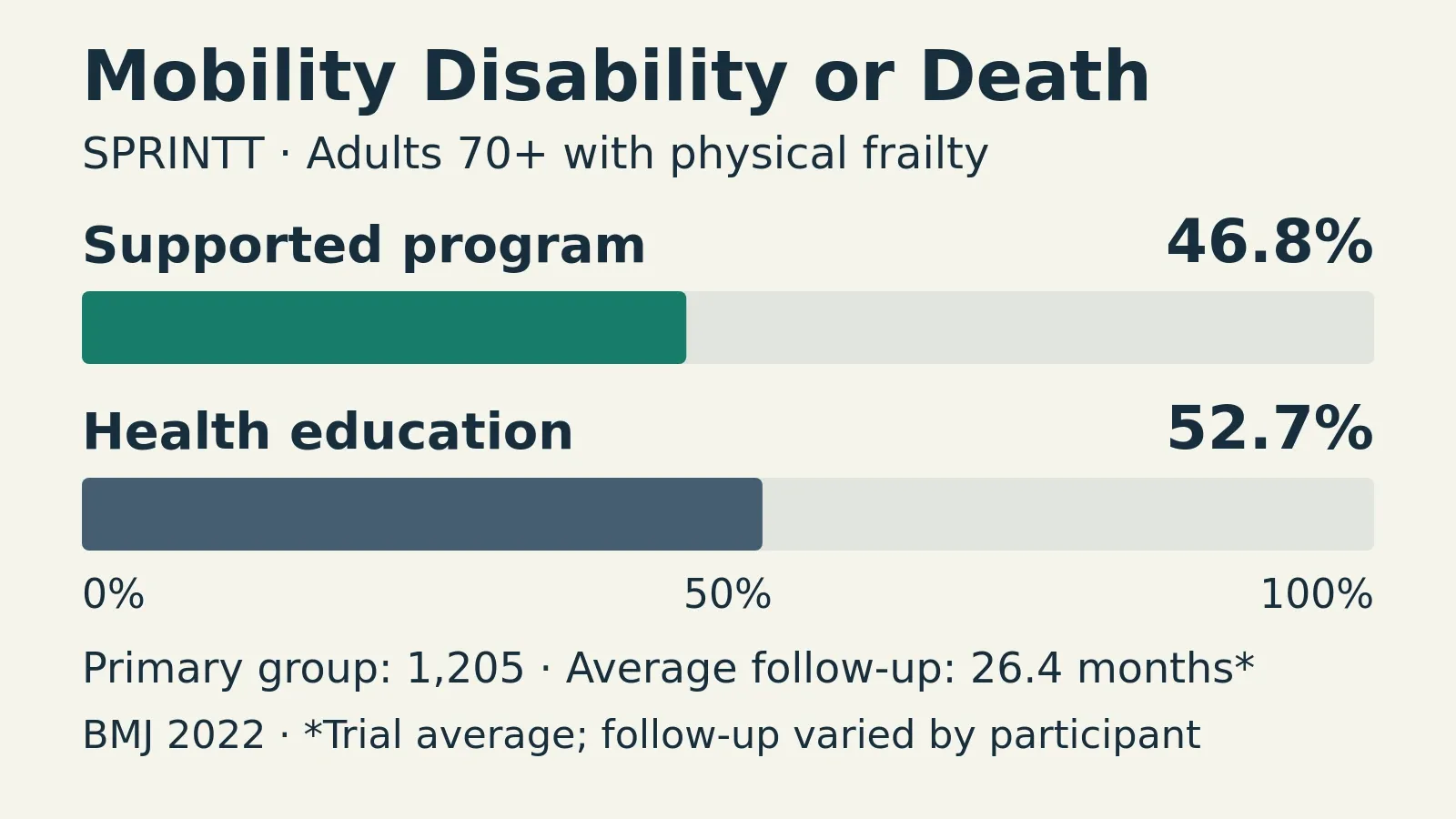
In the main comparison, 283 of 605 program participants reached the primary endpoint, versus 316 of 600 in the education group: 46.8% compared with 52.7%. The endpoint counted the first occurrence of mobility disability or death. Six deaths in the program group and seven in the education group were counted as those first events, so these percentages are not simply failed walking tests.
The observed difference was 5.9 percentage points. Follow-up varied, averaging 26.4 months across the trial; these are not fixed three-year risks. The researchers' time-to-event analysis also favored the program, with a hazard ratio of 0.78 and a 95% confidence interval of 0.67 to 0.92. In plain terms, the evidence supported a lower rate of reaching the endpoint over time, not a 22-percentage-point drop in the share affected.
Mobility disability meant losing the defined ability to finish the 400-meter walk. When an actual walking assessment was unavailable, the study could use standardized clinical information to adjudicate the outcome. It was not a direct test of whether someone could shop, cook, or live alone.
Preserving Walking Did Not Mean Fewer Falls
Falls were reported for 80 of 605 program participants, or 13.2%, compared with 49 of 600, or 8.2%, in the education group. That was a statistically significant difference. The researchers noted that more frequent contact with program participants might have increased reporting, but that possibility does not remove the observed imbalance.
The findings therefore should not be sold as a fall-prevention result. Nor can the positive walking result be extended to every older adult: a separate, exploratory group with better physical-function scores did not establish the same benefit. The trial also did not demonstrate longer life.
A Specific Ability Is Worth Measuring
Our chart of lifespan and healthy life expectancy describes health across populations. SPRINTT asks a smaller, testable intervention question: can a supported program help a particular group avoid losing a defined physical ability? Those are different scales of evidence, and both are useful.
Walking 400 meters is not a complete definition of independence. But keeping that ability is a more tangible result than an unspecified promise to age better. SPRINTT shows why the next question matters too: what support was needed to preserve it, and what happened to the people receiving that support along the way?
Study disclosure: SPRINTT received Innovative Medicines Initiative funding, including in-kind pharmaceutical-industry support. Several authors were industry employees. The paper reports that the funder had no role in study design, analysis, interpretation, or the publication decision.
