
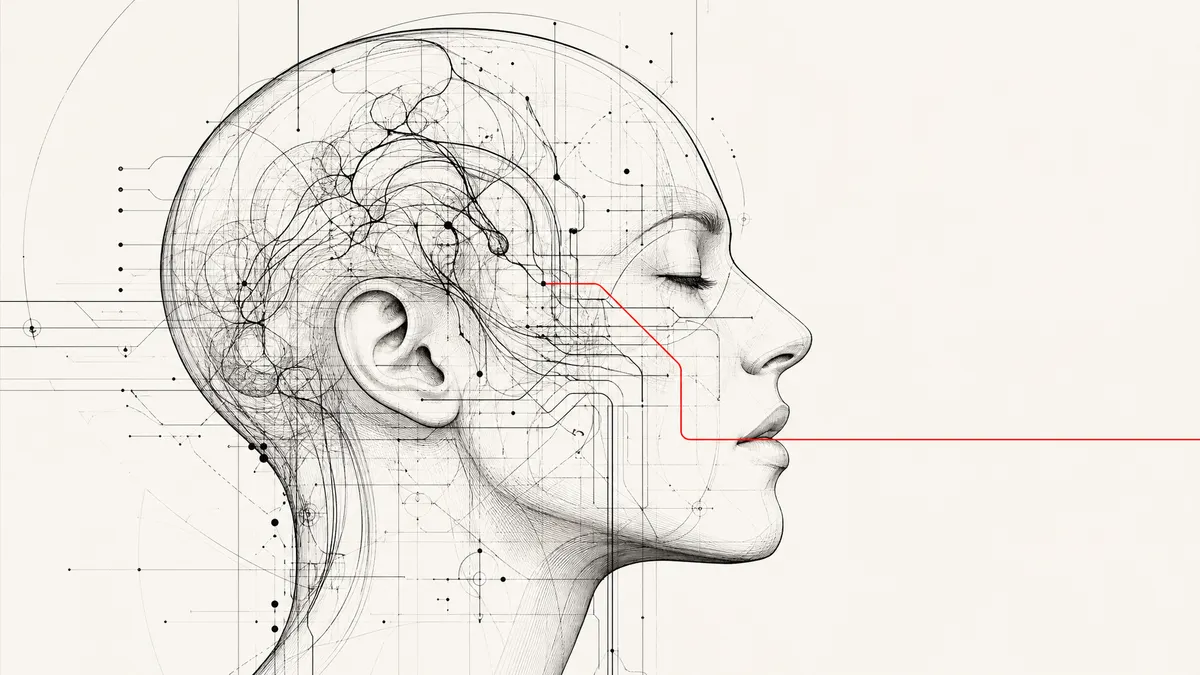
Brain-computer interfaces used to live comfortably in the future. They belonged to science fiction, investor decks, and the occasional lab demo where a cursor moved because a person thought about moving it.
That era is ending.
The important shift is not that a brain implant can control a computer. That has been true, in limited forms, for years. The shift is that brain-computer interfaces are getting close enough to language, agency, and everyday communication that they stop being only a medical device story. They become an interface story.
That sounds subtle. It is not.
A wheelchair, a screen reader, or a prosthetic limb extends a person’s capacity through the body or the environment. A speech brain-computer interface tries to restore something closer to intention itself. It sits near the line between what a person wants to say and what the world gets to hear.
That line deserves more seriousness than the usual miracle-demo framing.
The Real Breakthrough Is Speech, Not Mind Reading
The strongest brain-computer interface work is not about reading private thoughts. That idea is still mostly noise, and usually a distraction. The real progress is narrower, harder, and more human: helping people who have lost speech communicate again.
In 2023, two major Nature papers showed why the field started to feel different.
One study demonstrated a speech-to-text brain-computer interface for a participant with ALS who could no longer speak intelligibly. The system decoded attempted speech from intracortical microelectrode arrays and reached 62 words per minute, with a 23.8 percent word error rate on a 125,000-word vocabulary. That is not natural conversation, but it is no longer a toy demo either. Nature described it as a feasible path toward restoring rapid communication for people with paralysis.
A separate study from the UCSF Chang Lab went further into the social shape of communication. It decoded attempted speech and paired it with avatar control, showing how a neuroprosthesis might restore not only words, but some of the expressive texture around them. The paper’s code and restricted clinical data process are public enough to show scientific seriousness, while still reflecting the privacy constraints around a single participant’s neural data. The Nature paper is a reminder that this field is built on intimate human evidence, not anonymous benchmark data.
That distinction matters. A language model can be evaluated on millions of text samples. A speech BCI may move forward through a handful of people whose lives, injuries, diseases, and neural recordings become the frontier.
The technology is impressive. The human asymmetry is unavoidable.
From Assistive Device to Interface Layer
The first ethical mistake is to treat brain-computer interfaces as if they are just another gadget category.
They are not.
A phone interface asks what you tapped. A voice assistant asks what you said. A brain-computer interface may ask what your nervous system tried to do. That makes error different. If autocorrect changes a word, the mistake is annoying. If a speech BCI outputs the wrong word, the mistake can feel closer to misrepresentation.
The deeper problem is not only accuracy. It is authorship.
Who is speaking when a system decodes attempted speech, predicts likely words, smooths them through a language model, and sends them into the world? The answer can still be the user. But it becomes a designed answer, not an automatic one.
This is where brain-computer interfaces overlap with the broader AI interface problem. Vastkind has already covered how everyday devices are becoming more natural interfaces, from smart glasses to persistent AI tools like AI memory systems. The same pressure appears here, but with higher stakes: the more invisible an interface becomes, the more responsibility moves into the system design.
A keyboard makes mediation obvious. A neural interface can make mediation feel like direct expression, even when the pipeline is full of sensors, classifiers, probability, calibration, and correction.
That gap between feeling direct and being mediated is where the hard questions live.
The Medical Frame Is Necessary, but Too Small
For now, the strongest case for brain-computer interfaces is medical. That is where the benefit is clearest and the risk is most justified. People with paralysis, ALS, locked-in syndrome, stroke, or severe motor impairment may gain forms of communication and control that nothing else can provide.
That is not hype. It is one of the most morally serious uses of advanced technology.
But the medical frame is also too small if it becomes the only frame.
Clinical need can justify the first generation. It does not automatically answer how the technology should scale, who gets access, who pays, how upgrades work, what happens when a device company disappears, or how much control a user has over the model translating their intent.
Companies such as Neuralink and Synchron have made the field more visible. Neuralink’s PRIME study updates helped turn implanted BCIs into mainstream news, even when the company’s own communications are limited and promotional. Synchron’s endovascular approach, which avoids open-brain surgery by using blood vessels as the access route, points to a different path: less theatrical, potentially more clinically pragmatic, and still deeply consequential.
The contrast matters. Brain-computer interfaces are not one technology. They are a family of tradeoffs.
More invasive systems may capture richer signals. Less invasive systems may be easier to deploy. Speech restoration may require different signal quality than cursor control. A system built for one patient population may not transfer cleanly to another. The future will not be one brain chip. It will be a messy stack of implants, sensors, decoding models, clinical protocols, reimbursement decisions, and user training.
That is less cinematic than the myth. It is also more real.
The Consent Problem Will Get Harder
Brain data is often described as uniquely sensitive. That is true, but vague.
The sharper point is that brain-computer interfaces produce data from attempted action. Not every neural signal is a secret thought. But these systems still sit close to intention, movement, speech, frustration, fatigue, and adaptation. Over time, a useful BCI may need to learn the user as much as the user learns the device.
That creates a consent problem with a long tail.
A participant can consent to a trial. A patient can consent to an implant. But what does meaningful consent look like when the device improves through continuous calibration? What happens when decoding models are updated? Can a user inspect or delete training data? Can they move their neural interface history to another provider? Does the system still work if they opt out of certain forms of data sharing?
These questions sound bureaucratic until the interface becomes part of someone’s ability to communicate.
Then they become basic dignity.
The worst future for brain-computer interfaces is not a Hollywood mind-control scenario. It is a quieter dependency problem: people relying on systems they cannot audit, cannot repair, cannot easily switch away from, and cannot fully understand.
That is the same pattern visible across many frontier technologies. The first version restores power. The scaled version reorganizes dependency.
Why This Matters
Brain-computer interfaces are important because they force a cleaner question than most consumer technology: who owns the bridge between intention and action? For people who cannot speak or move, that bridge can be life-changing. But if neural interfaces become a new computing layer, then accuracy, consent, access, and authorship become social infrastructure, not just product features. The field deserves optimism, but only the kind that can survive contact with patients, clinicians, regulators, caregivers, and the people whose nervous systems become part of the stack.
The Future Is Not Telepathy. It Is Translation.
The most useful way to think about brain-computer interfaces is not as mind reading. It is translation.
The system translates neural activity into action. The user translates intention into attempted movement or speech. The model translates noisy signal into probable output. The clinical team translates a fragile prototype into daily use. Society translates a medical breakthrough into rules, markets, and expectations.
Every translation can help. Every translation can distort.
That is why the field should not be judged only by speed records, word error rates, implant counts, or viral videos. Those metrics matter. They show that the science is becoming practical. But the real test is whether the technology can restore agency without quietly taking over the terms of expression.
Brain-computer interfaces are entering the same difficult territory as AI assistants, smart glasses, and embodied robotics: the interface is becoming more intimate, less visible, and more powerful.
The difference is that this time the interface is not in the hand or on the face.
It is listening closer to the source.
That could become one of the most humane technologies of the century. It could also become one of the easiest to misunderstand.
The next phase should be measured by more than whether machines can decode us. It should be measured by whether people remain legible to themselves after the machine helps them speak.
Read Next
Vastkind tracks frontier technologies when they move from spectacle into human consequence. For a broader frame on convergence across frontier systems, read Artificial Intelligence Frontiers.