The robot labor shock will not begin with a dramatic announcement that machines have replaced humanity.
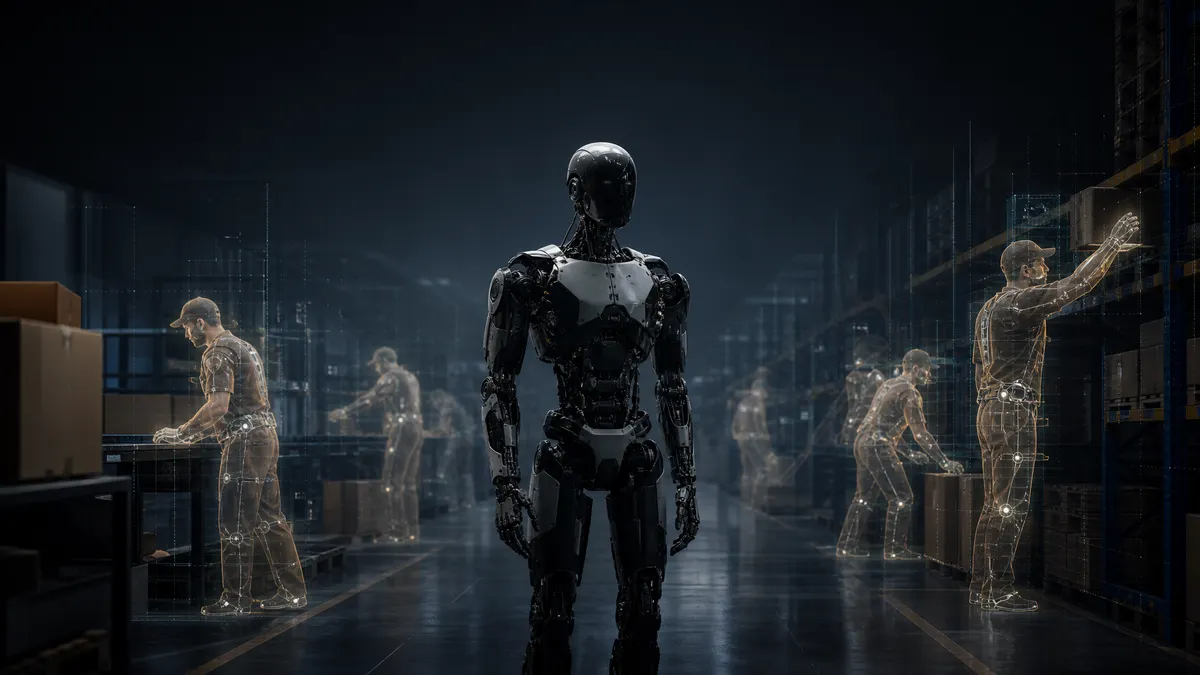
It will begin quietly, in jobs that were already treated as physically exhausting, low-status, hard to staff, or easy to ignore. Warehouses. Cleaning routes. Care homes. Loading docks. Security patrols. Restaurant kitchens. Factory stations. Delivery networks. Back rooms where people repeat the same motion until the body hurts.
That is where physical AI is moving first.
The public image of the robot future is still shaped by humanoid demos: a machine folding laundry, lifting boxes, walking through a factory, or putting away dishes. The social reality is sharper. Robots do not simply arrive as replacements for workers. They are trained by workers, supervised by workers, corrected by workers, and introduced first into forms of labor that already have less political protection than they deserve.
This is why the first real robot labor shock will not look like science fiction. It will look like a management decision.
Physical AI needs human bodies before it can replace them
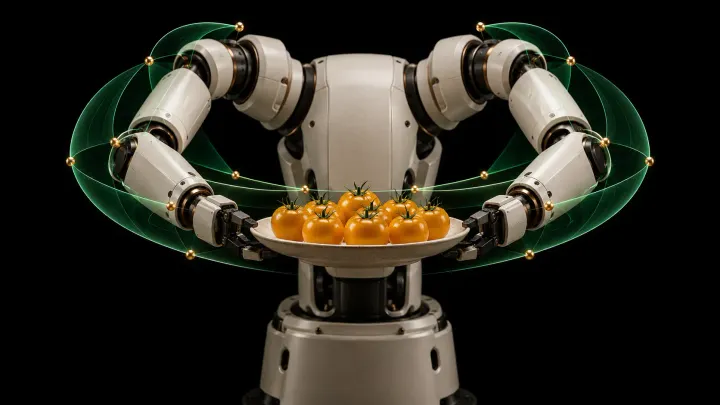
The phrase “physical AI” sounds clean. It suggests intelligence moving from screens into the world. Instead of chatbots answering text, machines will perceive, move, grip, lift, sort, deliver, clean, inspect, and assist.
But physical intelligence is harder than language. A robot does not only need to know what a microwave is. It needs to learn how the door resists, how a wrist turns, how a hand adjusts when the angle is slightly wrong, how a stack of cloth collapses, how a box shifts, how a human workplace actually behaves.
That data cannot be scraped from the internet in the same way text and images were scraped for large language models. It has to be generated by bodies.
MIT Technology Review recently argued that the human work behind humanoid robots is being hidden. Rest of World reported from Chinese robot training centers where workers wear virtual reality headsets and exoskeletons while repeating movements hundreds of times so robots can learn them. One trainer described himself as a “cyber-laborer.”
That phrase should stick.
The new robot economy does not eliminate human labor at the beginning. It converts human movement into training data. It turns gestures, muscle memory, fatigue, and repetition into assets owned by companies. The person opening the microwave for the hundredth time may not be replaced tomorrow. But the worker is helping build the system that could later reduce the need for people doing similar physical tasks.
This is not new in spirit. AI has always depended on hidden labor: labelers, moderators, clickworkers, data cleaners, test users, and people whose output became training material. Robotics adds the body. The next frontier is not only cognitive extraction. It is physical extraction.
The jobs at risk are not abstract
The first large wave of embodied automation will not be evenly distributed across society.
Robots are expensive, brittle, and operationally awkward. They will be placed where the business case is easiest: controlled environments, repetitive tasks, labor shortages, high injury exposure, high turnover, or work that people do not defend strongly because the workers are already invisible.
That points to a clear map:
- warehouses and fulfillment centers
- factories and quality inspection lines
- cleaning and facility maintenance
- eldercare and hospital logistics
- delivery and last-mile operations
- agricultural picking and packing
- security patrols and monitoring
- commercial kitchens and food preparation
These are not marginal parts of the economy. They are the physical substrate of modern life. They move goods, clean buildings, prepare food, care for bodies, restock shelves, and keep infrastructure running.
The social danger is not simply “job loss.” That phrase is too blunt. The deeper danger is that robotics changes the terms of work before anyone admits a transition is happening. A worker may not be fired immediately. Instead, the job can be decomposed. One task is automated. Another becomes robot supervision. Another becomes exception handling. Another becomes data collection. The pace increases. The skill profile narrows or shifts. The human is still there, but the job has become thinner, more monitored, and less negotiable.
That is often how automation really arrives: not as replacement, but as redesign.
Labor shortage is becoming the moral cover story
Robotics companies rarely say they want to weaken labor. They say they are solving labor shortages.
Sometimes they are right. Aging societies really do face shortages in care, logistics, manufacturing, and service work. Japan is the obvious example. Reuters has reported on AI-driven care robots being developed in response to Japan’s aging population and chronic shortage of care workers. China has made robotics central to its industrial strategy. The International Federation of Robotics says China already has an operational stock of around 2 million industrial robots and accounted for 54 percent of annual industrial robot installations worldwide, according to its World Robotics 2025 reporting.
The labor shortage argument is powerful because it contains truth. Some work is hard to staff. Some work injures people. Some tasks are repetitive, dangerous, or degrading. If robots reduce back injuries, chemical exposure, night-shift strain, or exhausting lifting, that is real progress.
But a true statement can still become a cover story.
“Robots will do the jobs humans do not want” is too convenient. Many people do unwanted jobs because those are the jobs available to them. The fact that a job is hard, dirty, repetitive, or low-status does not mean the person doing it is disposable. It means the economy has assigned necessary work to people with limited leverage.
If robots enter those jobs without worker power, the gains will flow upward. Owners get productivity. Customers get speed. Investors get scale. Workers get a narrower role, a surveillance layer, or a severance package.
The question is not whether robots should be used. The question is who captures the benefit when robots take over the work society never respected.
Humanoids make the politics easier to hide
The humanoid form is part engineering choice, part theater.
There are practical reasons to build robots shaped roughly like people. Human environments are designed around human bodies: stairs, doors, handles, shelves, tools, counters, carts, and machines. A humanoid can theoretically move through existing spaces without rebuilding everything.
But humanoids also do something rhetorically useful. They make automation look like a worker rather than a system.
A warehouse robot arm is obviously capital equipment. A humanoid robot is easier to narrate as a colleague, helper, assistant, or future teammate. That language softens the politics. It makes automation feel personal and friendly, even when the economic function is labor substitution or labor discipline.
This is why Vastkind’s earlier piece on how machines see, feel, and transform our future matters here. The most important robot question is not whether a machine looks human. It is what kind of institution the machine serves. A robot in a hospital, a warehouse, a battlefield, and a home may share hardware ideas, but the social meaning changes completely.
The same machine that reduces injury can also intensify pace. The same sensor that improves safety can deepen surveillance. The same robot that fills a labor shortage can weaken wage pressure. The same automation that helps one worker can remove bargaining power from another.
That is not a reason to reject robotics. It is a reason to stop treating robotics as neutral machinery.
The training-data fight is coming for movement
Large language models taught the public one lesson too late: data rights matter before the system is powerful.
Writers, artists, journalists, coders, photographers, and ordinary users learned that their work had helped train systems they did not control. The conflict arrived after the data had already been absorbed.
Robotics is approaching a similar conflict around movement.
If workers wear motion sensors to train robots, who owns that data? If a warehouse records how employees lift, reach, turn, and sort, can that data later be used to automate them? If care workers demonstrate how to move patients safely, does their embodied expertise become a corporate asset? If household robots learn from domestic labor, whose movements become the template?
These are not decorative legal questions. They define whether workers are partners in automation or raw material for it.
The hard part is that movement data is intimate. It can reveal strength, fatigue, disability, habits, mistakes, speed, hesitation, and bodily limits. In robotics, the worker is not only producing output. The worker may become the dataset.
That should change the labor bargain.
If human bodies are used to train robots, workers should have rights over collection, use, compensation, consent, and downstream deployment. Otherwise physical AI repeats the worst bargain of digital AI: take the data first, negotiate later, call it innovation.
Why This Matters
Robotics will shape the future of work through the jobs with the least public glamour and often the least worker power. If society waits until robots are visibly replacing people, the rules will arrive too late. The real transition starts earlier, when human motion becomes training data, when tasks are redesigned, and when labor shortage rhetoric makes automation feel morally obvious. The stakes are not only employment numbers. They are dignity, bargaining power, safety, surveillance, and who benefits when machines enter the physical world.
The better future is not anti-robot
A serious position on robotics cannot be anti-robot.
There are jobs that should be safer. There are tasks people should not have to do all day. There are care systems that need support. There are factories where automation can reduce injury. There are hospitals where robots can move supplies and free nurses for human care. There are warehouses where machines can take on the most damaging lifting and walking.
The point is not to freeze bad work in place for the sake of preserving jobs.
The point is to refuse a future where the people doing hard physical work are used to train their replacements without power, compensation, or a share of the upside.
A better robotics transition would ask different questions from the start:
- Are workers involved before deployment, not merely informed after it?
- Does automation reduce injury without intensifying pace?
- Are productivity gains shared through wages, hours, safety, or retraining?
- Is movement data collected with consent and limits?
- Are robots used to support care workers or justify thinner staffing?
- Does automation create pathways into better jobs, or only remove bad ones?
The first robot labor shock will not be evenly felt. It will concentrate where work is physical, repetitive, low-margin, and politically underprotected.
That is exactly why it deserves attention now.
The future of robotics will not be decided by the most impressive demo. It will be decided in the places where machines meet workers who have the least room to say no.
For more on embodied machines and the human stakes behind automation, read Vastkind’s coverage of robotics as physical intelligence and AI jobs beyond tool literacy.