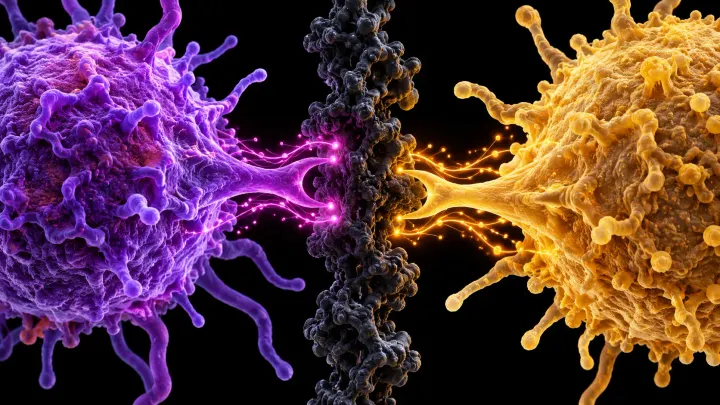
IVF has always been a technology story. But it has never been only a technology story.
Since the birth of Louise Brown in 1978, assisted reproduction has changed what medicine can do with eggs, sperm, embryos, timing, family structure, and genetic risk. Culture media improved. Embryos could survive longer outside the body. Freezing became safer. Genetic testing added a new layer of selection. What began as a treatment for infertility became a broader system for preserving, delaying, planning, and negotiating reproduction.
Now that system is entering another phase.
As MIT Technology Review’s What’s next for IVF lays out, fertility clinics and researchers are beginning to pull AI, robotics, embryo assessment, genetic screening, and even possible embryo editing into the IVF pipeline. The promise is cleaner: fewer failed cycles, fewer miscarriages, less human error, lower costs, and more access.
The reality is harder.
Reproduction is not a manufacturing problem waiting to be optimized. It is biology, medicine, hope, grief, money, inequality, risk, and social meaning wrapped into one of the most emotionally loaded decisions humans make. If IVF becomes more automated, the question is not simply whether more babies can be born. It is who gains control, who loses agency, and which decisions get quietly handed to systems most patients do not understand.
IVF’s next frontier is not one invention
The next IVF era will not be defined by a single breakthrough. It will be defined by convergence.
One part is embryo implantation, still one of IVF’s least controllable steps. Clinics can create embryos, assess them, and transfer them at what looks like the right time. But once the embryo enters the uterus, much remains uncertain. Even healthy-looking embryos often fail to implant.
Another part is selection. IVF has always involved choosing: which sperm, which eggs, which embryos, which moment. Traditionally, much of that judgment has been visual and experiential. That human expertise matters, but it is also variable.
AI promises to standardize some of that variation. Pattern-recognition systems can examine images of sperm, eggs, and embryos at scales human eyes cannot match. Columbia University researchers, for example, have developed the STAR system, which can scan over a million microscope images in an hour to identify rare viable sperm in severe male infertility cases. MIT Technology Review reports that the approach has already been linked to a first reported pregnancy.
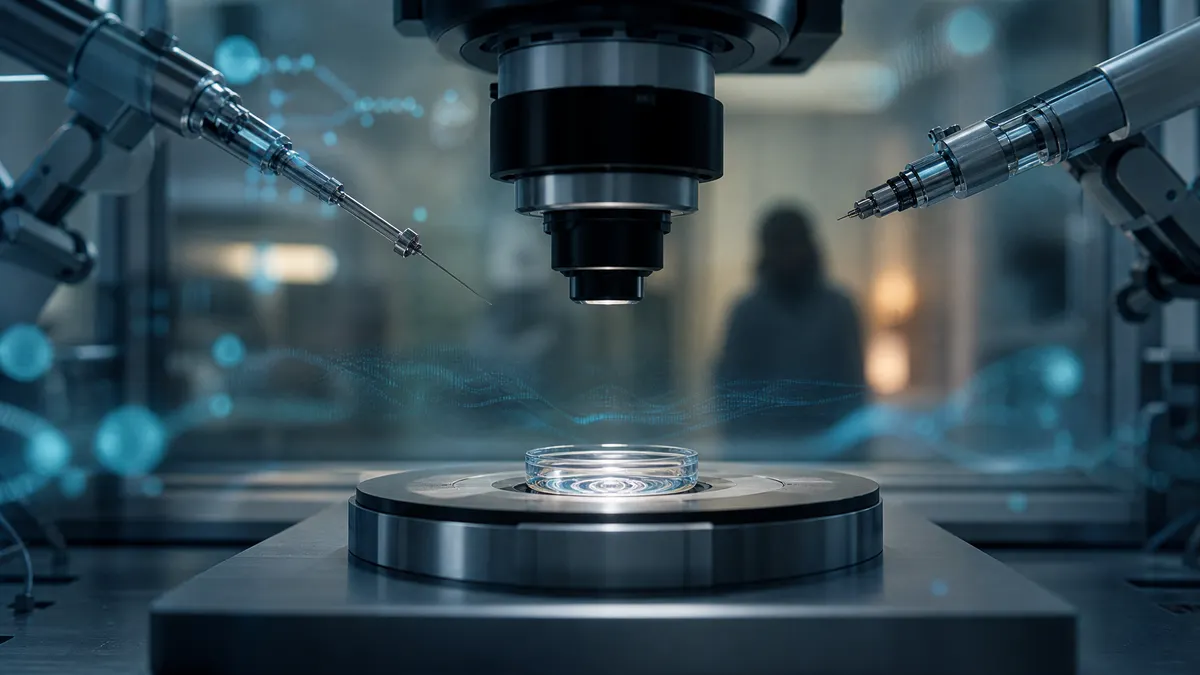
Then comes robotics. Automated IVF systems are beginning to perform parts of the lab workflow, including preparing sperm and eggs and creating embryos. The argument is straightforward: robots do not get tired, do not vary from clinic to clinic in the same way humans do, and could eventually process cycles more cheaply and consistently. One automated IVF system has reportedly been associated with at least 19 births.
Taken together, these tools point toward a fertility clinic that looks less like a craft laboratory and more like a tightly controlled biological production system.
That could be good. It could also be dangerous if the human meaning of the work gets flattened into throughput.
The strongest case for automation is access
IVF is often discussed as if it is already normal medicine. For many people, it is not.
It is expensive. It is physically demanding. It can require repeated hormonal stimulation, egg retrieval, embryo culture, transfer, waiting, failure, and emotional recovery. In many countries, access depends on income, insurance, geography, age, relationship status, clinic capacity, and local law.
So the strongest argument for AI and robotics is not futuristic convenience. It is access.
If automation can reduce labor bottlenecks, standardize lab quality, lower per-cycle cost, and make embryology expertise less dependent on a small number of highly trained specialists, IVF could become available to more people. That matters for infertile couples, same-sex couples, single parents by choice, cancer patients preserving fertility, people delaying parenthood, and anyone whose reproductive path does not fit older assumptions about family.
This is where the robotics story connects to Vastkind’s broader robotics lens: the real test is whether automation can become reliable enough to change everyday access. As with robotics more broadly, the bottleneck is trust, repeatability, safety, and deployment under real conditions.
But access is not automatic.
A clinic can use AI to lower costs, or it can use AI to sell premium ranking tools. A robotics platform can expand capacity, or it can become a high-margin product available only in elite fertility markets. Genetic testing can reduce suffering, or it can become a commercial filter layered onto anxious parents.
The technology does not decide that. Institutions do.
Embryo selection is where medicine becomes social policy
The most ethically intense part of the new IVF stack is embryo assessment.
Preimplantation genetic testing for aneuploidy, or PGT-A, screens embryos for abnormal chromosome numbers. It can be useful, especially for older patients, and may reduce miscarriages or shorten time to pregnancy in some groups. But it is not a perfect window into a future child. Some embryos labeled abnormal may still self-correct or lead to healthy births. Genetic signals are not destiny.
That uncertainty becomes even more serious with polygenic embryo screening, sometimes called PGT-P. These tests aim to predict complex traits influenced by many genes, such as disease risks, height, or cognitive traits. The scientific and ethical footing is far shakier.
This is the point where IVF stops being only a medical intervention and starts becoming social policy by another route.
If clinics begin offering broader embryo scoring, parents may feel they are simply making responsible choices. But the market can easily turn responsibility into pressure. If a test claims to rank embryos by future health, intelligence, or risk, declining the test can start to feel negligent. Choosing an embryo can begin to feel like choosing a life portfolio.
That is a heavy burden to place on prospective parents.
It also risks importing inequality into biology. Wealthier families may gain access to more screening, more cycles, more embryos, and more chances to optimize. Poorer families may be left with fewer options, or with none at all. The result would not be designer babies everywhere. It would be a subtler and more plausible future: reproductive advantage becoming another premium service.
Vastkind has covered a related version of this problem in personalized gene editing: a technology can be medically extraordinary and still create a brutal access problem.
AI will not remove uncertainty from reproduction
The temptation with AI embryo scoring is to believe uncertainty is being converted into knowledge.
Sometimes it is. Better imaging, time-lapse data, and large datasets may help clinics identify patterns linked to embryo viability. AI may improve consistency. It may reduce subjective variation. It may help embryologists find rare viable sperm or select embryos with a better chance of implantation.
But AI does not make reproduction transparent.
It learns from past data, clinic practices, patient populations, lab conditions, and outcome definitions. If those inputs are biased, inconsistent, or incomplete, the system inherits the problem. If the tool predicts implantation better than live birth, or live birth better than long-term child health, patients may misunderstand what is actually being optimized.
The system does not need to be malicious to mislead. It only needs to make a probabilistic judgment look cleaner than the biology underneath.
In fertility care, that matters because patients are often vulnerable, exhausted, and financially stretched. A score can feel like certainty when someone desperately wants direction.
The most responsible use of AI in IVF will keep human clinicians and embryologists in the loop, explain uncertainty clearly, and avoid selling rankings as fate. The worst use will dress statistical confidence up as destiny.
Gene editing is the line that changes the moral temperature
Embryo screening asks which embryo to transfer. Embryo editing asks whether the embryo itself should be changed.
That difference matters.
After He Jiankui used CRISPR in embryos that led to the birth of three children, the scientific backlash was severe for good reason. Germline editing does not affect only one patient in the ordinary sense. It can affect future generations. It also changes the consent problem, because the person most affected cannot agree to the intervention.
Some researchers argue that embryo editing could eventually prevent devastating single-gene diseases. That is the most morally serious case for it. If a family faces a high risk of transmitting a severe condition and embryo selection cannot solve the problem, editing may appear less like enhancement and more like prevention.
But that narrow case does not dissolve the risk.
Most diseases are not single-gene problems. Many are shaped by hundreds or thousands of genetic variants, environment, behavior, chance, and social conditions. Editing one risk could create another. Long-term safety is uncertain. And once the infrastructure exists, pressure will grow to expand from serious disease prevention toward enhancement, selection, and marketable advantage.
That is why embryo editing belongs in a different category from lab automation or AI sperm selection. It is not just a better tool inside IVF. It changes what society permits adults to decide on behalf of future people.
Why This Matters
IVF is becoming a platform where AI, robotics, genetic testing, and potentially gene editing meet at the beginning of human life. That makes the stakes unusually personal: the technology touches bodies, embryos, families, inheritance, and inequality at the same time. Better IVF could reduce suffering and expand reproductive freedom, but only if access, evidence, consent, and limits are treated as core design problems. The future of fertility should not be decided only by clinics, startups, and anxious markets.
The real future is better choices, not perfect babies
The most humane version of IVF’s next era is not a world of optimized babies.
It is a world where fewer people endure repeated failed cycles without explanation. Where embryologists have better tools. Where clinics are more consistent. Where patients understand probabilities instead of being sold certainty. Where genetic testing is used to prevent serious suffering, not to turn parenthood into product selection. Where automation lowers barriers rather than creating a luxury tier of reproduction.
That future is possible.
But it requires rejecting the cleanest marketing story. AI will not solve fertility. Robots will not make reproduction frictionless. Genetic screening will not make risk disappear. And embryo editing, if it ever becomes acceptable in narrow cases, will need more governance than the market is likely to provide on its own.
The next phase of IVF will be measured not only by success rates, births, and lab efficiency. It will be measured by whether technology gives people more humane reproductive choices without converting the beginning of life into another optimization contest.
For more on how emerging biology is changing medicine, risk, and access, read Vastkind’s coverage of personalized gene editing and partial epigenetic reprogramming.