The big story
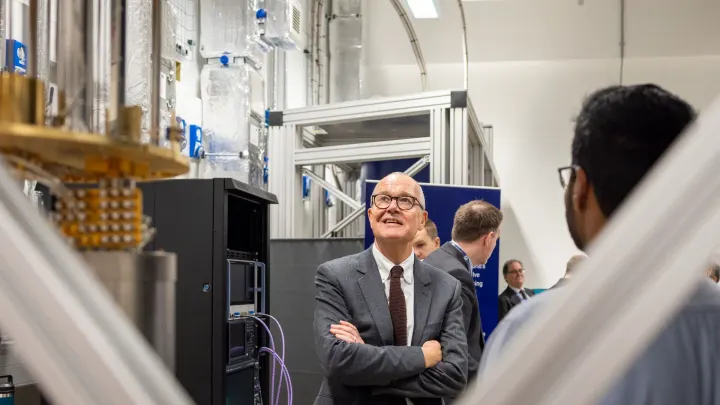
Making NQCC’s Quantum Computers Usable
The UK testbed program shows why delivery, reliable research access and useful computation are three different milestones.
Beyond the classical. The devices, discoveries and evidence that count.
The UK testbed program shows why delivery, reliable research access and useful computation are three different milestones.
A new paper explains why a filtered quantum result needs a filtered classical comparison. Its concrete example uses an experiment from 2015.
A simulation study shows how reusing one clue can turn a correct repair into a wrong one, and how a small change to the software restores its advantage.
Two trapped ions linked photons across existing city fiber. Remembering the first success helps connect it with the next, but this is one relay, not a network.
A shared microwave path makes the wiring simpler. Keeping neighboring qubits from disturbing each other is the harder part.
A smaller circuit can make a future quantum computer's job easier. The important change is in the instructions, not the chip.
Cleaner, single-use quantum states could help power scientific calculations and future cryptographic attacks. The hard part is keeping them useful.
A $215 million competition defines usefulness as at least 100 logical qubits, hundreds of millions of fault-tolerant operations and a scientific demonstration. The numbers expose how far the field has moved beyond raw qubit counts.
Aligned defects and nanopillars made selected silicon-carbide emitters brighter in a lab. Yield and system integration remain the harder scale tests.
New theory separates how much energy a quantum battery transfers from how reliably it transfers it. The best model design is not necessarily the most collective.
A bigger quantum computer can still fail at the calculation that matters. QUOPS and CUDA-Q Logical offer clearer ways to judge what a machine can do.
A Nobel laureate, fresh capital and a protein experiment: Pasqal’s next test is turning extraordinary physics into work that matters.