
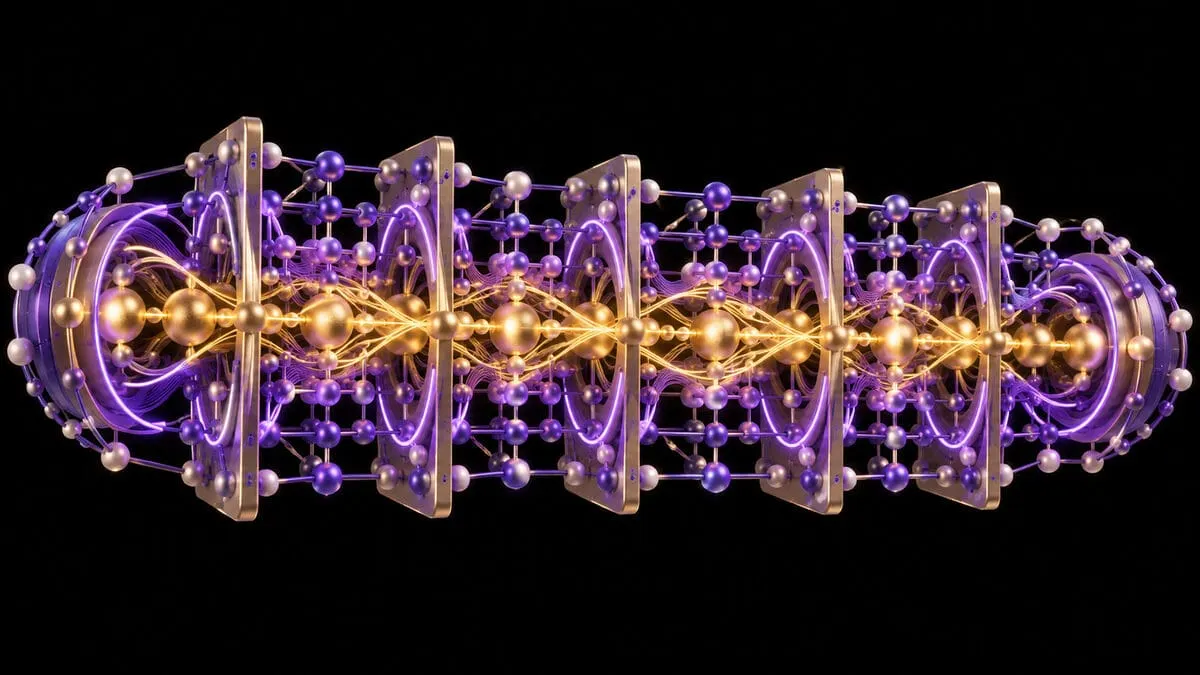
The US Department of Energy has attached a number to a scientifically useful quantum computer: up to $215 million in planned awards for teams that can reach at least 100 logical qubits, sustain hundreds of millions of fault-tolerant operations and demonstrate real scientific work. That is a funding target, not evidence that such a machine exists. Its value is that it replaces the industry’s favorite headline number—physical qubits—with a much harder test of whether a computation can survive long enough to matter.
Applications for the Quantum Genesis Q competition are due October 19. The program sets a 2028 goal and divides the money into stages: initial awards of up to $1.5 million, a $100 million general pool tied to the 100-logical-qubit target, and additional pools for systems reaching 150 and 200 logical qubits. DOE also plans a separate $45 million effort for national laboratories to validate the machines.
The word planned matters. DOE says only $2.5 million of the competition funding is available in fiscal year 2026; later funding depends on congressional appropriations. The same contingency applies to much of the validation budget. A prize structure can focus engineering effort, but it cannot appropriate money or manufacture reliable qubits.
In plain English: A physical qubit is a fragile quantum component. A logical qubit is useful information protected by many physical qubits working together to detect and correct errors. Reaching 100 logical qubits is therefore not the same as connecting 100 devices. The computer must repeatedly correct mistakes while still performing the intended calculation.
One Hundred Is Only Half the Target
Quantum hardware loses information through noise: heat, stray electromagnetic interactions, imperfect control pulses and measurement errors. Error correction spreads one logical unit of information across many physical qubits. As errors appear, the machine measures patterns called syndromes and repairs the logical state without directly reading—and destroying—the quantum information.
That overhead can be enormous. The exact number of physical qubits per logical qubit depends on hardware quality, error-correcting code and the computation. That is why a requirement for 100 logical qubits says more than a raw chip count, but still not enough.
DOE adds a second requirement: hundreds of millions of fault-tolerant operations. A quantum algorithm is a sequence, and each step is another chance for errors to accumulate. A machine that holds a protected qubit for a moment but cannot execute a deep sequence is like a calculator that preserves ten digits but switches off after the first multiplication.
The analogy has limits. Quantum operations are not ordinary arithmetic instructions, and different algorithms demand different gates, connectivity and precision. Still, depth is the reason the competition’s two requirements belong together. Logical width tells us how much protected information the machine can hold. Fault-tolerant operation count tells us how much reliable work it can do with that information.
The final requirement is a scientific demonstration. DOE names fields including chemistry, materials and nuclear science. The agency’s broader Quantum Genesis initiative aims to connect future machines with national-laboratory workloads. A credible demonstration would need more than running an algorithm: it should define a useful scientific question, compare the answer with the best classical approach and disclose the resources used.
Validation Is the Quiet Center of the Plan
The separate laboratory testbed may be the most important part. Vendors naturally optimize systems around their own metrics. Independent teams can check whether a reported logical qubit remains protected under realistic workloads, whether operation counts include correction overhead and whether the scientific result can be reproduced.
That does not make national laboratories neutral by magic. Validation protocols can favor certain architectures, and a single benchmark can become a target rather than a measure. The program will need transparent definitions and results that other researchers can inspect.
Nor does 100 logical qubits automatically imply “quantum advantage.” A narrow quantum calculation can beat one classical method while losing to a better algorithm, faster hardware or an approximation that answers the scientific question well enough. The competition’s strongest design choice is to pair machine specifications with an application and external verification.
The next evidence arrives in stages. First, watch which architectures pass the application review and what exact validation rules DOE publishes. Then watch whether Congress funds the out-years promised in the announcement. By 2028, the decisive question will not be whether a team can display 100 protected qubits once, but whether independent evaluators can make the system perform a long, reproducible scientific calculation.
That is a stricter standard than celebrating a clever device, just as a quantum defect that catches more light still needs system-level engineering. It is also why a quantum battery needs reliability, not just speed. And the difference between a headline metric and sustained work mirrors the memory limits of AI agents: the useful system is the one that maintains correctness across the whole task.
The price is eye-catching. The real commitment is the definition of success.
Production note: Vastkind reviewed the Department of Energy competition announcement, program structure and funding contingencies. No applicant has yet demonstrated the full target under this competition.