
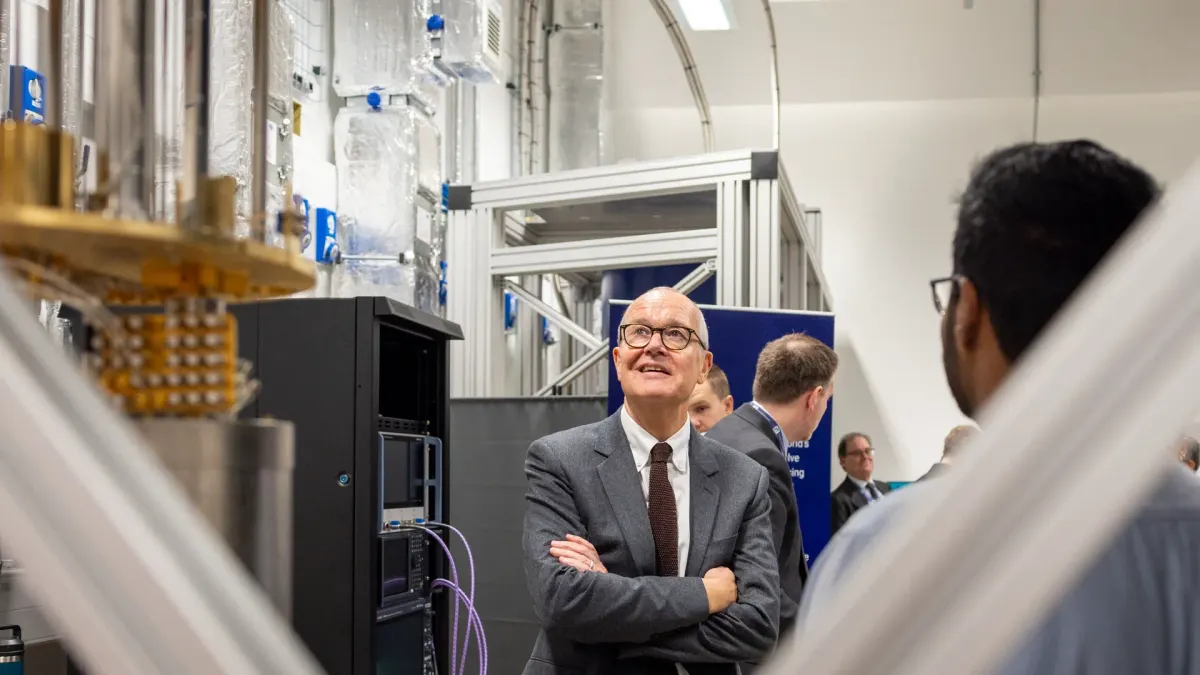
Getting a quantum computer to its customer can mean moving a small industrial operation. For its installation at Britain’s National Quantum Computing Centre, QuEra says it shipped roughly 14,000 kilograms of materials from Boston in a climate-controlled container. The project also required integrating optical equipment, vacuum systems, electronics and software at Harwell.
That is an unusually tangible glimpse of a problem hidden by qubit counts: a quantum computer has to become something people outside its builder’s team can reliably operate before they can investigate what it is good for.
The NQCC’s Phase 1 testbed report, released on October 21, 2026, makes that distinction concrete. Seven suppliers completed their contracted deliveries in 2025. Its status table records six systems accepted for the next evaluation phase and one still in pre-evaluation. Delivery, acceptance and useful computation are different milestones.
What the Customer Is Actually Buying
The £30 million Quantum Computing Testbed Initiative is not a purchase of seven interchangeable computers. Its suppliers use different physical approaches: trapped ions, neutral atoms, superconducting circuits, silicon spins and light. These are different ways of creating and controlling qubits, the quantum systems used to encode information.
Six testbeds are installed in facilities managed by the NQCC at Harwell; QuEra’s is in its own co-located facility. The aim is to give researchers systems they can characterize, experiment with and improve, rather than judge entirely through a manufacturer’s demonstration.
That creates a demanding kind of first customer. A visitor may watch an impressive calculation once. A research team needs to return, write its own program, understand the interface and collect enough results to tell whether a change helped.
The report also records friction. A target for two-thirds of the testbeds to be functional by March 31, 2025, was only partially met. Some contracts were extended, with all deliveries completed by the end of that year. These are completed procurement milestones with an imperfect timetable, not evidence that all seven machines were ready for unrestricted use on the same day.
Three Steps That Should Not Be Confused
The report’s acceptance criteria provide a useful way to separate three claims often compressed into the word “working.” This is a reading of the program’s requirements, not a new performance benchmark.
- Delivered: the supplier has provided the agreed system and met the contracted delivery scope. That establishes that the project has reached a physical and contractual milestone.
- Usable for testing: an expert user can operate it through a documented programming environment and executable scripts. There must be enough uptime and continuity of access to run experiments, plus a path for upgrades. This is where a machine becomes a practical research instrument.
- Useful for a problem: a computation produces a result worth obtaining, judged against an appropriate alternative. Acceptance into an evaluation program does not establish this final claim, much less an advantage over conventional computers.
The middle step is easy to overlook. A perfectly described experiment is not much use if researchers cannot get consistent access to the machine. Nor can they sensibly compare results if the programming interface or calibration changes in ways they cannot track.
For an outside team, documentation, access and support therefore become part of the experiment, not administrative details added after the interesting physics.
The Work Behind Repeatable Access
The supplier accounts show what that middle step can involve. Quantum Motion describes automated calibration that monitors changes in its silicon-spin system and adjusts controls. Calibration is the work of keeping a machine’s operations aligned with the behavior researchers expect; drift means those settings need attention again. Automation offers a way to reduce repeated manual intervention, although this report does not establish a measured uptime improvement from it.
QuEra’s account shows a different challenge: recreating a complex neutral-atom system at a new site and connecting it to the software that users need. Its report describes only partial progress toward some UK-access and control-stack goals. The shipment is evidence of substantial installation work, not a claim that everything was finished.
These sections are written from the suppliers’ perspective. They are useful accounts of integration problems, but they are not an independent comparison of which machine is fastest, most reliable or closest to commercial value. QuEra’s separate discussion of its Boston machine should not be read as measured performance of the Harwell installation.
What the Next Phase Can Tell Us
The program’s second phase, running through 2025–2027, turns those installations into an evaluation effort. The report describes onboarding and training, verification of system specifications, benchmark protocols and experiments with small example problems. Those examples help researchers explore how to program and assess the machines; they do not by themselves demonstrate a valuable commercial application.
A credible comparison will need the conditions behind any result: what was run, how much access was available, how errors were handled and what alternative was used. The October report describes a common evaluation regime still being developed. It is not a league table from which readers can pick a winner.
That makes it a useful companion to the US effort to define a useful quantum computer. Funding and technical targets set the destination. The NQCC’s first-customer experience exposes the practical work needed before outside researchers can even begin a fair test.
A delivered machine is something a supplier has built. A usable testbed is something another team can learn from repeatedly. For the NQCC, that transition is a meaningful achievement: reliable access that lets researchers discover the machine’s limits as well as its strengths.
