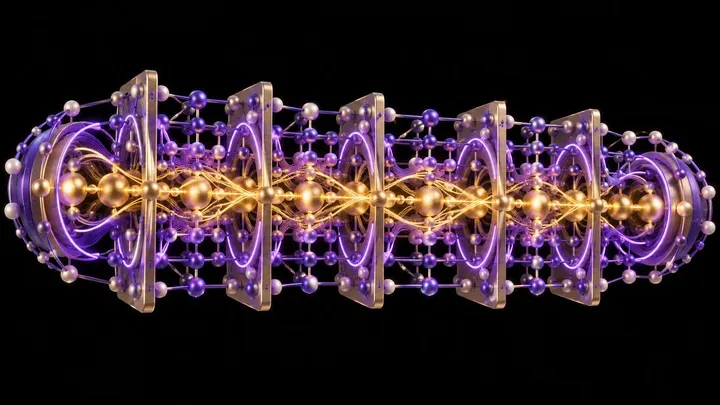
A powerful quantum computer would need a steady supply of something it can use only once. Google has made that ingredient cleaner on its Willow processor: a specially prepared quantum state that helps the machine perform operations its error-corrected memory cannot handle on its own.
The improvement is roughly fortyfold, but it measures errors in that ingredient, not the speed of the whole computer. Understanding the difference reveals why the result matters for everything from studying molecules to the future of digital signatures.
Google announced the Science publication on October 15. The experiment had already appeared in a December 2025 preprint. Its new journal publication brings attention to an important engineering problem: a quantum computer must manufacture reliable operations, not just preserve information.
A computer that consumes its ingredients
Error correction spreads quantum information across several physical qubits, allowing the machine to detect and handle some faults. That protects a logical qubit: the more dependable unit a program would use. But storing information reliably is not the same as being able to perform every kind of calculation.
For the architectures in this experiment, certain essential operations need an extra resource called a magic state. It is a carefully prepared quantum state, not a material or a new kind of particle. Use it to enable one of those operations and it is consumed. A long program therefore needs a continuing supply.
That changes the engineering question. A machine might have enough protected memory yet spend much of its effort preparing what its calculations will consume. Improving that preparation can make ambitious programs less demanding even without making each physical qubit faster.
Google's method, called magic-state cultivation, starts with an imperfect state in a small error-correcting code. Measurements look for signs of trouble. Attempts that fail the checks are discarded; the survivors are cleaner. Think of quality control with a reject bin, not a filter that repairs every faulty item.
The reject bin is part of the result
The reported state quality reached about 99.99%, with an important qualification beside it: only 8% of attempts were retained in that benchmark. Roughly eight out of 100 attempts contributed to the result.
That selection includes checks during both preparation and measurement. It is not a demonstrated production rate for a continuously operating quantum factory, nor does it mean 92% of future programs would fail. It tells us how the experiment arrived at its cleanest measured states.
The measurement itself required new work. Noise could make an earlier technique overstate the quality of a state. The researchers developed a different method to bound the remaining error. The small error is impressive precisely because checking it is difficult.
There is another boundary in the accessible experimental paper. A useful state must move from the small code that prepared it into a larger structure where the computer can use it. The team demonstrated this kind of transfer, but it did not preserve the headline quality: errors accumulated while the state was being held, leaving its measured quality around that of the unrefined comparison.
The experiment has therefore advanced two different tasks by different amounts: making a cleaner resource, and showing a route for handing it over. It has not yet joined them into a lossless production line.
Why molecules and materials enter the picture
The attraction of quantum computing is not that it should replace every laptop calculation. Some problems involve the behavior of quantum systems themselves, including molecules and materials. Their properties depend on interactions that can become very difficult to model as the system grows.
A concrete example already exists in a separate strand of Google's work. Its molecular-geometry demonstration combined nuclear magnetic resonance data with quantum calculations to infer aspects of molecular structure. The test involved two molecules, including toluene, rather than a patient or a drug trial. Google explicitly said this initial molecular demonstration was not beyond classical computing capabilities.
That is the sensible bridge to medicine: better tools for understanding molecules could contribute to research. The cultivation experiment did not discover a medicine or demonstrate a treatment. It addresses part of the computing machinery that more ambitious scientific calculations could eventually require.
Materials provide another specific target. An independent resource study examined fault-tolerant simulations of models relevant to high-temperature superconductors. Such materials can carry current without electrical resistance under suitable conditions. Understanding their behavior is a different problem from simply running a larger conventional simulation.
That study estimated computational resources; it did not discover a new superconductor. The connection is nevertheless practical: algorithms may call for large numbers of the expensive operations that magic states help supply. A better supply process could change what fits inside a feasible machine.
Cryptography is the other side of the same capability
A sufficiently capable quantum computer could also attack some of the mathematical problems that protect digital signatures and key exchange. That is a specific threat to certain public-key systems, not a claim that every kind of encryption becomes useless.
A separate 2026 resource estimate explores what an attack on 256-bit elliptic-curve cryptography might require. Its results depend on assumptions about hardware errors, connectivity and timing. They are not an attack performed on Willow, and Google's new experiment does not supply a date when cryptocurrency keys will become vulnerable. Cryptocurrency signing and cryptocurrency mining are also different tasks.
The preparation is already under way elsewhere: NIST finalized its first three post-quantum cryptography standards in 2024. Our explanation of the migration problem follows the less spectacular work of finding where vulnerable cryptography is actually used.
For quantum computing itself, the revealing number is no longer just how many qubits a chip contains. As our guide to useful quantum work explains, the whole calculation has to survive. Google's cleaner ingredient is a real advance toward that goal. Its value will multiply when the machine can make enough of it, keep its quality through the handoff, and spend it on a complete calculation.
Source note
Experimental details above refer to the accessible December 2025 preprint. The October 15, 2026 Science publication date and abstract were checked against publisher-supplied metadata; the full journal text was not accessible. The abstract describes the fidelity as a bound of at least 0.9999(1). Application examples are separate studies, not results of the cultivation experiment.