Two days after an immune signal was removed, most traces of the response had disappeared from ordinary RNA measurements. In cells carrying an engineered storage structure, the earlier response was still readable. The difference was not that these cells had been exposed to a different event. They had kept molecular evidence that the comparison cells had largely lost.
The experiment, reported on October 21 in Nature Biotechnology, points to a useful way of studying a cell's past. The researchers call their storage structures recordanelles. So far, the work is a research-tool demonstration in one laboratory-grown human cell line, not a test for patients.
A Snapshot Can Miss the Earlier Signal
Messenger RNA carries copies of genetic instructions that cells use to make proteins. Which messages are present, and in what amounts, helps researchers see how a cell is responding. But those messages are continually made and broken down. A measurement taken after a response has faded may miss evidence that it happened.
That creates a practical problem: researchers cannot always know in advance when an interesting response will occur. Sampling later is easier if the cell has preserved some of its earlier messages instead of showing only what remains at that moment.
The team tested that idea using interferon beta, an immune-signaling molecule. Cells received a 20-hour exposure, followed by two days without the signal. Comparison cells without functional RNA storage had largely lost the associated pattern. Cells equipped with the improved recorder retained it, including when researchers analyzed individual cells rather than only pooled samples.
The result is more informative than finding one lingering marker. It preserves a pattern of messages associated with the earlier response. It does not establish a complete memory of everything the cell experienced.
Saving the Messages Inside the Cell
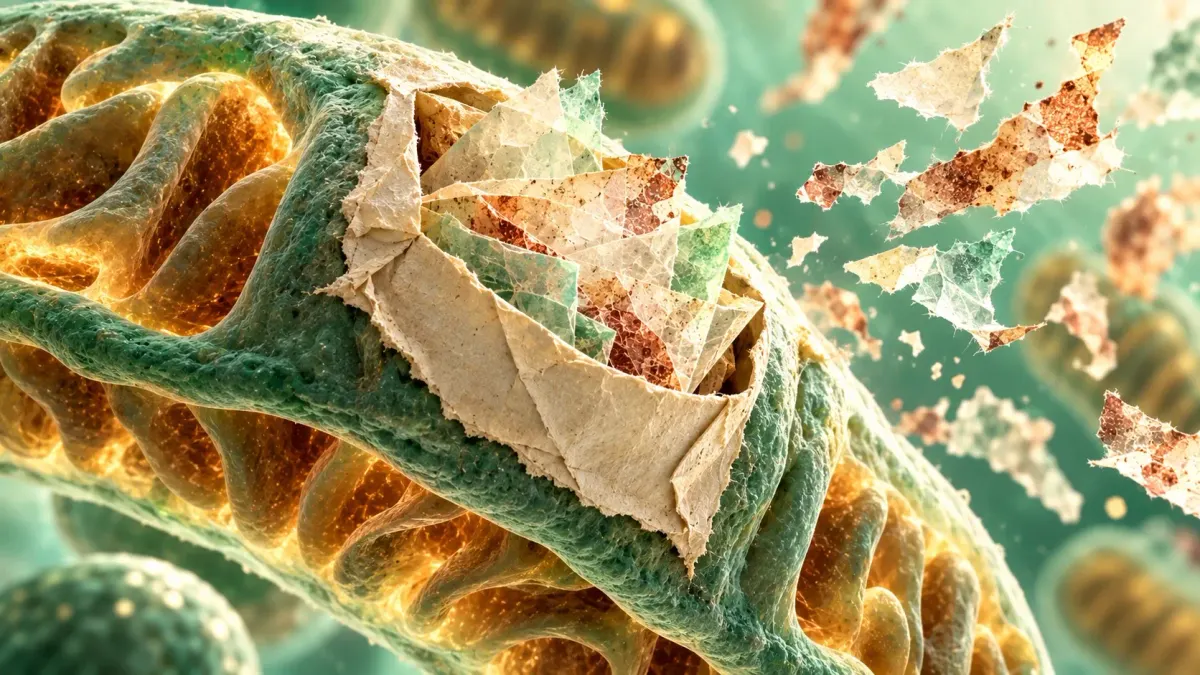
A recordanelle is built from one engineered protein with three jobs. One part attaches it to the outside of a mitochondrion, a cellular structure best known for supplying energy. Another helps assemble a dense storage structure. A third binds messenger RNA, allowing the structure to collect and protect some of the cell's messages.
The researchers can then isolate the mitochondria-associated material and read the stored RNA. The cell has not converted each event into a new digital-style code. The molecules themselves are the retained evidence.
That distinction connects to a broader question in biology. Experiments on how DNA folding changes gene control ask why a cell makes particular messages. This tool asks which messages can still be recovered after they were made.
Storage also has a turnover problem. In cultures that were not split into fresh cultures, the researchers could still detect the earlier interferon response after five days. When they split the cultures to allow continued growth, the record faded sooner. The five-day result is therefore not a guaranteed memory span for every cell or experimental setting.
A Recorder Must Not Keep the Response Running
Keeping RNA is not automatically the same as keeping a neutral record. If the preserved messages continue directing protein production, the recorder could prolong the response it is supposed to observe.
An earlier version of the tool showed that problem: some response-related protein levels remained elevated. The improved version was designed to reduce protein production from the stored RNA. In the measured two-day comparison, its protein response largely subsided like the controls' while the RNA evidence remained detectable.
That is an important separation: remembering a response without simply keeping it active. It is not proof that the recorder leaves every aspect of a cell unchanged. The authors explicitly note that adding a protein structure, occupying mitochondrial surface and capturing RNA can themselves disturb the system. All the mammalian experiments used HEK293T cells, a common laboratory cell line; other cell types and tissues remain to be tested.
An Archive Is Not Yet a Timeline
This is not the first attempt to preserve a cell's RNA history. An earlier method, TimeVault, used engineered vault particles to store messenger RNA. The new paper explores a different architecture attached to mitochondria, not a demonstrated victory in a head-to-head comparison.
Nor does retaining messages reveal their exact order. If two responses leave traces in the same archive, the present method does not automatically show which happened first. Encoding the sequence of events is a possible next development, not an accomplished feature.
The immediate gain is more concrete. A cell that looks quiet at the moment of measurement can still carry readable evidence of an earlier response. Preserving that evidence gives researchers a way to ask about the past without pretending they have already reconstructed the whole story.