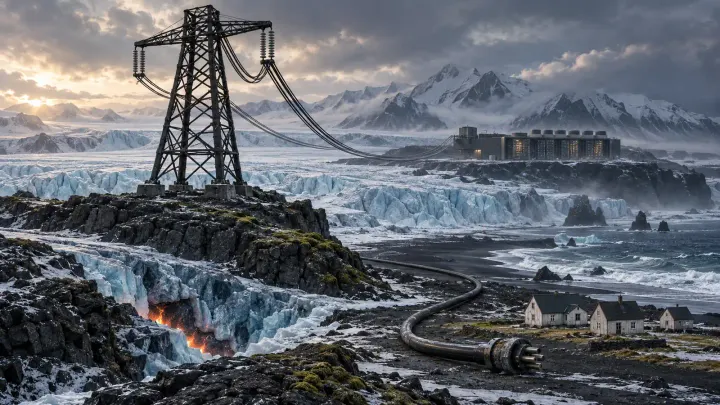
The most valuable result from a geothermal project can be a hole that disproves the plan. On September 21, the US Department of Energy announced more than $99 million for 21 selected projects that will drill, stimulate and test geothermal resources. Five are field-scale enhanced-geothermal experiments; 16 are exploration wells meant to determine whether promising heat underground can become a usable reservoir.
This is public funding for tests, not 21 new power plants. The department’s announcement describes a portfolio designed to reduce technical and development risk. Its most important promise is unusually practical: data from the projects are supposed to enter the public Geothermal Data Repository, allowing failures and successes to inform more than the company that drilled each well.
Heat is necessary. A reservoir needs two more things.
A conventional hydrothermal resource needs heat, fluid and permeability—the connected pores and fractures that let fluid move through rock. Some places advertise themselves with hot springs or steam. Many do not. A hidden resource can look attractive in surface surveys and models until a well measures the actual temperature, flow and geology at depth.
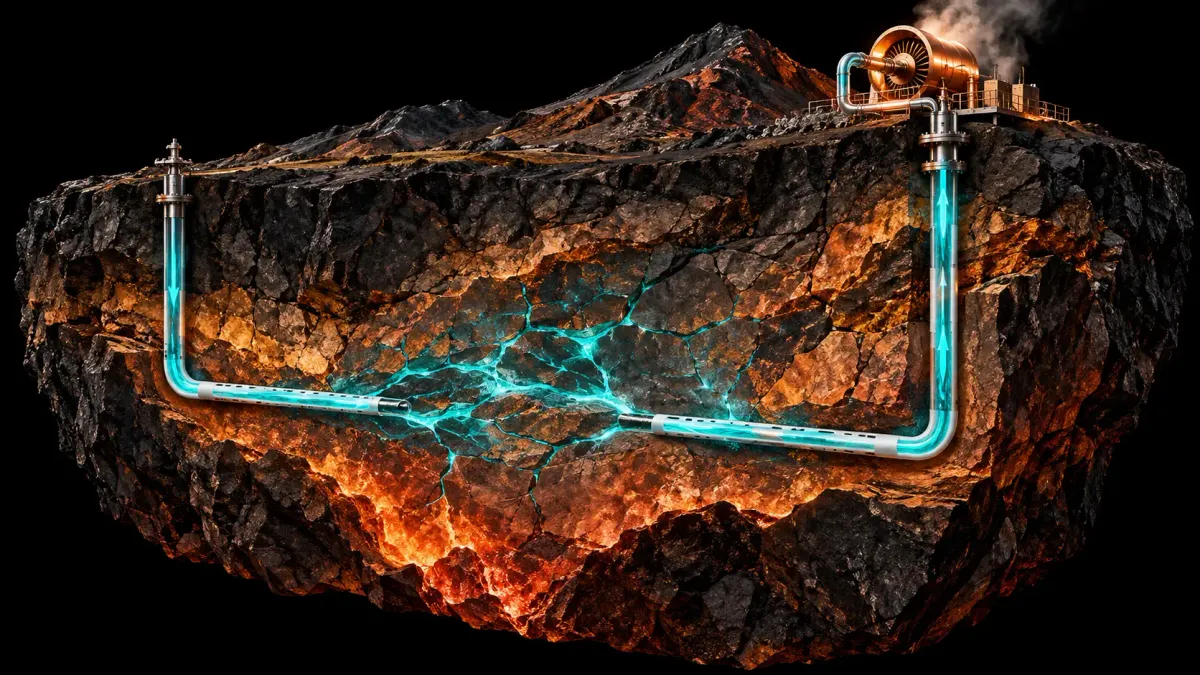
Enhanced geothermal systems, or EGS, begin where the rock is hot but natural fluid or permeability is insufficient. Operators inject fluid under controlled conditions to open existing fractures or create new ones, then circulate water through the hot rock and return it to the surface. In principle, that expands geothermal power beyond the few places with ideal natural reservoirs. In practice, the engineered underground heat exchanger must move enough water, retain useful temperature and avoid unacceptable seismic or water-management consequences.
A geothermal map can suggest that hot rock is present. It cannot sell electricity. A well must confirm temperature, and a pair of wells must show that fluid can circulate through the reservoir fast enough and long enough to carry useful heat back to the surface. Exploration proves what exists; field tests probe whether engineers can use it.
Drilling is where uncertainty becomes expensive. The DOE says drilling can represent more than half of a geothermal project’s cost. For enhanced systems, casing and cementing alone can account for roughly 30% to 40% or more of total well costs, and equipment must survive temperatures beyond ordinary oil-and-gas practice.
Five projects test the engineered reservoir
The five EGS projects pursue different versions of the circulation problem. Fervo Energy plans wells in Idaho plus a three-component geophone array rated for at least 200°C, intended to monitor how stimulation changes the reservoir. AlterG Resources will compare two hydraulic-completion methods in deep horizontal well pairs in Nevada. The University of Utah aims to operate an EGS doublet beside an existing hydrothermal system and measure sustained circulation, permeability and thermal output.
Zanskar proposes injecting into impermeable hot rock next to a producing New Mexico hydrothermal reservoir, using engineered pressure support to connect conventional and enhanced approaches. Quaise Energy will test at Newberry Volcano in Oregon, where the stated bottom-hole range of 265°C to 365°C exceeds the conditions in which most conventional EGS tools and materials have been validated.
Those are materially different experiments. A sensor surviving 200°C, a stimulation method creating a connected flow path and a doublet sustaining thermal output are separate milestones. None alone demonstrates a commercially competitive plant.
Sixteen wells buy information before construction
The larger group is less glamorous but may be just as consequential. Exploration projects will drill into candidate resources in California, Idaho, Nevada, New Mexico, Oregon, Utah, Washington and Alaska. Several target temperatures above 150°C or 200°C. GeoAlaska proposes a deeper well above 350°C on the flank of Mount Augustine; another project will test a resource on San Ildefonso Pueblo land in New Mexico.
Some teams are also testing the process of discovery. Zanskar plans to update a probabilistic geological model while drilling from one pad. DAVINCI EP will use paired horizontal confirmation wells in California’s Brawley area. XGS Energy intends to record continuous electronic drilling data and integrate core, logs and temperature measurements. The transferable product may be a better way to decide where the next well belongs—not just one successful site.
Public data could make that transfer real, but the announcement does not yet specify when each project will drill, how datasets will be standardized or what negative results will be released. Funding selection also does not guarantee a well reaches its target, a reservoir circulates or a developer secures the permits and capital for a plant.
The next scorecard should therefore resist counting projects as megawatts. Count wells drilled, temperatures confirmed, flow sustained, induced seismicity observed, costs disclosed and datasets posted. Geothermal’s promise is heat that can run when wind and sunlight are unavailable. Its discipline begins earlier: letting an expensive hole tell investors, engineers and communities whether the resource is actually there.
Keep exploring
- Google’s geothermal deal puts the power plant first — a dated ledger separating contracts, construction and operation.
- AI’s grid bottleneck is transformers — why generation is only one part of delivering firm power.
- The grid’s missing component is trust — how infrastructure depends on agreements as well as hardware.
AI-assisted. Sources checked.