The weakest way to talk about GPT-5 is to ask whether it will ignite the next market rally.
That is downstream noise.
The harder and more useful question is this:
If GPT-5 is meaningfully more unified — stronger across reasoning, coding, multimodal work, and tool use inside one system — what changes structurally?
That is the real story.
Not whether traders get excited for a week.
But whether one model layer starts absorbing more of the fragmented digital work that currently gets split across apps, interfaces, and narrower AI tools.
If that happens, GPT-5 will matter less as a product launch and more as an operating shift.
A unified model changes more than the chat box
A lot of AI discussion still treats each model release as a better chatbot.
That framing is already too small.
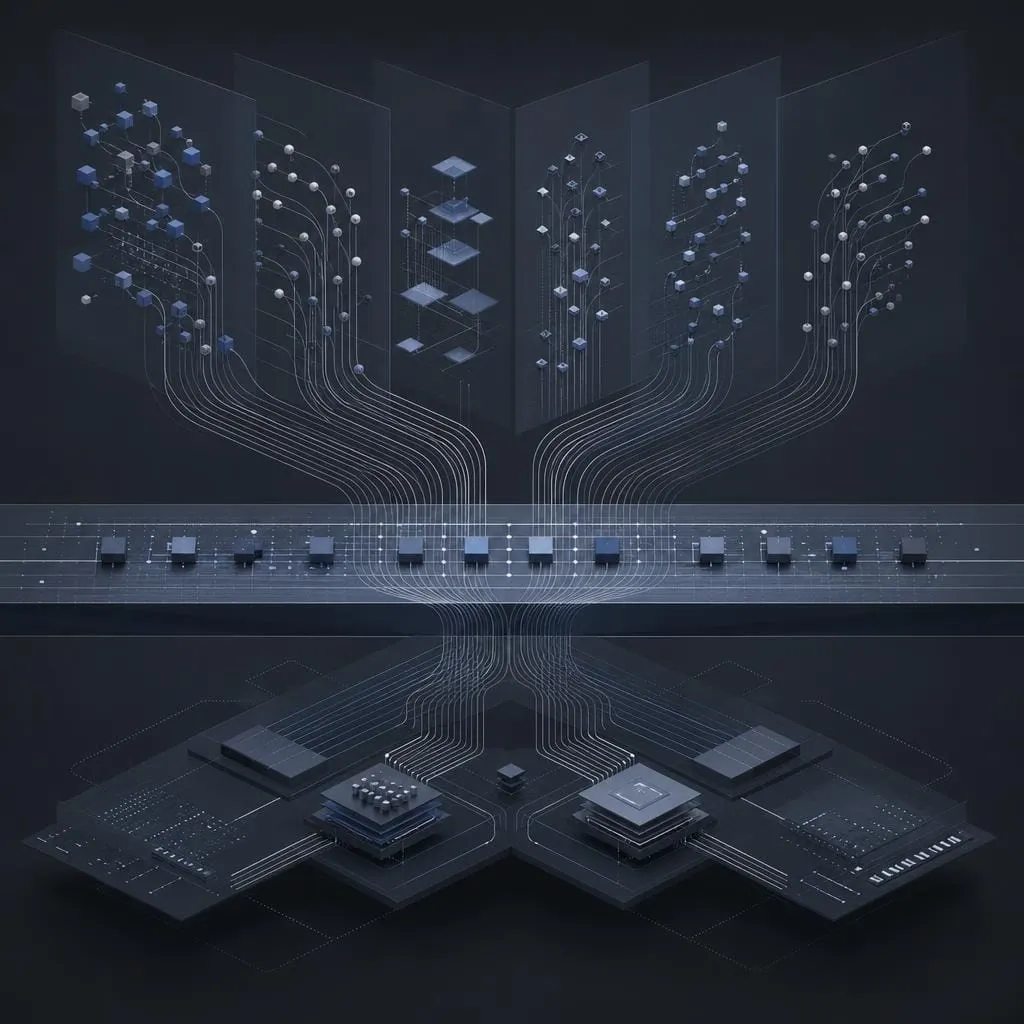
The real significance of a more unified frontier model is that it can collapse workflow friction. Instead of bouncing between one system for drafting, another for coding, another for image interpretation, another for retrieval, and another for deeper reasoning, users start working through one continuous layer that can carry more context across tasks.
That matters because handoffs are expensive.
Every time a workflow fractures across tools, the human becomes the router, the memory system, the safety layer, and the quality controller. A better unified model reduces some of that overhead.
This is why GPT-5 matters most if it behaves less like a single answer engine and more like a general work surface.
For the more specific routing angle behind that shift, see GPT-5 Router Logic: Why the Real Product Is Model Orchestration, Not Just a Smarter Model.
The first gains appear in continuity, not magic
People often look for model progress in dramatic demos.
But the more important gains may be quieter.
A stronger unified model can preserve context better across tasks. It can reduce the need to restate goals. It can move from analysis to drafting to revision to tool use with less cognitive whiplash. It can keep more of the workflow inside one reasoning frame.
That kind of continuity is easy to underrate because it does not always look spectacular in a benchmark image.
Operationally, though, it matters a lot.
It changes product design, because teams can build around one deeper model layer instead of choreographing awkward jumps between specialized systems. It changes user behavior, because people stop managing the seams as actively. And it changes the economics of adoption, because convenience and coherence often beat raw feature count.
This is also where the labor story gets sharper. The effect is not simply "AI gets better at one task." It is that more adjacent tasks begin to fuse into one model-mediated workflow. That raises the ceiling on what one user can do, but it also deepens dependence on whichever platform owns the layer.
The hidden story is concentration
This is the part launch coverage often softens.
If one integrated model becomes more capable and more usable, it can simplify the user experience while simultaneously concentrating power.
That concentration shows up in several forms.
Product concentration: fewer independent tools remain necessary.
Infrastructure concentration: more value accrues to the companies controlling compute, model training, and distribution.
Data concentration: more of the user’s work passes through one system that can observe patterns across tasks.
Governance concentration: more judgment gets delegated to a smaller set of model providers and safety frameworks.
So the case for unified AI is not just convenience.
It is also dependence.
That is why the memory and policy layer matters so much. If one system becomes the place where work accumulates, then memory is no longer a UX nicety. It becomes a governance question. See Memory Policy Is Not UX. It Is the Governance of What AI Gets to Keep..
Compute, cost, and oversight do not disappear
A more unified model does not magically remove the underlying tradeoffs.
Someone still pays for the compute. Someone still decides when deeper reasoning is worth invoking. Someone still manages the latency budget. Someone still governs failure modes, hallucinations, unsafe outputs, and tool misuse.
In other words, model unification may hide complexity from the user while increasing complexity underneath.
That is not a contradiction. It is the product bargain.
The smoother the system feels up top, the more important the invisible allocation logic becomes below: routing, fallback behavior, safety design, monitoring, memory boundaries, and cost control.
This is one reason GPT-5 should be read alongside governance rather than only alongside benchmarks. If more operational authority sits inside one model layer, then the architecture of delegation matters more. See Agentic AI Governance Is the Architecture of Delegated Power and ARC-AGI-2 and the New Economics of Intelligence.
Why the market question is still not entirely wrong
The market framing is shallow, but not totally stupid.
It is just early.
If GPT-5 really does reduce workflow friction and expand practical use, then yes, infrastructure firms, platform companies, and some downstream software categories will feel that. But those effects come through adoption, product integration, and organizational change — not because the name of a new model hit the news cycle.
That distinction matters.
Hype can move prices temporarily.
Operational usefulness changes markets more slowly and more durably.
Why This Matters
GPT-5 matters if it turns frontier AI into a more coherent work layer rather than just a stronger demo system. That would change how products are built, how workers move across tasks, and how much dependence shifts toward a few model platforms. The biggest impact would not be a one-day rally. It would be the quiet restructuring of digital workflows, institutional leverage, and oversight responsibility.
Conclusion
The right question about GPT-5 is not whether it sounds impressive on launch day.
It is whether it removes enough workflow friction to become part of how work naturally happens.
If it does, then the real change will not be a headline about market enthusiasm.
It will be a deeper consolidation of capability, context, and control inside one AI layer.
That is the shift worth watching.
CTA: Read next: OpenAI GPT-5: Why a Unified Model Changes More Than the Chat Interface, Memory Policy Is Not UX. It Is the Governance of What AI Gets to Keep., and Agentic AI Governance Is the Architecture of Delegated Power
Read next: For the wider AI workflow shift, go to Vastkind's AI hub, then read why AI work is no longer just about learning tools and why agentic AI needs governance architecture.


