

A weird thing happened to the AI boom.
It stopped being mainly about models.
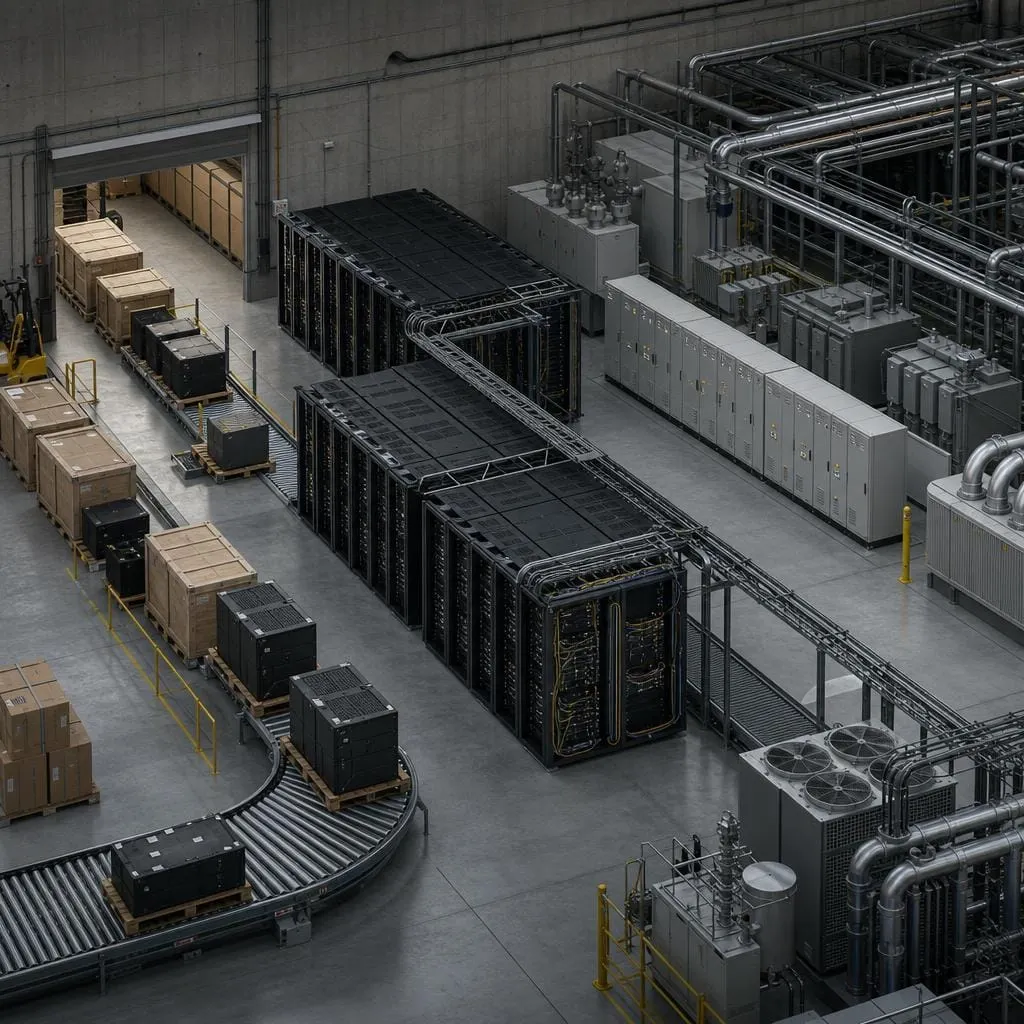
The breakthroughs are still software. But the real gatekeepers of frontier AI now sit lower in the stack: accelerator shipments, power capacity, cooling systems, procurement contracts, and physical deployment timelines. If you cannot get the chips, power the racks, or build the facilities, your AI strategy is not a strategy. It is theater.
That is why AI chip sales data matters.
Not because hardware obsessives want better charts. But because compute is becoming a form of industrial and political power, and public measurement is one of the only ways to make that power visible.
The important shift is from model hype to infrastructure legibility
For a long time, AI discussion could stay comfortably abstract.
People argued about benchmarks, capabilities, and product launches. That made the field feel mostly like software: faster models, smarter outputs, better interfaces.
That framing is no longer enough.
Once AI capability depends on supply chains, facility buildouts, grid access, cooling, financing, and specialized hardware, the real question changes. It becomes less “who has the best model?” and more “who can accumulate, operate, and sustain enough compute to matter?”
That is why datasets like Epoch AI’s chip-sales tracking matter. They take a part of the AI economy that is usually hidden behind selective disclosures and turn it into something closer to public infrastructure accounting.
That is a deeper shift than it looks.
Visibility changes what people can argue about.
What the dataset actually does
At the simplest level, the value of AI chip-sales tracking is that it tries to measure a market that powerful companies would prefer to keep blurry.
Chipmakers and hyperscalers do not usually provide neat, transparent unit counts for the accelerators that now shape the AI race. So any serious public accounting effort has to reconstruct reality from fragments: earnings signals, product mix assumptions, analyst estimates, supply-chain traces, deployment clues, and institutional triangulation.
That means the dataset is not magic truth.
It is disciplined inference.
And that is still incredibly useful, because disciplined inference is much better than strategic opacity.
The important design move is that the numbers do not stop at shipments. They get translated into a common compute frame, estimated cost, and approximate power draw. That is what makes the picture legible as infrastructure rather than just as commerce.
H100-equivalents are not perfect, but they make power measurable
One of the hardest problems in AI infrastructure analysis is that the accelerator market is not one thing.
Different chips, vendors, architectures, software ecosystems, and deployment patterns make clean comparison difficult. So translating heterogeneous hardware into a common unit like H100-equivalent compute is not about perfection. It is about comparability.
That matters because public accountability usually begins with shared units.
No, H100-equivalent compute does not capture every real-world constraint. Memory bandwidth, interconnect, software maturity, utilization, and workload differences still matter. But without some common frame, the public conversation stays stuck in scattered product names and marketing claims.
A shared compute currency makes it possible to ask sharper questions.
How fast is usable capacity accumulating? Who is accumulating it? How concentrated is the market becoming? How much electricity will it take to keep this growth alive?
Those are not side questions anymore.
They are the real AI questions.
The deeper story is concentration
Once you can measure compute in a more coherent way, the next thing you see is concentration.
This is not just a market where better products win customers. It is a market where a small number of actors can secure scarce accelerators, sign giant procurement agreements, build power-hungry facilities, and absorb the capex needed to stay at the frontier.
That changes who gets to participate in serious AI development.
Hyperscalers and frontier labs start to look less like ordinary companies and more like compute states. They do not merely build products. They accumulate the industrial substrate required to shape the next wave of models, services, and defaults.
Everyone downstream feels that.
Startups rent access rather than owning capacity. Universities struggle to remain competitive. Public-interest research gets pushed to the edges. Smaller national ecosystems become dependent on whoever already controls the infrastructure.
This is why compute concentration is not just an industry footnote.
It is a question about who gets to steer the future of AI at all.
Power is not a side constraint. It is the bottleneck made physical.
The dataset becomes even more important when it translates hardware accumulation into power implications.
That is where the story stops sounding digital.
AI accelerators are not only expensive. They are electrically hungry. And chip-level TDP is still only part of the real load once you include servers, networking, cooling, and facility overhead.
That means the AI race is increasingly constrained by a brutally physical question: where do the electrons come from?
This is why the infrastructure side of AI now links directly to grid stress, interconnection queues, water use, local land conflicts, and the politics of who bears the cost of capacity expansion. For the energy side of that bottleneck, see AI Data Center Power: Fusion, Geothermal, SMRs—Who Wins the Race? and High Bandwidth Memory: Why HBM Is Deciding the AI Supply War.
Once AI is understood as electrical infrastructure, “software scale” stops sounding frictionless.
Public measurement is the beginning of governance
This is the part people still underrate.
A dataset like this is not just useful because it informs analysts. It matters because it creates an object that regulators, researchers, journalists, utilities, and communities can point to.
Without shared public measurement, AI infrastructure remains easy to mythologize and hard to govern.
With it, different arguments become possible.
You can ask whether compute concentration is distorting competition. You can ask whether local communities are bearing unfair infrastructure burdens. You can ask whether export controls, industrial policy, and domestic chip strategies are reshaping global AI power. You can ask whether a handful of firms are quietly becoming the de facto operating layer of machine intelligence.
That is why visibility is political.
It does not solve the problem. But it defines the terrain on which the problem can finally be fought over.
Why This Matters
AI chip sales matter because they reveal that frontier AI is increasingly built like infrastructure, not like a normal software market. Once compute is measured in accelerator shipments, H100-equivalents, power draw, and facility footprints, the stakes become easier to see: concentration, exclusion, electricity demand, and public cost. That changes the meaning of AI progress. The real issue is no longer just how smart the models get. It is who controls the physical system that makes those models possible.
Conclusion
The most dangerous thing about the AI infrastructure boom is not that it is happening.
It is that it can happen under conditions of strategic opacity.
That is what makes public chip-sales measurement so important.
It gives us a way to see the industrial buildup beneath the model story.
And once you can see it, the questions become harder to avoid.
Who owns the compute. Who gets access. Who pays the energy bill. Who absorbs the externalities. Who gets to decide what scales.
That is not hardware trivia.
That is the political economy of AI.
CTA: Read next: AI Data Center Power: Fusion, Geothermal, SMRs—Who Wins the Race? and High Bandwidth Memory: Why HBM Is Deciding the AI Supply War
Read next: For the wider infrastructure frame, start with Vastkind's Compute hub, then read why high bandwidth memory shapes the AI supply war and why AI power demand is becoming strategic infrastructure.
