
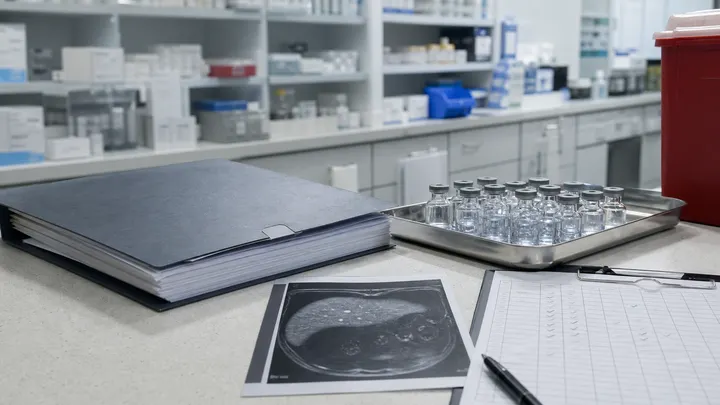
Hepcludex FDA Approval: What Bulevirtide Changes for Chronic Hepatitis D
FDA approval gives chronic hepatitis D a US treatment pathway. The harder question is whether evidence, diagnosis, price and payer access can catch up.
Read the briefing →Frontier 05 / Biotech
Vastkind follows tools, platforms, labs, data, and companies turning biology into a design, measurement, and production problem.
FDA approval gives chronic hepatitis D a US treatment pathway. The harder question is whether evidence, diagnosis, price and payer access can catch up.
Read the briefing →Start here
Biology is being pulled into computational and automated workflows.
Lab automation, measurement, translation, manufacturing, and clinical proof.
Any story that treats living systems like clean code.
Read now
Newest biotech stories on tools, platforms, translation, and proof.

A Lancet Oncology Commission turns cancer care into an infrastructure story: survival depends on people, diagnostics, equipment, and capacity.

Brain-computer interfaces are no longer only a lab miracle. They are becoming a new human interface layer, and that changes the stakes.

The miracle case is not enough. Personalized CRISPR now has to become medicine that can scale.

IVF is becoming more automated and data-driven, but the future of fertility will be shaped as much by access, ethics, and trust as by lab performance.
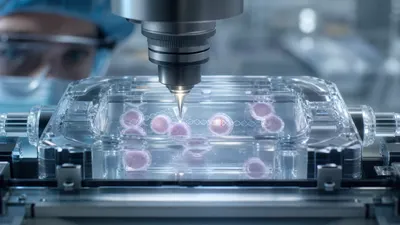
Prime editing has crossed from elegant theory into the clinic, but the hardest questions are still ahead.

The real microrobotics story is not tiny robots conquering the bloodstream. It is the discovery that narrow, controllable clinical environments can make the field finally useful.
Field note
A compact operating note for Biotech: what changed, what to watch, what to doubt, and where the constraint sits.
Discovery is becoming more computational, measured, and workflow-driven.
Systems that design, run, measure, and revise experiments faster.
AI can replace experiments.
Living systems often refuse simple engineering assumptions.
Corridors
Use these routes when a story crosses into neighboring fields, forces, or reading formats.
 Latest corridor story
Hepcludex FDA Approval: What Bulevirtide Changes for Chronic Hepatitis D
Latest corridor story
Personalized CRISPR Needs a Platform
Latest corridor story
Hepcludex FDA Approval: What Bulevirtide Changes for Chronic Hepatitis D
Latest corridor story
Personalized CRISPR Needs a Platform
Archive
Use the archive for retrieval; the map above carries the orientation.

The real biotech story is not that biology has become easy to rewrite. It is that design power is rising faster than delivery, scale, and governance can comfortably absorb.

A baby’s personalized CRISPR treatment shows what precision medicine can become. It also exposes the manufacturing, regulatory, and access problems medicine has not solved yet.

AlphaGenome is impressive, but the real bottleneck in AI genomics is still biological validation, not model ambition.