Prime editing has always carried a cleaner promise than older gene-editing narratives. Instead of cutting DNA and hoping the repair process behaves, it aims to make more precise sequence changes with less collateral damage.
That is why this first human proof point matters.
A patient with chronic granulomatous disease, or CGD, has now received a prime-editing therapy designed to repair a specific mutation in NCF1. Early signals suggest meaningful restoration of immune-cell function. That does not mean the field has solved gene editing. It does mean prime editing has moved from beautiful mechanism to clinical reality.
That is a serious threshold.
What Actually Happened
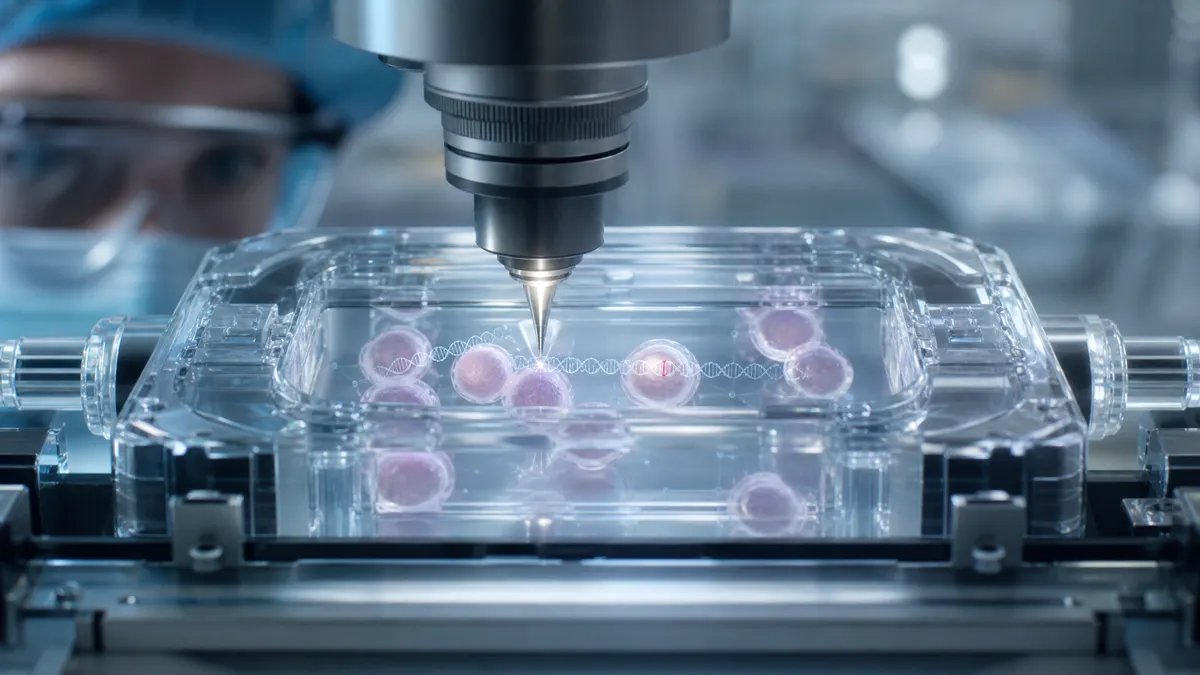
The therapy, PM359, edits a patient’s own blood stem cells outside the body and then reinfuses them after conditioning.
The target is a small but clinically devastating mutation in NCF1, a gene involved in the oxidative burst machinery that helps neutrophils kill pathogens. In p47phox CGD, that system breaks down, leaving patients vulnerable to serious infections and inflammatory complications.
The early reported signal is striking because it is functional, not merely molecular. If oxidase-positive neutrophils rise meaningfully and the effect holds, the therapy is not just changing sequence data on paper. It is restoring part of the immune system’s real-world behavior.
That is the kind of evidence that matters.
Why Prime Editing Feels Different
Prime editing is attractive because it promises a more precise kind of repair than double-strand-break CRISPR approaches.
The simplified version is this: instead of making a full cut in the DNA and relying heavily on the cell’s repair pathways, prime editing uses a Cas9 nickase fused to reverse transcriptase plus a guide RNA that helps write in the desired sequence change.
That matters for two reasons.
First, it expands the range of editable changes beyond what many base-editing systems can handle.
Second, it may reduce some risks associated with double-strand breaks, such as unwanted insertions, deletions, translocations, or larger structural changes.
May is the important word there. The theoretical safety advantage is part of the appeal. But theory is not a substitute for long-term human follow-up.
Why the NCF1 Case Is Technically Interesting
NCF1 is not an easy gene to work with. It sits in a tricky genomic neighborhood near highly similar pseudogenes.
That matters because homologous regions can complicate both diagnosis and editing. Even if prime editing avoids some of the hazards associated with more disruptive cutting approaches, this is still a place where careful surveillance matters.
In other words, prime editing did not choose an easy test case. It chose one that makes the precision story meaningful if it holds up.
That is partly why this early result feels important beyond CGD itself. If the platform can work in long-term repopulating blood stem cells against a difficult target, it lowers platform skepticism across the field.
What the Big Questions Still Are
Early success should not collapse into premature certainty. Several questions matter more than the headline.
1. Durability
Do the edited stem-cell populations persist and keep producing functional immune cells over years, not weeks?
A short-run signal can be exciting. A durable clinical effect is what turns a proof point into a therapeutic class.
2. Safety
This includes not just immediate adverse events but long-term genomic integrity. Researchers need to know whether off-target effects, structural variants, or unexpected clonal behavior emerge over time.
The absence of alarming early safety signals is encouraging. It is not the endpoint.
3. Manufacturing and scale
Ex vivo gene editing is medically powerful and operationally difficult. Manufacturing robustness, conditioning burden, logistics, and cost all shape whether a therapy remains a heroic niche intervention or becomes something patients can realistically access.
4. Program continuity
This is the uncomfortable biotech reality: a clinically promising program can still slow down if capital, portfolio strategy, or partnerships move in another direction.
That gap between scientific momentum and corporate prioritization is one of the least glamorous but most important realities in advanced medicine.
Why This Matters Beyond One Disease
Prime editing’s first human proof matters because it tests a larger proposition: can precision repair become a safer, broader editing paradigm for diseases where sequence correction is cleaner than gene replacement or brute-force cutting?
If the answer starts becoming yes, the implications extend far beyond CGD.
That could affect rare genetic disease, hematology, inherited metabolic disorders, and eventually a much wider range of conditions where exact repair matters.
It also matters culturally. Gene editing has spent years oscillating between miracle language and safety anxiety. A credible prime-editing success could help rebuild the public imagination around gene medicine in a more disciplined way: less spectacle, more clinically legible repair.
The Access Problem Starts Early
The moral challenge appears long before a therapy becomes mainstream.
If precision gene-editing therapies work but remain expensive, logistically intense, and concentrated in elite centers, their social meaning changes. They stop being just medical advances and start becoming case studies in who gets frontier care first.
That is not a reason to dismiss the science. It is a reason to take the politics of access seriously from the beginning.
Why This Matters
Prime editing matters because it represents a new attempt to make gene medicine more precise, less destructive, and more clinically governable. This first human result does not close the argument. It opens it under real conditions. If durable immune restoration holds and long-term safety remains clean, prime editing could become one of the most important precision-medicine platforms of the next decade. If the biology works but the therapies remain financially or operationally narrow, the field will still face a harder question: who gets the benefits of exact repair when exact repair finally becomes possible?
That is the adult version of the breakthrough story.
CTA: Read next: ER-100 Glaucoma & NAION Trial: What’s Actually Being Tested