

If longevity is ever going to stop sounding like a subculture and start sounding like medicine, it will happen through articles like this one.
Not because ER-100 has already proved that human tissue can be rejuvenated. It has not.
But because this may be the first time one of longevity's boldest ideas has been pushed into a real human trial where safety, delivery, and functional outcomes matter more than mythology.
That is why the phrase "first human rejuvenation trial" is useful, but also dangerous.
Useful, because it marks a real threshold. Dangerous, because it invites people to imagine a broad anti-aging breakthrough when the actual story is much narrower, much more clinical, and much more credible.
ER-100 matters because it changes the burden of proof.
What ER-100 Is Actually Testing
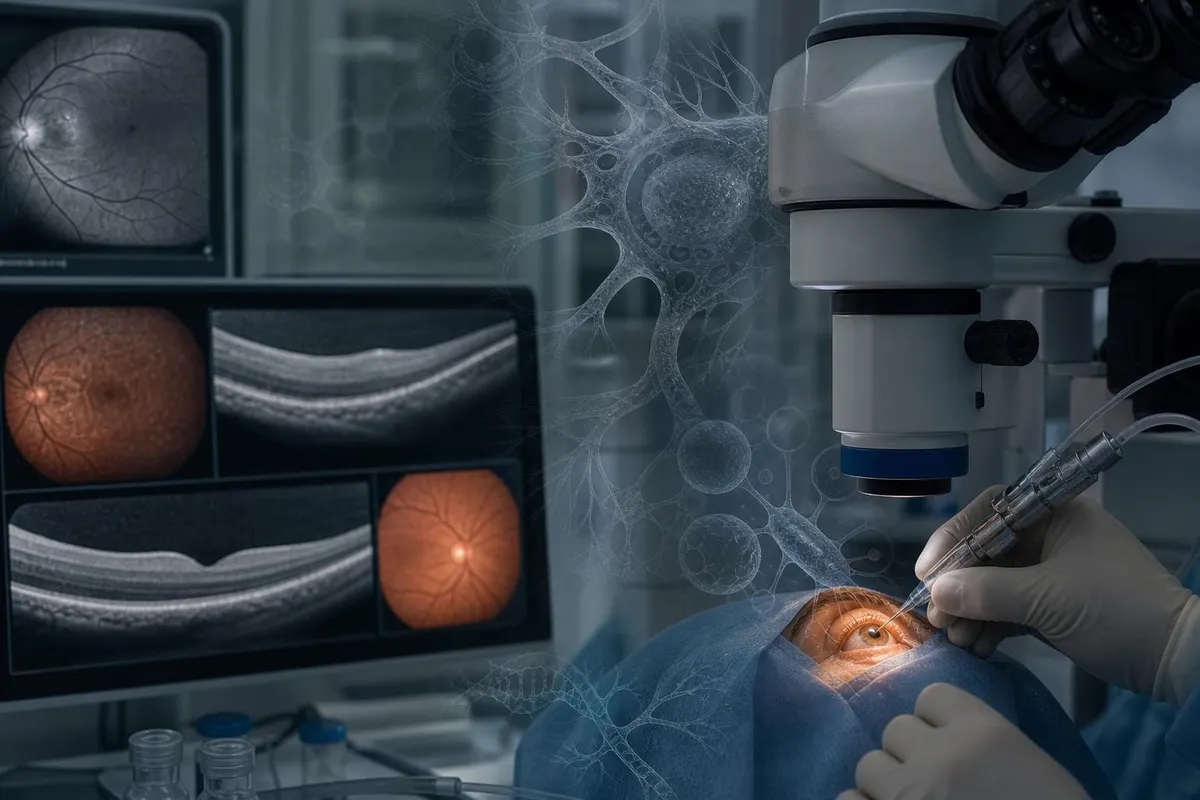
ER-100 is associated with a partial epigenetic reprogramming strategy being explored for optic neuropathies, including glaucoma and NAION.
That matters because the therapeutic claim is not "make people younger." The real question is whether carefully controlled reprogramming signals can help protect or restore function in damaged optic tissue.
That is a very different promise.
It is smaller. It is more disciplined. And it is exactly what gives the program significance.
For years, rejuvenation stories have lived in mouse papers, founder narratives, and speculative timelines. ER-100 pushes the field into a harsher environment where a therapy has to survive protocols, dose logic, clinical oversight, and the possibility of disappointing data.
That is not a side detail. That is the story.
Why the Eye Comes First
The eye is not a random first target. It is the most legible place for a high-risk regenerative idea to meet medicine.
There are three reasons.
- Delivery can be localized. That keeps exposure tighter than a whole-body intervention.
- Function can be measured. Vision and retinal structure offer unusually strong readouts compared with many other aging-related contexts.
- The medical need is obvious. Vision loss is not a vanity problem. It is a direct threat to independence, mobility, and daily life.
That combination makes ophthalmology a strategic entry point for reprogramming-based medicine.
It also reveals something bigger about the future of longevity biotech.
If the field succeeds, it probably will not begin with a universal anti-aging product. It will begin with bounded, disease-first interventions in tissues where the biology can be constrained and the outcomes can be measured honestly.
That is slower than the fantasy version of longevity.
It is also how real medicine gets built.
Why "Rejuvenation" Is Both Right and Misleading
The word rejuvenation is doing a lot of work here.
In one sense, it is fair. Partial reprogramming exists because researchers believe some forms of age-linked cellular decline may be more reversible than medicine once assumed. That is why the concept attracts so much attention.
But the word also misleads if it makes people picture a generalized rollback of human aging.
An early ocular gene-therapy trial is not proof that a human body can be reset like software. It is a tightly bounded attempt to see whether a regenerative logic can preserve or improve function in one clinically tractable setting.
That distinction matters because the public story around longevity is still too vulnerable to category errors.
A tissue-specific repair signal is not the same thing as whole-body age reversal. A first-in-human study is not the same thing as validated rejuvenation. A plausible mechanism is not the same thing as repeatable medical benefit.
If we do not keep those distinctions clean, the entire category becomes easier to oversell and easier to discredit.
What an Early Trial Can Actually Prove
This is where most coverage gets sloppy.
A first human trial is not meant to settle the whole argument. It is meant to narrow uncertainty.
The important questions are more operational than romantic:
- is the therapy tolerable?
- can delivery be controlled?
- are there obvious safety flags?
- is there any hint of functional benefit?
- does the effect appear durable enough to justify further development?
Those are modest questions only if you misunderstand how hard translation is.
In reality, they are the gate between elegant theory and clinically serious medicine.
If ER-100 shows a clean safety profile with even directional evidence that optic function can be preserved or improved, that would be a very meaningful result. Not because it proves rejuvenation is solved, but because it would show that reprogramming may be governable inside real therapeutic development.
That is a much more important milestone than a louder headline.
The Real Shift: Longevity Has to Accept Adult Standards
The biggest thing ER-100 changes is cultural.
Longevity has spent years living on stories that were emotionally powerful and scientifically suggestive, but still protected from the humiliation of medicine.
Medicine humiliates every ambitious field eventually.
It asks for:
- controlled dosing
- monitored safety
- endpoint discipline
- reproducibility
- a clear benefit story that survives outside the lab
That is the pressure ER-100 brings into focus.
If the trial goes well, the field gains more than one promising program. It gains credibility for the idea that at least some rejuvenation logic can cross into regulated medicine.
If it goes badly, the loss will also be larger than one company. It will reinforce the belief that reprogramming is conceptually seductive but clinically unstable.
Either way, the field is now entering a phase where it has to earn belief the hard way.
That is healthy.
What to Watch Next
The smartest way to follow this story is to ignore the biggest claims and watch the smallest concrete signals.
Watch for:
- trial-registry detail and endpoint clarity
- enrollment and dose-escalation progress
- safety language and any pauses or protocol changes
- whether functional benefit appears durable rather than noisy
- whether management and observers describe the study with increasing precision or increasing vagueness
In frontier biotech, vague language is often a warning.
Precision is usually a better sign than excitement.
Why This Matters
ER-100 matters because it is one of the first real chances to see whether rejuvenation can become medicine without collapsing into fantasy. If partial reprogramming can safely protect or restore optic function, the implications reach beyond ophthalmology into the larger question of whether age-linked damage can be repaired in bounded, clinically credible ways. But this also raises the harder issues that every serious therapy eventually faces: long-term safety, trust, access, and who gets the first real gains. The stakes are not just about living longer. The stakes are about whether longevity becomes a public medical frontier or stays a private dream.
Conclusion
The first human rejuvenation trial does not mean rejuvenation has arrived.
It means the field has run out of excuses.
From here on, the story gets better and harsher at the same time. Better, because we finally get real evidence. Harsher, because many ideas that sounded profound in theory will now have to tolerate dosing, risk, and outcome data.
That is exactly what should happen.
ER-100 matters because it is not asking the public for wonder. It is asking medicine for permission.
CTA: Read next: Partial Reprogramming OSK vs OSKM: Why the Whole Trick Is Control
Evidence boundary
ER-100 matters because it moves part of the rejuvenation conversation into human testing. That does not mean broad human rejuvenation has been proven.
The trial should be read through its actual endpoints, safety design, target population, and follow-up period. A first human trial can be important without answering the largest longevity claims.
Read next: For the broader evidence frame, start with Vastkind's Longevity hub, then read what longevity science can prove, why rapamycin still needs human proof, and why measurement is still the bottleneck.
