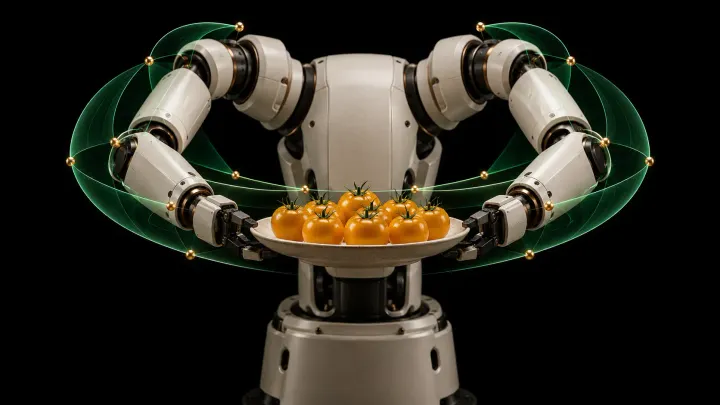
For years, artificial intelligence has mostly lived on screens.
It writes, predicts, generates, summarizes and reasons inside machines we never see move. Its failures are often cheap enough to refresh, rerun or ignore.
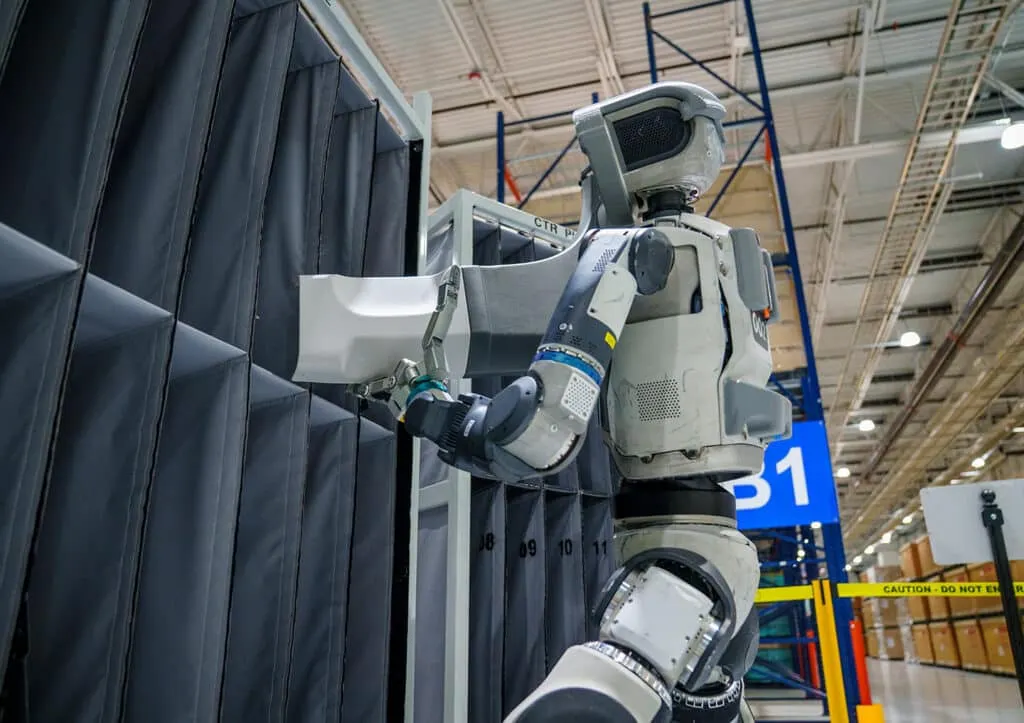
Boston Dynamics' Atlas points to a different frontier: intelligence that has to stand up, balance, lift, recover, swap batteries, connect to factory systems and keep working when the physical world pushes back.
That is why Atlas matters.
Not because one humanoid robot proves artificial general intelligence. It does not. The public evidence does not support that claim.
Atlas matters because it shows what AI looks like when it starts leaving the screen and entering the factory floor.
Atlas matters because AI is trying to become physical
Boston Dynamics is not presenting Atlas as a lab curiosity anymore.
On January 5, 2026, the company announced the product version of its fully electric humanoid robot and said it would begin manufacturing immediately. The first 2026 deployments are scheduled for Hyundai's Robotics Metaplant Application Center and Google DeepMind, with additional customers planned for early 2027.
That changes the mood of the story.
Atlas is no longer only a famous robot from viral videos. Boston Dynamics is positioning it as an enterprise humanoid for industrial work: material handling, order fulfillment, automotive-sector tasks and workflow integration through its Orbit software.
The details are what make the announcement interesting. Boston Dynamics says Atlas can lift up to 50 kg, has 56 degrees of freedom, can work autonomously with minimal supervision, can navigate to a charging station, swap its own battery and return to work. The company also says a task learned by one Atlas can be replicated across the fleet.
That last point is easy to glide past. It should not be.
If it works, the product is not just a humanoid body. It is a way to turn factory tasks into learned, transferable behavior across machines.
That is the real AI story.
The factory is a much harder benchmark than a robot demo
Robot demos are built to be watched. Factories are built to punish weakness.
A demo can hide resets, narrow setup conditions, remote help, failed takes and favorable object choices. A factory has different rules. The machine has to fit into throughput, shift timing, safety practices, maintenance schedules, inventory systems, work instructions and the boring economics of whether it creates more value than friction.
This is why Atlas is exciting without needing mystical language.
The factory floor is one of the first places where physical AI can be tested against reality at industrial speed.
In a January 2026 interview, Business Insider reported Boston Dynamics CEO Robert Playter saying Atlas would need to learn a new task within 48 hours before deployment and that factory usefulness would require roughly 99.9 percent reliability. The first target is parts sequencing, with more complex assembly work later.
Those numbers are not decoration. They define the difference between a thrilling machine and an industrial one.
A robot that can do something once is a video. A robot that can learn a new work process quickly, repeat it, recover from interruptions and stay inside the reliability envelope of a factory becomes part of operations.
That is where the future gets serious.
Gemini Robotics changes the question from motion to behavior
Boston Dynamics already knows how to make robots move in ways that look impossible.
The missing layer is broader behavior: seeing the work, understanding instructions, planning actions, handling variation, using tools, interacting with people and adjusting when conditions change.
That is why the Google DeepMind partnership matters.
Boston Dynamics and Google DeepMind said on January 5, 2026 that they are working to integrate Gemini Robotics foundation models with Atlas. The stated aim is to combine Boston Dynamics' physical capability with DeepMind's robot AI models, beginning with manufacturing and automotive work.
Google DeepMind describes Gemini Robotics as a family of models for embodied AI: systems that can perceive, reason, use tools and interact with humans in physical environments. Its product page describes vision-language-action models, embodied reasoning, multi-step task planning, dexterity, interactivity and transfer across multiple robot forms.
That is the part that moves the story beyond another humanoid launch.
The central question is no longer only whether Atlas can move like a capable machine. Boston Dynamics has been proving motion for decades.
The question is whether a model-driven robot can turn perception, language, planning and motor control into reliable work.
That is a much harder threshold.
It is also why the factory is such a powerful testbed. A warehouse or automotive plant does not reward a robot for seeming intelligent. It rewards the system for moving the right part, at the right time, into the right process, without creating a safety incident or a maintenance headache.
The real breakthrough would be fleet learning, not one impressive robot
The most important commercial claim around Atlas may be fleet replication.
Boston Dynamics says that once one Atlas learns a new skill, that task can be deployed across an entire Atlas fleet. If that becomes dependable, the economics of humanoid robotics change.
The customer is no longer buying a single clever machine. The customer is buying an operating layer for physical work.
That layer includes the robot body, the AI model, the task-development process, the battery and maintenance system, the factory software connection, the safety envelope, the deployment workflow and the metrics that show whether the robot is actually useful.
This is why Atlas belongs next to the wider shift in robotics foundation models. Vastkind has covered how NVIDIA's Isaac GR00T is really about building the robotics stack, not just releasing another model name. The same logic applies here. Hardware matters. Model capability matters. But the commercial prize is the stack that turns learned behavior into reliable physical labor.
There is a labor story inside this too.
Humanoid robots will not first change work by replacing every job with a cinematic machine. They will enter where tasks are repetitive enough to measure, physically demanding enough to automate, and variable enough that traditional fixed automation has limits.
Parts sequencing is a perfect early example. It is not glamorous. That is why it matters.
The future of physical AI will probably arrive through boring tasks that turn out to be economically important.
The evidence boundary matters, but it should not kill the excitement
There is a weak way to be excited about Atlas, and a strong way.
The weak version says Atlas is showing signs of general intelligence. That overreaches. Public sources do not prove that Atlas has general intelligence, broad autonomy in a live factory, or reliable performance across a large range of unstructured industrial tasks.
The strong version is better.
Atlas shows that serious robotics companies and frontier AI labs are now treating embodied intelligence as an industrial problem, not only a research spectacle.
That is a real shift.
It means future AI progress may not be judged only by benchmarks, chat windows or synthetic reasoning tests. It may also be judged by whether a machine can work through a shift, handle physical variation, recover from mistakes, explain its actions, avoid hurting people and integrate with systems of record.
That is more exciting than another screen-based model upgrade.
It is also more demanding.
When AI has a body, mistakes have weight. A bad answer in a chatbot can be corrected. A bad grasp can drop a part. A bad plan can block a workflow. A bad safety decision can injure a person. A brittle deployment can waste capital and erode trust.
This is why physical AI will require a different kind of confidence than software AI. It has to earn trust through operation.
Why This Matters
Atlas matters because it turns the AI conversation toward the physical world.
For the last several years, the frontier has been dominated by systems that manipulate language, images, code and digital workflows. That is already powerful. But the world is not only made of text and pixels. It is made of parts, floors, shelves, tools, batteries, doors, bins, humans, maintenance schedules and work that has to happen on time.
If models like Gemini Robotics can help robots generalize across tasks and if platforms like Atlas can survive industrial reality, AI starts to become a labor and infrastructure technology, not just an information technology.
That does not mean humanoid robots are about to flood factories overnight.
It means the test has changed.
The question is no longer whether a robot can look impressive onstage. The question is whether AI can become useful in a body.
That is the frontier Atlas makes visible.
Not robot AGI.
Physical AI.
And the first place it has to prove itself is not in science fiction.
It is on the factory floor.
Read next: Large Behavior Models Matter Because They Could Change Robotics' Real Bottleneck and Humanoid Robots Are Entering the Uptime Race.