

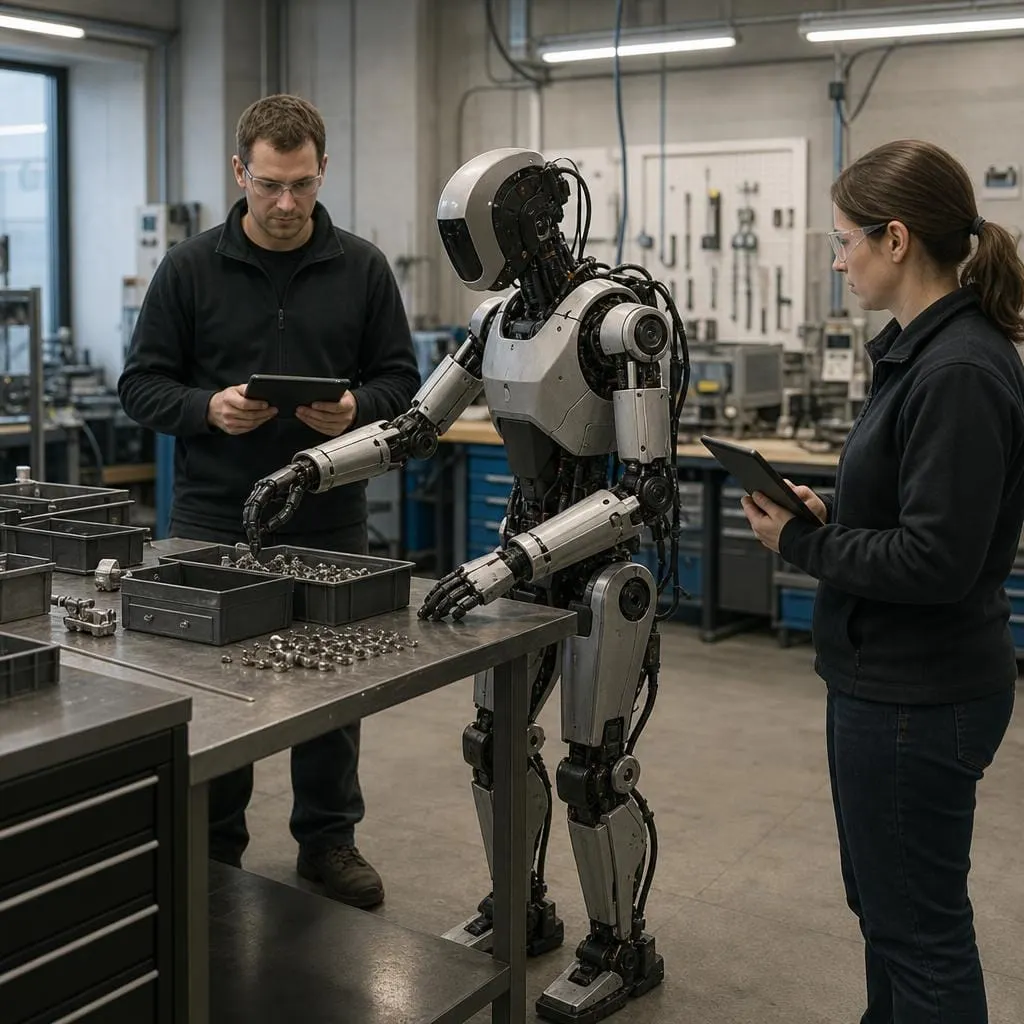
The easiest way to misread a large behavior model is to focus on the phrase “one brain.”
It sounds cinematic. It sounds like the robot is becoming a creature.
That is not the important part.
The important part is that robotics may be shifting from handcrafted controller stitching toward learned behavior systems that coordinate locomotion and manipulation in one policy.
If that shift is real, the bottleneck changes.
The field becomes less about endlessly gluing specialized subsystems together and more about data quality, transfer, evaluation, recovery behavior, and safety under physical constraint.
That is why Atlas’s large behavior model matters.
Not because the demo looks futuristic, but because it hints at a different operating model for robotics.
What Atlas actually demonstrated
The real technical claim is not just that Atlas walked and grasped in the same demo.
It is that a single language-conditioned policy handled coordinated whole-body behavior across actions that would previously have been more likely to live in separate stacks or heavily hand-integrated systems.
That matters because locomotion and manipulation are where robotics tends to reveal its fragmentation. It is one thing to make a robot balance. It is another to make it manipulate. It is another to keep the full body coherent while the task unfolds, the environment shifts, and the robot has to recover gracefully.
A unified behavior model suggests that at least some of this coordination can be learned at the behavior level rather than composed from a brittle chain of bespoke controllers.
That is a real step.
But it only becomes strategically important if the policy keeps working outside the most flattering slices of the demo space.
Unified policy changes what the hard part of robotics looks like
For years, one of the exhausting realities of robotics has been integration burden.
A robot can have decent perception, decent motion control, decent manipulation, and still fail because the handoffs between those pieces are fragile, overfit, or expensive to maintain.
That is why a whole-body behavior model matters more than its headline aesthetic.
If a shared policy can coordinate body parts and task intent in a unified action space, then adding new behavior may start looking less like controller surgery and more like improving data, fine-tuning recovery, widening the evaluation set, and tightening the sim-to-real loop.
That is a different discipline.
It does not make robotics easy.
It makes the bottleneck move.
Data and evaluation now become the real moat
This is the part people consistently underrate.
Once behavior is learned more end to end, the strategic advantage shifts toward who can gather better demonstrations, curate failure cases, close the loop between deployment and retraining, and evaluate transfer honestly.
That means teleoperation, simulation quality, data curation, annotation standards, rollout logging, and recovery metrics start mattering at least as much as elegant architecture diagrams.
The most interesting detail in the Atlas story may not be the model size or the language conditioning.
It may be that recovery improved by adding failure demonstrations and retraining rather than rewriting a handcrafted stack.
That is a clue about where robotics is going.
If more capability comes from the data flywheel, then robotics starts to resemble a behavior refinery.
That also means claims of generality need more discipline. A good demo is not enough. The real question is whether the model transfers across tasks, scenes, objects, grasp conditions, and disturbances with reliability that holds up under repeated evaluation.
For the broader robotics stack view, see Isaac GR00T: Why NVIDIA Is Building the Stack, Not Just the Robot Model and Optimus on Ice: Tesla's Humanoid Robot Hits a Wall in 2025.
The open problem is not whether unified behavior is cool. It is whether it is dependable.
This is where the physical world becomes merciless.
A robot policy can look general until it meets variation in surfaces, object friction, occlusion, timing pressure, minor collisions, human co-presence, limited onboard compute, or the thousand tiny uncertainties that make real environments expensive.
That is why recovery, transfer, and robustness matter more than the phrase “foundation model for robots.”
A unified policy is not valuable because it sounds elegant.
It is valuable if it reduces integration burden without creating new layers of opaque failure.
And the safety problem gets harder, not easier, when behavior becomes learned, distributed, and less legible in module-by-module terms. Once the robot’s competence is shaped by large-scale behavior learning, certification and operational trust have to lean more heavily on evaluation, logs, bounded deployment, and measurable reliability.
This is another version of the same wider pattern we keep seeing in AI systems: capability becomes more fluid, and governance has to move closer to the operating layer.
The real signal is that robotics is becoming a systems-and-data contest
The deeper takeaway is not about Atlas alone.
It is that robotics may be entering a phase where the winners are less defined by isolated mechanical cleverness and more by who can build the strongest behavior stack: shared policy design, real-world data loops, sim-to-real discipline, on-robot compute, failure recovery, and safety constraints that survive deployment.
That would be a major change.
It means progress will come less from a robot doing one impressive trick and more from a platform learning coherent behavior across many tasks without collapsing under variability.
That is a much tougher standard.
It is also the one that matters.
Why This Matters
Large behavior models matter because they could change what robotics progress depends on. If locomotion and manipulation can increasingly be coordinated by a shared policy, then the real constraint shifts from controller stitching to data quality, evaluation rigor, recovery performance, and safety discipline. That is powerful because it may accelerate capability. It is also risky because learned whole-body behavior is harder to certify and easier to overclaim. The future of humanoids will be decided less by demos than by whether unified behavior survives the mess of reality.
Conclusion
The large behavior model story is not that Atlas now has a single robot brain.
That framing is too cute.
The real story is that robotics may be moving toward a different bottleneck.
If unified policies keep improving, then the hard part becomes less about stitching controllers and more about building behavior systems that can transfer, recover, and stay reliable in physical environments that do not care about demo polish.
That is where the field gets serious.
Because once the body is controlled through learned behavior, the question is no longer whether the robot can look impressive.
It is whether the behavior stack can survive reality.
CTA: Read next: Optimus on Ice: Tesla's Humanoid Robot Hits a Wall in 2025 and Isaac GR00T: Why NVIDIA Is Building the Stack, Not Just the Robot Model
