

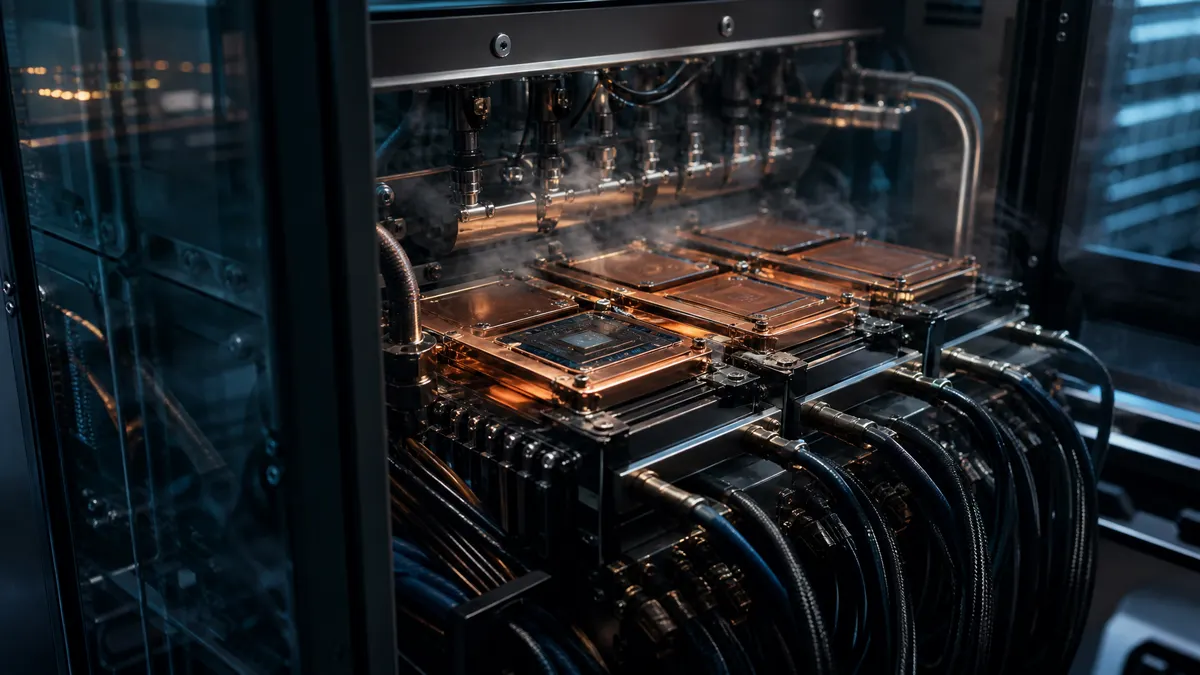
AI has a scaling problem that no benchmark chart can hide forever: power.
Models keep getting larger, inference demand keeps compounding, and the physical cost of moving bits is starting to matter as much as the logic doing the math. That is why Extropic is interesting. Not because it promises another incremental AI chip gain, but because it is betting that the next big efficiency jump may come from a different compute primitive altogether.
Its idea is simple to describe and hard to build: if modern AI workloads depend heavily on sampling, why keep forcing conventional chips to approximate that work through large digital pipelines that burn energy along the way? Why not build hardware whose native behavior is probabilistic sampling in the first place?
That is the wager behind Extropic’s thermodynamic sampling units, or TSUs. The promise is not “GPUs are over.” The promise is narrower and more serious: for some classes of generative and uncertainty-heavy workloads, thermodynamic chips might eventually produce useful outputs with radically lower energy cost.
If that holds up, this is not just a chip story. It is an AI infrastructure story.
Why Extropic matters now
The timing is not random.
AI is moving into a phase where the constraint is increasingly physical. Training still matters, but inference, deployment scale, and continuous usage are becoming the harder economic problem. That means the important question is no longer just how capable a system is. It is how expensive it is to run, how much energy it pulls, and whether the surrounding infrastructure can carry the load.
That broader pressure already shows up across the stack. If you have read our pieces on AI data center power, high bandwidth memory, or AI chip sales, the pattern is obvious: AI progress is no longer just a software race. It is a power, cooling, supply-chain, and infrastructure race.
That is the context Extropic is trying to exploit.
Its thesis is that the field has spent years optimizing around dense digital arithmetic because GPUs became the default engine of AI progress. But if some important workloads are fundamentally probabilistic, then brute-forcing them through matrix-heavy hardware may not stay economically elegant forever.
That does not make Extropic right. It does make the bet legible.
What Extropic is actually building
Extropic is building probabilistic computing hardware.
Its thermodynamic sampling units are designed to sample from probability distributions directly in silicon by exploiting controlled physical noise inside transistor-based circuits. Instead of running a large digital pipeline that computes probabilities and then samples from them afterward, the sampling behavior is meant to happen as a native hardware operation.
That matters because generative AI, Bayesian inference, Monte Carlo methods, and many uncertainty-heavy workloads all revolve around sampling in one form or another. The company’s argument is that if sampling is central to the computation, then the underlying hardware should stop treating it like an afterthought.
The basic building blocks in Extropic’s first-generation public framing include cells such as:
- p-bits for Bernoulli-style sampling
- p-dits for categorical sampling
- p-modes for Gaussian sampling
- p-MoGs for mixtures of Gaussians
These cells interact locally, update according to tunable probability laws, and form larger graphs that can sample from energy-based models.
That is the conceptual leap: the chip is not mainly a giant deterministic arithmetic engine. It is a programmable sampling fabric.
Why thermodynamic chips could matter more than another faster GPU
The appeal here is not novelty theater. It is energy economics.
On modern accelerators, a lot of power is not spent on the arithmetic itself. It is spent moving data around. Wires, memory traffic, synchronization, and system overhead all add up. That is one reason AI energy has become such a serious topic: scale does not just multiply capability, it multiplies physical cost.
Extropic’s answer is locality.
If state and computation live close together, if updates happen through local couplings, and if randomness is generated in the same physical substrate doing the sampling, then some of the usual digital overhead can in principle shrink. That is the heart of the efficiency story.
The company’s architectural argument is paired with an algorithmic one. Extropic is not only proposing unusual hardware. It is also proposing a matching stack around denoising thermodynamic models and a denoising thermodynamic computer architecture. In plain language, it is trying to co-design the model family and the chip, rather than forcing a strange chip to imitate a GPU world.
That is important. Special hardware usually dies when the software stack feels bolted on. Co-design is the only serious version of this bet.
Can this really beat GPUs?
This is where the article needs restraint.
Extropic has pointed to system-level analysis suggesting that TSU-like hardware could, on small generative benchmarks, reach comparable quality with dramatically lower energy per sample than a GPU baseline. The headline number is striking, and that is exactly why it should be handled carefully.
Right now, the strongest honest version of the claim is this:
- the mechanism is intellectually coherent
- the early architecture-story hangs together
- prototype-level evidence is interesting
- end-to-end proof at meaningful scale is still missing
That last line matters most.
There is a big distance between an elegant technical narrative and a production-relevant platform. The challenge is not just whether a p-bit flips efficiently in a prototype. The challenge is whether the full system works under real constraints: host orchestration, synchronization, off-chip I/O, mapping complexity, drift, error handling, and workload breadth.
So the right question is not “Did Extropic kill GPUs?” That is unserious.
The right question is whether thermodynamic chips can win meaningful territory where sampling is so central, and energy pressure so real, that the old hardware stack starts to look wasteful.
Where TSUs could win first
If Extropic works, it probably does not win first by replacing general-purpose AI acceleration everywhere.
It wins first where the workload already wants what the hardware naturally does.
That likely means areas such as:
- generative image or video pipelines where sample economics matter
- Bayesian inference and uncertainty-heavy systems
- Monte Carlo and simulation-heavy technical workloads
- scientific or engineering loops where ensembles and probabilistic exploration are core behavior
- hybrid systems where GPUs still handle dense math while TSUs take on sampling-intensive inner loops
This is the part many AI hardware stories miss. New compute platforms do not need to dominate everything to matter. They need to dominate something expensive enough to create adoption pressure.
That is also why Extropic is more interesting as a heterogeneous-compute story than as a revolution headline. A future where different chips specialize around different inner loops is much more plausible than a neat one-chip replacement narrative.
What is real already, and what is still unproven
The real part:
- Extropic has articulated a clear hardware thesis.
- It has a public conceptual stack rather than vague hand-waving.
- It has shown prototype and roadmap discipline through X0, XTR-0, and the planned Z1 path.
- It has released supporting software and documentation that at least make external scrutiny possible.
The unproven part:
- whether the system-level energy gains survive contact with full deployment overhead
- whether compiler and mapping complexity become a bottleneck
- whether the architecture scales beyond small benchmark conditions
- whether the real commercial wins arrive in the workloads the market actually pays for first
- whether third-party measurement confirms the dramatic efficiency story
That last point is decisive.
Until independent validation arrives on larger hardware, this remains a serious but still speculative infrastructure bet.
What this means for AI infrastructure
If Extropic is even partially right, the cultural meaning is bigger than the company itself.
It would suggest that the AI hardware future is not just about making the existing recipe larger, denser, and more power-hungry. It would suggest that part of the next cycle may come from rethinking the primitive itself.
That matters because AI now collides with the real world much faster than it used to.
Power availability matters. Cooling matters. Interconnects matter. Grid stress matters. Capital intensity matters.
Once those constraints become central, hardware innovation stops being a side story to model progress. It becomes one of the main stories.
That is also why Extropic fits a larger Vastkind pattern. The future of AI will not be decided only by which model sounds smartest in a demo. It will be decided by which systems can scale physically, economically, and institutionally without breaking the environments that support them.
Why This Matters
Extropic matters because it points toward a harder truth about AI: the next bottleneck may be energy and infrastructure more than intelligence alone. If thermodynamic chips can make sampling-heavy workloads dramatically more efficient, they could change not just chip design, but the economics of generative systems, scientific computing, and large-scale AI deployment. If they fail, that failure still teaches something important: brute-force AI scaling is running into physical limits that the industry can no longer treat as background noise. Either way, this is a story about what kind of infrastructure the AI era will demand.
Conclusion: this is a real bet, not yet a proven one
Extropic is worth taking seriously for one reason above all: it is trying to solve the right problem.
The company is not pretending that better branding solves AI’s energy problem. It is asking whether the hardware itself should be rebuilt around the actual probabilistic character of important workloads. That is a real question, and the field needs more of those.
But seriousness cuts both ways.
Until Z1-class hardware or comparable independent validation proves the end-to-end case, this remains an ambitious claim, not a settled breakthrough. The burden now is measurement, not mythology.
That is exactly where the story gets interesting.
CTA: Read next: AI Data Center Power: Fusion, Geothermal, SMRs—Who Wins the Race?
Read next: For the physical AI infrastructure layer, see Vastkind's Compute hub, Vastkind's Energy hub, why intelligence that burns too much compute does not scale, and why AI power supply is becoming part of the race.
