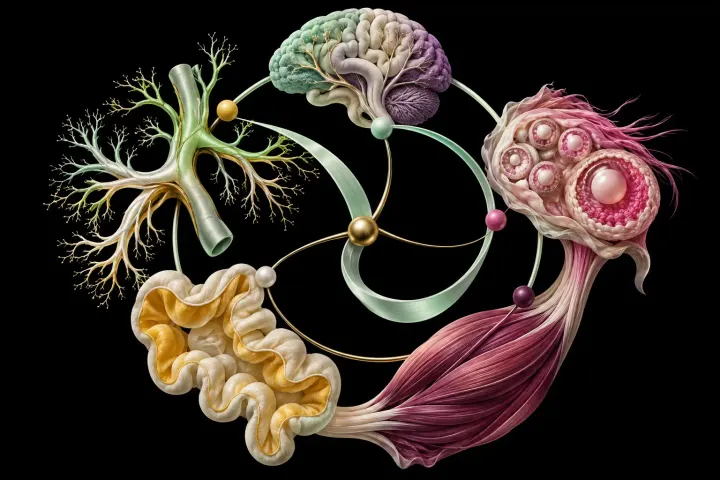
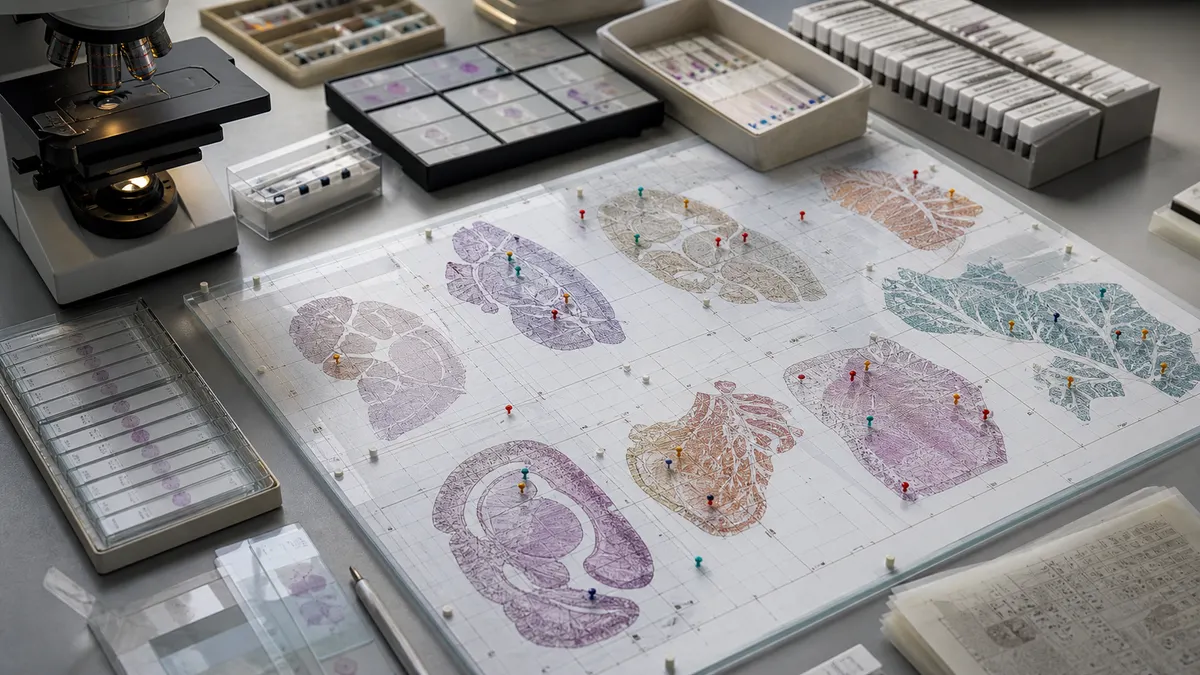
The National Institutes of Health said on June 11, 2026, that its Cellular Senescence Network has reached a major atlas-building milestone: a new framework for cataloging senescent cells across the human body.
The tempting headline is that scientists are getting closer to anti-aging treatments. The more useful reading is stricter. The Human Senescence Atlas turns one of longevity biology's loudest ideas into a location problem, a classification problem, and a measurement problem.
That matters because cellular senescence has often been discussed as if it were one thing. A cell stops dividing, remains metabolically active, releases signals, and may contribute to inflammation, tissue dysfunction, or age-related disease. But inside a living human body, senescent cells are rare, diverse, and embedded in specific tissue environments. Treating them as one generic enemy was always too simple.
SenNet is trying to replace that simplification with coordinates.
What the Human Senescence Atlas actually changes
The Human Senescence Atlas is not a consumer test, a treatment, or proof that aging can now be reversed. It is a research infrastructure project.
The NIH Common Fund launched SenNet in 2021 to identify and characterize senescent cells across the body, across health states, and across the lifespan. The program combines Tissue Mapping Centers, technology-development projects, and a data coordinating center. Its job is not only to find senescent cells, but to make their detection, classification, and data sharing more reproducible.
The June 2026 milestone is important because the consortium is now presenting the first comprehensive atlas framework for senescent cells across human tissues, anchored by the Cell commentary "Charting Human Cellular Senescence in Aging and Disease". NIH describes maps across areas such as the brain prefrontal cortex, lungs, and lymph nodes, plus new computational tools, blood markers linked to aging-study outcomes, and single-cell, spatial-omics, and AI-based methods for finding rare senescent cells inside complex tissue.
Yale School of Medicine framed the same milestone through the work of Rong Fan and collaborators across nine other institutions. The Yale account is especially useful because it names the key shift: SenNet is mapping senescence at single-cell and spatial resolution, and the data show that senescence is not a single state.
That is the article. Not "aging solved." Not "zombie cells conquered." A biological category that used to be easy to sloganize is being broken into tissue-specific, context-dependent maps.
For readers who follow longevity, this is the next layer after the basic evidence ladder. Vastkind's guide to what longevity science actually studies explains why mechanism is not the same as human proof. SenNet adds a prior step: before a mechanism can be tested cleanly, researchers need to know which cells, in which tissue, under which conditions, are actually being discussed.
Why senotypes matter more than "zombie cell" language
The public nickname for senescent cells, "zombie cells," is memorable and often misleading.
It suggests a simple villain. Find the bad cells, kill the bad cells, slow aging. But NIH's own summary is more complicated. In healthy tissues, senescent cells can support wound healing and help prevent tumor growth. With age, they may accumulate instead of being cleared by the immune system, releasing signals that contribute to chronic disease and tissue damage.
That dual role creates the real challenge. A cell state can be protective in one context and harmful in another. A treatment strategy that ignores that difference risks being biologically crude, even if the marketing sounds elegant.
SenNet's concept of "senotypes" is an attempt to make that difference visible. NIH describes senotypes as a classification system that groups senescent cells according to where they are found and the conditions around them. Yale's release says the broader collection reveals a spectrum of cellular profiles that vary by tissue and disease.
In plain English: a senescent cell in lung tissue may not mean the same thing as a senescent cell in a lymph node, brain tissue, skin, or liver. Its surrounding cells, immune environment, disease context, and molecular signals matter.
That shifts the field away from the fantasy of one universal aging switch. It points toward a harder model where researchers need tissue maps, local cell neighborhoods, biomarkers, and longitudinal validation before they can know which senescent states are useful targets.
The most mature version of longevity medicine will probably not start with the claim "remove senescent cells." It will start with narrower questions: which senotype, in which tissue, at which disease stage, in which patient group, measured against which outcome?
The measurement layer longevity science has been missing
Longevity has a measurement problem before it has a persuasion problem.
The field is full of plausible mechanisms: epigenetic clocks, inflammation, mitochondrial dysfunction, stem-cell exhaustion, senescent cells, metabolic pathways, immune aging, protein quality control. Some are scientifically serious. Some are commercially overused. The gap is often the same: showing that a marker or mechanism maps cleanly to meaningful human outcomes.
That is why the SenNet milestone has more leverage than a typical "new aging discovery" story. It is not simply adding another candidate intervention to the pile. It is building a measurement layer around one biological process that has been easy to oversell.
Spatial measurement matters because cells do not act in isolation. A senescent cell's effect depends partly on where it sits, what it secretes, which cells surround it, and whether the body is using that state for repair, defense, dysfunction, or chronic inflammation. Single-cell measurement matters because tissue averages can hide rare but important cell states. Shared classification matters because one lab's marker set cannot become a mature field if another lab cannot compare it cleanly.
That is also why this update belongs beside Vastkind's argument that the longevity industry has a measurement problem. The public longevity market often treats measurement as branding: biological-age scores, before-and-after claims, intervention dashboards, personalized protocols. SenNet uses measurement in the opposite direction. It makes claims harder by forcing them into coordinates, cell states, tissue context, and public data.
That will frustrate hype. It should.
Better maps do not make biology simple. They make the simplifications easier to catch.
Why This Matters
The practical consequence is not immediate treatment. It is a stricter path for future research.
For scientists, a human senescence atlas can help turn scattered markers into comparable evidence. If a study claims a therapy changes senescence, a stronger atlas gives researchers a better way to ask what changed, where it changed, and whether the change matches a known senotype or tissue pattern.
For drug developers, the atlas may eventually sharpen target selection. A company working on senolytics, immune aging, kidney disease, frailty, metabolic risk, or tissue repair needs more than a broad claim that senescent cells are bad. It needs to know which cell populations are harmful, which are protective, and which biomarkers might track a real biological effect.
For regulators and clinicians, the atlas could help separate meaningful endpoints from attractive but weak proxies. A biomarker that predicts disease risk in aging studies is interesting. It is not automatically a validated clinical endpoint. Tissue context and outcome validation still decide whether a measurement can support a treatment claim.
For the public, the atlas is a useful antidote to longevity theater. It shows what serious aging biology looks like when it moves away from lifestyle promises and toward shared infrastructure: tissue samples, data standards, computational tools, spatial maps, and uncomfortable uncertainty.
This does not make the story less exciting. It makes it more adult.
What remains unproven
SenNet's atlas framework is a foundation, not a verdict.
It does not prove that clearing senescent cells will extend healthy human life. It does not prove that any current senolytic is broadly effective for aging. It does not tell a person which supplement, drug, test, or protocol to use. It does not turn senescence into a single clinical target.
The unresolved questions are large.
Researchers still need to show whether atlas-defined senotypes predict outcomes across diverse human populations. They need to know whether blood markers can stand in for tissue-level processes. They need to test whether removing, modifying, or preserving certain senescent cells improves disease-relevant outcomes without disrupting useful repair or tumor-suppression functions.
The SenNet work also raises a translation problem. Public atlases can accelerate discovery, but clinical use depends on trial design, endpoint selection, safety, access to tissue data, and the ability to measure effects without overinterpreting proxies. A beautiful map can still be misused if commercial claims move faster than validation.
That boundary is especially important for senolytics. Vastkind's look at senolytics in humans made the same point from the treatment side: the field needs human proof, not just mechanistic appeal. SenNet strengthens the upstream research layer, but downstream trials still have to earn their claims.
The real signal
The Human Senescence Atlas is a sign that longevity science is becoming less magical and more infrastructural.
That is good news for the field and bad news for lazy narratives. If senescence is tissue-specific, context-dependent, and measurable only with careful tools, then the future of aging biology will not be decided by broad anti-aging language. It will be decided by maps, classifications, longitudinal studies, clinical endpoints, and the discipline to admit when a marker is not yet proof.
The strongest version of this story is not that humans are about to defeat aging. It is that aging research is being forced to become more precise before it is allowed to sound more confident.
Start with the Longevity hub for Vastkind's broader map of aging science, evidence boundaries, and claim checks.