
Senolytics became famous for a reason that should already make you suspicious.
They were sold to the public through a meme: zombie cells.
That phrase worked because it compressed something biologically real into something emotionally catchy. Senescent cells can contribute to tissue dysfunction, inflammation, and age-related decline. But once that story escaped the lab, it got flattened into a much dumber promise: remove the bad cells, get the youth back.
Medicine does not approve memes.
It approves data.
That is why UBX1325 matters.
Not because it proves senolytics have arrived, and not because it validates the broader longevity hype, but because it is one of the clearest cases where the senolytics story has been forced into something much more demanding than theory or mouse optimism: sham-controlled human evidence.
Why UBX1325 matters more than most senolytics stories
Most senolytics coverage lives in a comfortable zone of suggestion.
You get mechanistic excitement, animal data, biomarker talk, and broad philosophical claims about aging being treatable. What you usually do not get is disciplined clinical evidence in a real disease setting.
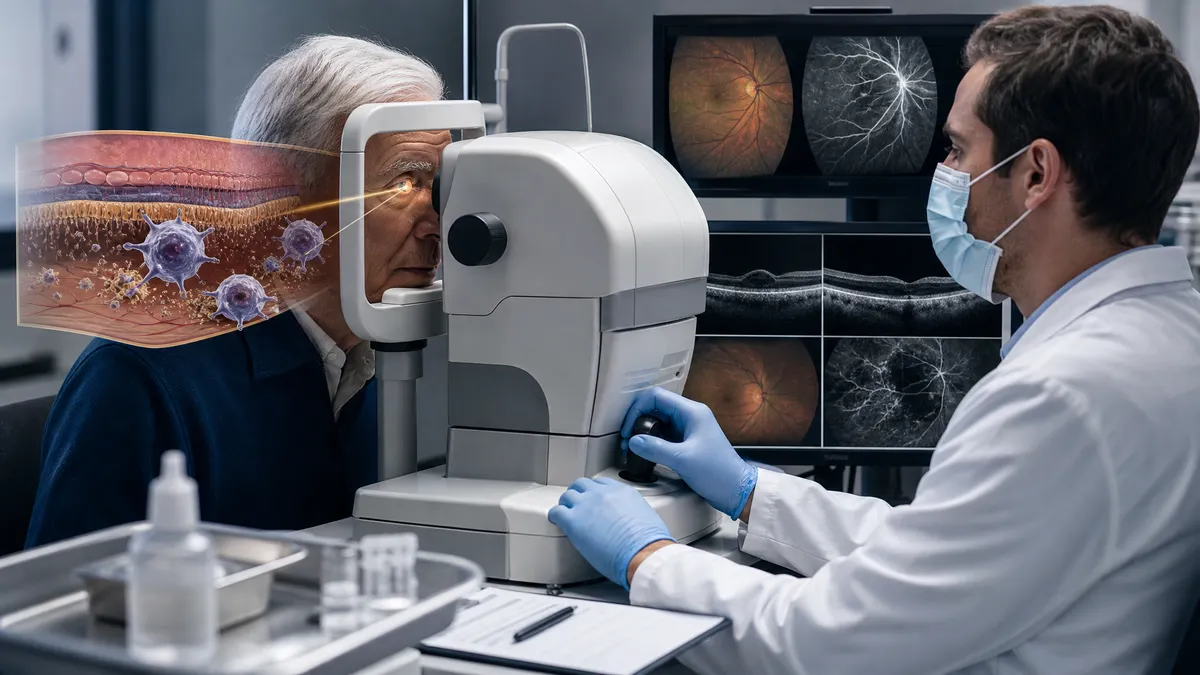
UBX1325 is different because it pushes the question into ophthalmology, specifically diabetic macular edema, where outcomes are measurable, delivery is localized, and the distance between theory and patient benefit becomes much harder to fake.
That is exactly the kind of setting geroscience needs.
If a supposed age-targeting intervention cannot survive serious testing in a constrained, observable medical context, then it has no business being inflated into a general anti-aging narrative.
The eye is not a side story here
Some people read retinal trials as somehow narrow or peripheral to the “real” longevity story.
That is backward.
The eye keeps appearing in age-related biotech for the same reason it appears in gene therapy, partial reprogramming, and other translational frontier fields: it offers controlled delivery, quantifiable endpoints, and a serious unmet-disease context without requiring whole-body exposure on day one.
In other words, the eye is where ambitious biology often has to grow up.
That makes it a very good place to test senolytics.
For related context, see ER-100 Glaucoma & NAION Trial: What’s Actually Being Tested and Partial Reprogramming OSK vs OSKM: Why “Partial” Is the Whole Trick.
What the current human data actually says
The clearest way to talk about UBX1325 is with restraint.
NEJM Evidence published phase 2 data evaluating UBX1325 in diabetic macular edema patients with prior suboptimal response to anti-VEGF treatment. Patients were randomized to receive either a single intravitreal dose of UBX1325 or sham and followed over time.
That design matters.
A sham-controlled setup is exactly the kind of filter this category needs, because longevity-adjacent medicine is unusually vulnerable to placebo-rich storytelling, selective interpretation, and investor-friendly overreach.
The signal so far is not “senolytics won.”
The signal is narrower:
- the therapy appears serious enough to test in a real clinical framework
- safety and tolerability matter at least as much as efficacy here
- any directional efficacy signal has to be interpreted as early and context-specific, not universal proof of the whole senolytics thesis
That may sound less exciting than the meme version.
Good. It is supposed to.
The biggest misunderstanding: senescence is not simply bad
This is the conceptual trap that keeps wrecking public understanding.
Senescence is not just biological trash waiting to be removed. It can also play roles in wound response, tissue remodeling, and tumor suppression depending on context.
That means the crude public slogan — clear senescent cells everywhere — is not a medical strategy. It is a marketing distortion.
This is why tissue specificity matters so much.
It is also why a senolytic succeeding in one disease context would still not justify a broad consumer leap into systemic anti-aging use. Biology does not reward that kind of simplification.
If anything, the clinical future of senolytics is likely to be narrower, more targeted, and more indication-specific than the longevity internet wants to admit.
What success would actually look like
A lot of people are still watching this field for a cinematic breakthrough moment.
That is probably the wrong mental model.
Success for senolytics would look more like this:
- one defined disease area shows credible benefit
- the safety profile remains acceptable under longer observation
- the mechanism holds up under more than one trial
- the treatment proves useful enough to matter clinically, not just statistically
- only after that does expansion into other indications begin to feel justified
That is not a glamorous path.
It is a medical path.
And frankly, geroscience needs more of that.
The field has spent years being narratively ahead of itself. What it needs now is not bigger claims. It needs harder filters.
Why this trial is culturally important beyond ophthalmology
UBX1325 matters beyond eye disease because it forces a collision between two very different cultures.
One is the culture of longevity enthusiasm, which loves first principles, master theories, and category-defining rhetoric.
The other is the culture of medicine, which is slower, narrower, and much less interested in philosophical beauty than in whether patients actually do better under controlled conditions.
That collision is healthy.
It reveals whether “aging biology” can produce not just compelling explanations, but interventions that survive contact with trial design, endpoint discipline, and regulatory seriousness.
That is the real threshold.
Not whether senolytics sound plausible. Whether they can act like medicine.
Why This Matters
UBX1325 matters because it is part of a larger reckoning for longevity science. The field cannot live forever on mice, metaphors, and mechanism slides. At some point, its therapies have to enter controlled human trials and tolerate the humiliation of real evidence. Senolytics are interesting precisely because they may become one of the first geroscience categories to either survive that transition or fail under it. That makes this a clinical story, but also a credibility story for the entire longevity movement.
Conclusion
The most important thing about UBX1325 is not that it confirms the senolytics dream.
It is that it tests it honestly.
That is more valuable.
If senolytics are going to matter, they will matter because they show repeatable benefit in defined human disease settings, not because the public enjoys the phrase zombie cells. UBX1325 is one of the clearest early examples of that process starting to happen.
So this is the right way to read the story:
not as proof, not as failure, but as a real clinical reality check.
And for geroscience, that may be exactly what progress looks like.
CTA: Read next: Longevity 2026: Why the Field Is Finally Facing Clinical Reality
Evidence boundary
Senolytics are biologically plausible, but human proof depends on disease-specific outcomes and safety, not on the label alone. Clearing senescent cells in a model system is not the same as improving healthy human aging.
The key test is whether a treatment produces a meaningful clinical benefit in the target population without creating risks that erase the upside.
Read next: For the wider evidence standard, start with Vastkind's Longevity hub, then read why measurement is still the bottleneck and why plausible biology still needs human proof.