

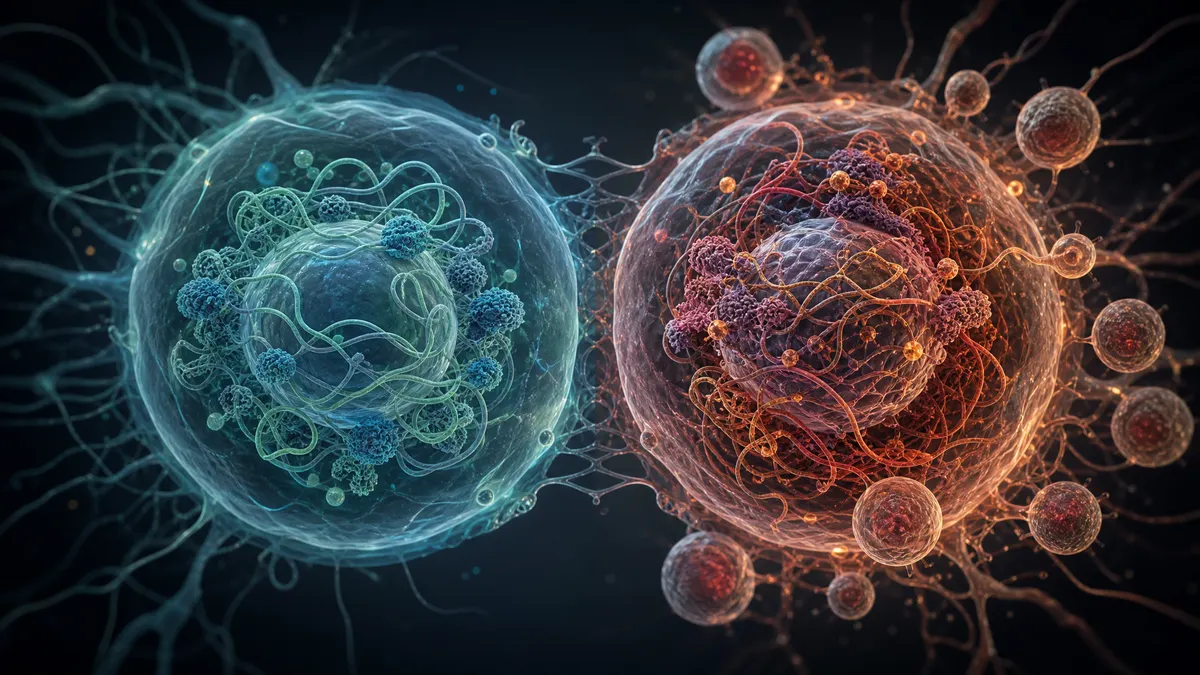
“Reprogramming” sounds like science fiction because the original Yamanaka-factor story more or less was. A small set of transcription factors appeared to push mature cells back toward pluripotency, reopening one of biology’s biggest questions: if cell identity can be reset, could age-linked decline be reset too?
That possibility is why longevity researchers keep returning to OSK and OSKM. But the real story is not just about whether cells can be pushed backward. It is about whether that push can be controlled tightly enough to preserve function without erasing identity.
That is where the argument between OSK and OSKM matters.
What OSK and OSKM Actually Mean
OSKM refers to the classic four Yamanaka factors: Oct4, Sox2, Klf4, and c-Myc. Together, they are highly effective at driving cells toward a more plastic, less differentiated state.
OSK removes one of those factors: c-Myc.
That subtraction sounds small. It is not. Myc is deeply tied to proliferation, cell-cycle pressure, and oncogenic risk. In practical terms, adding Myc can make reprogramming more efficient, but it can also make the whole system feel less like precision repair and more like a dangerous acceleration of biological instability.
So when longevity medicine talks about partial reprogramming, it often talks about OSK rather than OSKM because the field is not chasing maximum reset power. It is chasing the narrowest possible intervention that might restore function without tipping cells into chaos.
Why “Partial” Is the Whole Trick
The word partial is doing almost all the ethical and scientific work here.
A full reset would be catastrophic in living tissue. Your retina, liver, or heart does not need to forget what it is. It needs enough epigenetic restoration to recover function while remaining recognizably itself.
That is why partial reprogramming is not a softer version of the same idea. It is a fundamentally different therapeutic goal.
The tightrope looks like this:
- Too little change: no meaningful functional benefit
- Too much change: loss of cell identity, disorganized tissue behavior, or tumor risk
- Poorly controlled delivery: the right biology in the wrong place at the wrong intensity
This is also why many casual summaries of the field get the framing wrong. The challenge is not merely “can we reverse aging?” The challenge is whether we can create a repeatable control system for cell state.
Why OSKM Still Matters Even if OSK Is Safer
OSKM remains important because it shows what stronger reprogramming force can do. It is part of the original conceptual breakthrough, and in laboratory settings it can produce more dramatic identity shifts.
But the very thing that makes OSKM exciting in a dish makes it harder to imagine as a clean therapeutic platform in patients. Higher potency is not automatically better when the target is living tissue with long-term safety demands.
In medicine, a therapy does not win because it is the boldest. It wins because it can survive regulators, monitoring, dose control, and years of follow-up.
That is why the OSK approach carries so much translational weight. It feels closer to something that could be governed.
Why the Eye Is the Logical Starting Point
If partial reprogramming enters medicine, it will likely enter through contained, measurable tissues first. The eye makes sense for exactly that reason.
Localized delivery matters. Researchers can constrain exposure more tightly than they could in a systemic anti-aging intervention.
Measurement matters too. Vision is functionally important and clinically trackable. Imaging, structural readouts, and performance endpoints can reveal whether a therapy is helping, stalling decline, or causing harm.
And the urgency is real. Vision loss is not abstract. It strips independence quickly and visibly.
This is why ocular programs matter beyond ophthalmology. They are not just about saving sight. They are a test case for whether reprogramming can move from elegant biology into adult medicine.
What Success Would Actually Look Like
The internet version of this story usually imagines age reversal. The real clinical version is narrower and more important.
A serious early success would look like:
- acceptable safety and tolerability
- controlled delivery without major identity-related complications
- modest but real functional improvement or slowed decline
- durability strong enough to suggest mechanism rather than noise
That may sound less dramatic than the mythology around reprogramming. It is also how trust is built.
If partial reprogramming works, it will likely work first as tissue-specific repair under tightly bounded conditions. That is still a huge deal. It would mean aging-linked dysfunction is becoming something medicine can modify rather than merely endure.
The Real Bottleneck Is Governance Through Biology
Partial reprogramming is often described as a biological challenge. It is that. But it is also a governance challenge inside the cell.
Can scientists define a dose window that is strong enough to help and weak enough to contain? Can they target the right tissue and avoid spillover? Can they measure whether a beneficial shift is actually durable rather than cosmetically exciting? Can they do all of that without turning one of longevity’s most powerful ideas into a public trust disaster?
Those are the real questions hiding underneath the OSK vs OSKM shorthand.
Why This Matters
Partial reprogramming matters because it is one of the few longevity ideas that plausibly points toward regeneration, not just risk management. If it can be controlled, it could open a path to repairing age-driven damage in specific tissues rather than only slowing decline around the edges. If it cannot be controlled, the failure will not just hurt one program. It will shape how the public, regulators, and investors view the whole future of reprogramming-based medicine.
The future of this field depends less on how powerfully we can reset cells than on how precisely we can stop.
CTA: Read next: ER-100 Glaucoma & NAION Trial: What’s Actually Being Tested
Evidence boundary
OSK and OSKM comparisons matter because small changes in reprogramming design can change the safety profile. But mechanism-level promise is not proof of a broad human rejuvenation therapy.
The central question is control: which cells are affected, how far they are reprogrammed, whether identity is preserved, and whether the effect can be repeated safely in humans.
