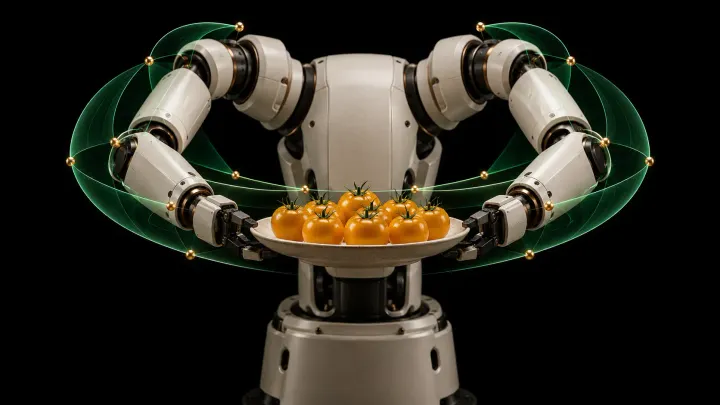
The easiest way to misunderstand humanoid robotics is to confuse a convincing demo with a workable product.
That is the trap Tesla’s Optimus story keeps exposing.
When production slows, redesigns pile up, and timelines slip, the point is not just that one company missed a milestone. The point is that humanoid robotics keeps running into the same brutal wall: physical reality is much less forgiving than software theater.
That is why Optimus matters.
Not because Tesla has already won the humanoid race, but because every setback makes the real question harder to ignore. Can a humanoid robot become a durable, economical, high-uptime worker in messy real environments — not on stage, not in a lab, but in the actual rhythm of industrial life?
That is a much higher bar than most robot hype admits.
The real bottleneck is not intelligence alone
A lot of humanoid coverage still treats the problem as if better AI will naturally unlock general robot usefulness.
That is incomplete.
Reasoning, perception, and language interfaces matter. But humanoid robotics does not fail only because the software is immature. It fails because useful labor in the physical world depends on a stack of constraints that all have to work together:
- balance under changing conditions
- dexterity under repetition
- thermal stability
- battery endurance
- grip reliability
- component wear
- recovery from small errors
- safe operation around humans and equipment
- acceptable cost per useful hour of labor
A robot can look impressive and still fail the economic test completely.
That is the gap Optimus is sitting inside.
Why factories are a harsher truth machine than demos
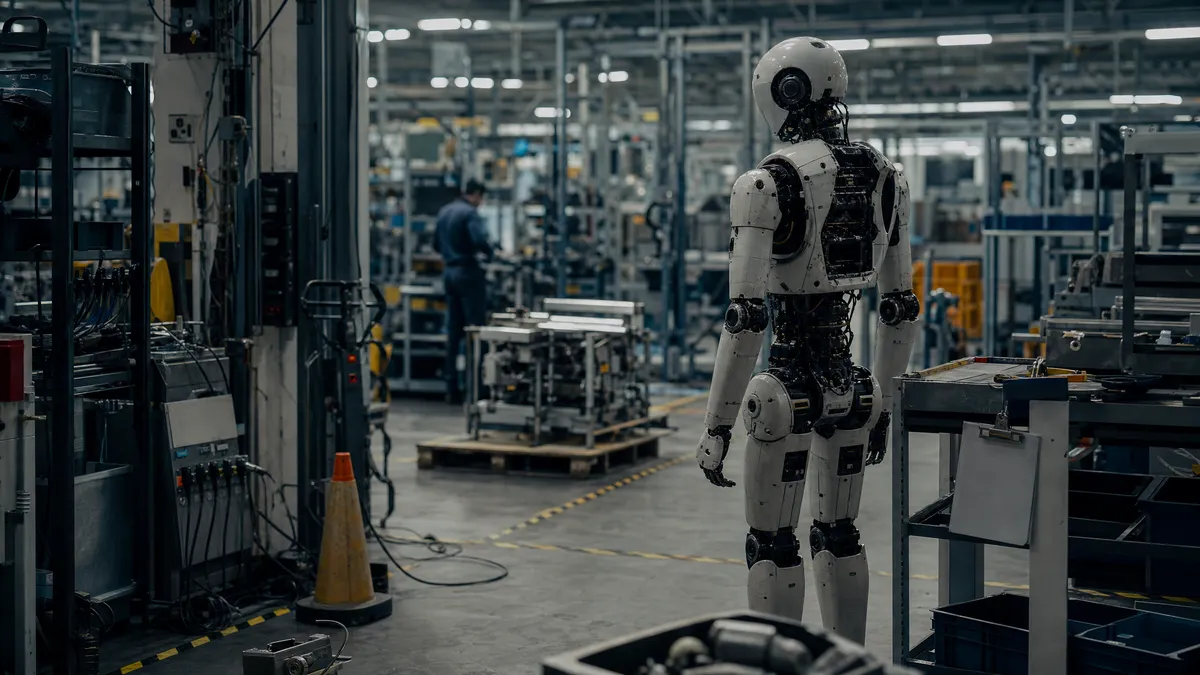
Factories look structured from a distance, which makes them seem like the obvious first home for humanoids.
But that reading is too superficial.
Real factory work is repetitive, yes — but it is also unforgiving. The value is not in doing one good sequence once. The value is in doing thousands of cycles with speed, consistency, low failure rates, predictable maintenance, and minimal intervention.
That is where the fantasy starts breaking.
A humanoid robot is not competing against human imagination. It is competing against a very old industrial standard: boring reliability.
If a machine overheats, drifts, mis-grips, stalls, needs careful resets, or burns too much support labor around the edges, it stops being a revolutionary worker and becomes an expensive operations problem.
That is why “it can do the task” is almost meaningless.
The real question is whether it can do the task often enough, safely enough, cheaply enough, and long enough to justify its existence.
Why the humanoid form is both the promise and the burden
The bullish case for humanoids is easy to understand.
Human environments are already built for human bodies. A general-purpose robot with arms, hands, and bipedal mobility could in theory use existing tools, move through existing spaces, and slot into existing workflows without waiting for the world to be rebuilt around it.
That is the dream.
The burden is that the humanoid form is mechanically punishing.
Hands are hard. Walking is hard. Carrying while balancing is hard. Reaching, turning, gripping, recovering, and repeating without wear or instability is hard. As soon as you ask the machine to do many of those things at once, complexity spikes.
So the form that looks most broadly useful is also one of the hardest to make economically robust.
This is exactly why the field keeps oscillating between bold promises and engineering sobriety.
Tesla’s slowdown is a category lesson, not just a company story
Tesla draws attention because it packages robotics the way it packages cars: maximal ambition, compressed timelines, and the promise that software scale can bend hardware reality fast enough.
Sometimes that framing works.
But humanoids are different.
A robot workforce is not just another consumer product launch. It is an attempt to merge mechanical endurance, embodied intelligence, industrial safety, supply chains, and operating economics into one system. That makes every weak point visible.
So when Optimus slows down or gets reworked, the signal is larger than Tesla.
It suggests the industry is still in the phase where public narratives outrun deployment discipline. Humanoids are not failing because the dream is absurd. They are failing because the transition from “promising prototype” to “dependable labor unit” is much harder than the hype cycle wants to admit.
For the stronger infrastructure-side view of this race, see Isaac GR00T: Why NVIDIA Is Building the Stack, Not Just the Robot Model.
The hidden metric is uptime, not virality
This is where robotics and AI discourse keep diverging in a useful way.
In software, people can get drunk on demos because the marginal cost of iteration is low and the visible progress curve is fast.
In robotics, the hidden metric that matters is uptime.
How many useful hours can the system deliver? How often does it fail? How much supervision does it need? How expensive is recovery? How much value does it create compared with specialized machines or human labor?
That is a colder framework, but it is the right one.
And once you apply it, a lot of humanoid bravado starts looking premature.
The field does not just need robots that appear more capable. It needs robots that remain capable after long repetition, shifting conditions, maintenance cycles, and real operational pressure.
That is a different standard entirely.
Why this still matters even if the timeline slips
It would be a mistake to read setbacks as proof that humanoids are fake.
That is not the right conclusion.
The better conclusion is that the adoption curve will probably be narrower, slower, and more use-case-specific than the grandest narratives imply. Early wins may come from constrained industrial tasks, logistics support, and carefully staged environments long before we get anything resembling a general robot worker.
That does not kill the category.
It clarifies it.
In fact, the companies that survive this phase may be the ones willing to underpromise on near-term magic and overdeliver on boring operational competence.
That is not sexy. It is how real platforms get built.
Why This Matters
Humanoid robotics matters because labor, care, logistics, and industry all have real long-term reasons to want more adaptable machines. But the Optimus story is a reminder that the decisive barrier is not just smarter AI. It is embodied reliability under economic pressure. If humanoids cannot stay stable, useful, and maintainable in real environments, the category remains theater. If they can, the result is not just a better robot demo. It is a new labor and infrastructure layer with serious economic and social consequences.
Conclusion
The problem with humanoid robot hype is not that it dreams too big.
It is that it hides the real exam.
That exam is not whether a robot can wave, sort, carry, or respond on cue. It is whether the machine can survive industrial reality with enough reliability to become more than a spectacle.
That is the standard Tesla keeps running into.
And it is the standard the whole humanoid field will have to pass before the story changes from fascination to actual deployment.
Until then, every redesign is not just a delay.
It is a reminder that in robotics, reality grades harder than the stage does.
CTA: Read next: Isaac GR00T: Why NVIDIA Is Building the Stack, Not Just the Robot Model