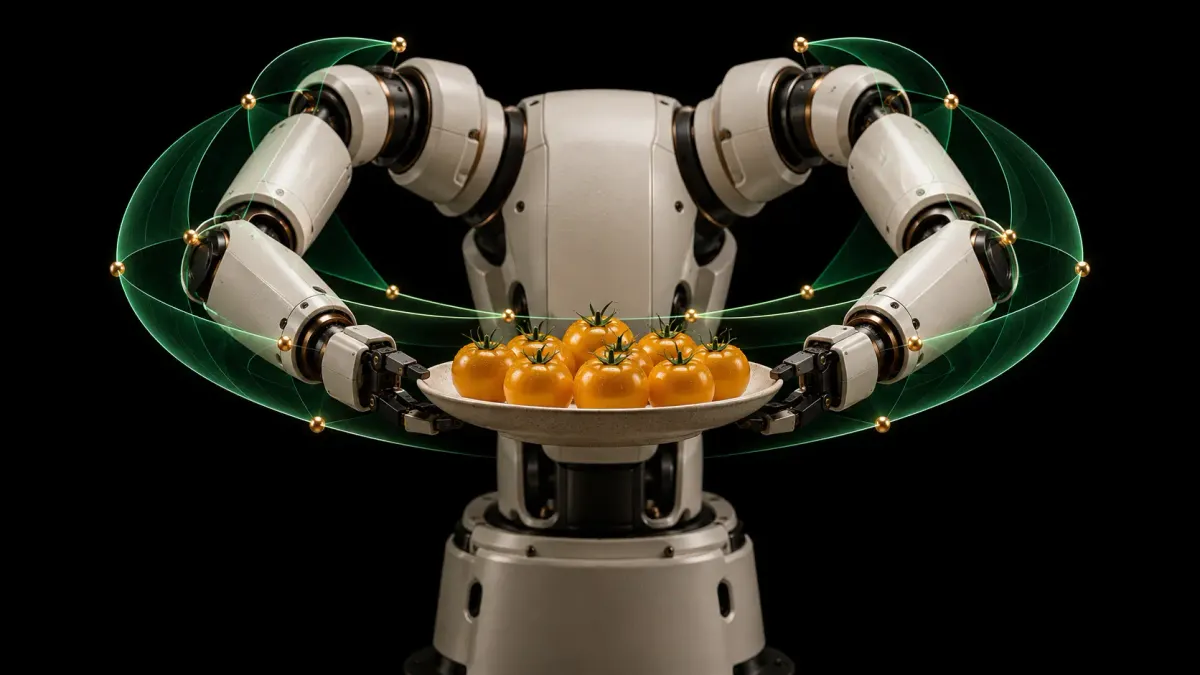
Two robot arms must lift a plate without tipping eight tomatoes onto the floor. A person wearing a virtual-reality headset tries to demonstrate the motion, but tiny disagreements between the controllers tilt the plate. In ten attempts, the unassisted operator succeeds zero times. A new system called GLIDE does not replace the operator. It writes code that constrains the operator’s commands—and raises successful demonstration collection to seven out of ten attempts.
That result comes from a University of California, Irvine preprint posted September 21 and accepted to the 2026 Conference on Robot Learning. It is a small laboratory study: three manipulation tasks, ten evaluation trials per reported condition and no test of long-horizon work. Its useful idea is more general. If people cannot reliably demonstrate a task through teleoperation, the lesson itself may need assistance before it becomes training data.
The operator is still in charge—but not unfiltered
Many modern robot policies learn by behavior cloning: record a person controlling the machine, then train a model to imitate those actions. The recipe assumes the demonstration is good enough to copy. That assumption breaks when success depends on synchronized arms, precise contact timing or a dexterous hand whose movements do not map neatly to human controllers.
GLIDE—Guardrails for Learning from Infeasible Demonstrations Efficiently—places a programmable filter between the operator and the robot. A coding agent receives the task description and the existing teleoperation software. It inspects which commands and robot states are available, predicts likely failures and writes guardrail code. The code can limit wrist rotation, couple the height of two grippers, delay a release or constrain a bottle’s position over a glass.
The system does not teach a robot by inventing the whole task. A person still supplies the intention and demonstrations. GLIDE edits the control pathway so common mistakes are harder to make: keep the plate level, steady the handoff, align the bottle before pouring. The resulting data are assisted demonstrations, not untouched human expertise.
After each round, GLIDE reviews recorded video and numerical trajectories offline, revises the code and runs another collection round. The improvement was not automatic or monotonic. For wine pouring, the first two guardrail versions still produced no successful demonstrations. A later version added phase-aware tilt, alignment and grasp limits and reached nine successes in ten attempts.
Three tasks reveal three different kinds of help
The plate task needed the arms to behave less independently. GLIDE coupled their motion after grasping, limited their height difference and preserved the distance between grippers. Success in demonstration collection rose from 0% with raw VR control and 20% with expert-written rules to 70% with the best generated guardrails.
For handing a marker from one gripper to another and placing it upright, the system added smooth approach, handoff damping and a gentle release phase. Raw control succeeded once in ten attempts; human-authored guardrails succeeded six times; the best GLIDE version succeeded nine times. Throughput rose from 0.5 to 3.9 completed handovers per minute.
Wine serving demanded a different sequence: position the glass, align the bottle mouth, control the tilt and avoid losing either object. Raw teleoperation never completed the task. Both expert-written rules and the best GLIDE version reached six and nine successes respectively in ten collection trials.
Those numbers measure demonstration collection, not autonomous work. The team next fine-tuned the π0.5 vision-language-action policy on the gathered data and kept the guardrails active during execution. With a mixed pool of successful and imperfect demonstrations, guarded policies completed the plate, marker and wine tasks in 70%, 60% and 60% of ten trials. Without the runtime filters, the same trained policies achieved 0%, 40% and 40%.
The guardrail is part of the capability
This matters because robot learning is often described as if scale were mainly a question of collecting more videos. GLIDE suggests another bottleneck: some valuable demonstrations are expensive precisely because the interface makes them difficult. Better training data may require a control system that temporarily shares the work with the demonstrator.
But the system also blurs a boundary that evaluations must keep visible. A policy that succeeds only while task-specific guardrail code is running has not learned the entire task inside its neural network. The guardrail is part of the deployed capability, just as a stabilizer is part of an aircraft’s control system. Removing it changes the system being evaluated.
The evidence is narrow. Each reported rate represents only ten trials. The experiments use two stationary robot setups and three carefully designed tasks. Runtime guardrails read joint positions and other proprioceptive state, not vision or touch, so they cannot directly detect a slipping object or see whether liquid is spilling. The paper does not test mobile manipulation, unfamiliar objects or a work shift with accumulated wear and interruptions.
The next convincing demonstration would therefore be transfer: can a generated guardrail survive changes in object size, placement and friction without being rewritten around every new case? And can it know when to intervene without flattening the flexibility that learning was meant to provide? If those tests go well, robot training may become less about asking humans for perfect performances—and more about building interfaces that make imperfect expertise usable.
Keep exploring
- A missed pick shows what useful robots need to do next — why recovery is a system capability, not an embarrassing outtake.
- Large behavior models matter because they could change robotics’ real bottleneck — the larger argument about data and evaluation.
- Digit 5 makes robot safety a cooperative problem — how a machine’s behavior and its surrounding workflow share responsibility.
AI-assisted. Sources checked.