
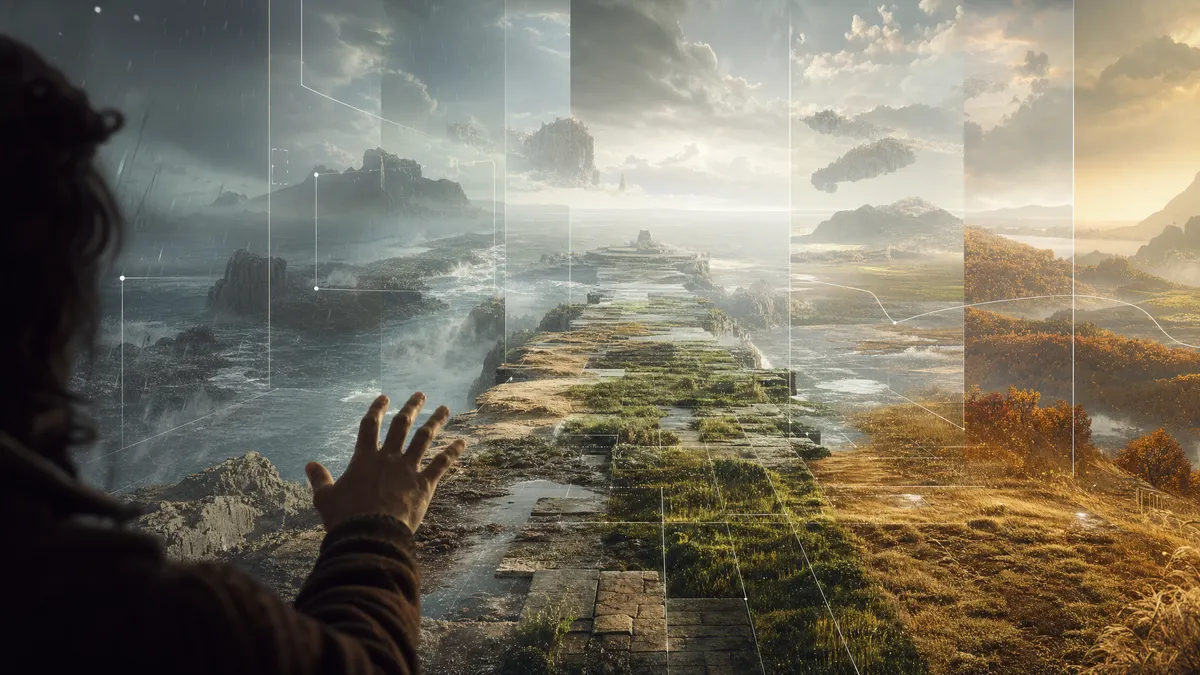
For years, generative AI has mostly been about outputs you watch.
A chatbot answers. An image model renders. A video model produces a clip.
Genie 3 points at a different category entirely: systems that do not just generate media, but generate worlds you can move through, change, and use.
That is why the important question is not whether Google DeepMind’s latest demo looks impressive. It does. The real question is what happens when AI starts producing interactive environments that behave less like content and more like simulated reality.
That shift matters for VR, yes. But VR is not the deepest story here.
The deeper story is that world models are becoming part of the infrastructure for agents, robotics, training, and eventually new interface paradigms.
What Genie 3 actually is
DeepMind describes Genie 3 as a general-purpose world model that can generate interactive environments from a text prompt in real time. According to the company, the system can render dynamic worlds at 720p and 24 frames per second, maintain environmental consistency for several minutes, and support promptable world events such as changing weather or introducing new objects and characters.
That already puts it in a different bucket from ordinary generative video.
Video models make scenes you watch. Genie 3 makes scenes you navigate.
That difference sounds small until you think through the implications. Once a model has to respond to movement, preserve enough continuity to make spatial exploration coherent, and accept live interventions into the environment, it stops being just a media model. It starts becoming a simulation layer.
DeepMind is explicit about the intended direction. Genie 3 is not positioned mainly as a toy for virtual tourism. It is framed as a tool for embodied-agent research, including use with SIMA-style agents operating inside generated 3D environments.
Why this is bigger than a VR headline
The obvious headline is VR. “Promptable worlds” sounds like a first step toward a Holodeck, and that framing is not wrong.
It is just incomplete.
The more important change is that AI systems are getting better at generating spaces for action, not just assets for consumption.
That matters because agents learn differently when they can explore, fail, retry, and encounter counterfactual variations inside a simulated environment. A world model can become a training ground, a test harness, a planning surface, or even a new user interface.
This is where the story connects to the broader agent shift. If you want AI systems that can operate in messy environments over longer chains of action, static benchmarks are not enough. You need settings where behavior unfolds over time.
That is why world models sit so naturally beside the rise of agentic systems. For more on the current ceiling of those systems, see Agentic Time Horizons: Why AI Agents Still Tap Out Early.
The real product is simulated experience
Genie 3 suggests a larger design shift that many people still underestimate.
In the old software model, humans interact with menus, files, buttons, and predefined environments. In the emerging model, you increasingly specify intent and the system assembles the working environment around that intent.
That could mean:
- a training simulation built on demand for a rare industrial scenario
- a robotics practice environment generated to stress a particular class of failure
- an explorable educational world built around a historical period or physical process
- a creative tool where you direct a scene by describing how the world should evolve
This is a much more consequential idea than “AI video, but interactive.”
It points toward software that is less about opening a fixed application and more about instantiating a temporary world.
Where Genie 3 is genuinely strong
The strongest part of Genie 3 is not perfect realism. It is the combination of three things at once:
- live navigability
- short-horizon consistency
- promptable state change inside the world itself
That package matters.
DeepMind says Genie 3 can preserve world consistency for several minutes and visual memory for around a minute, even though it generates environments autoregressively frame by frame rather than relying on an explicit 3D scene representation. That is technically meaningful because interactive generation compounds error much faster than ordinary clip generation. The system has to keep enough memory of prior state to make revisiting an area feel coherent instead of collapsing into noise.
If that capability continues to improve, the door opens to much richer simulated workflows for both humans and agents.
Where the hype still runs ahead of reality
This is the part people will overstate if you let them.
Genie 3 is important, but it is not a finished runtime for mainstream immersive computing.
DeepMind lists the limits pretty openly:
- interaction horizons are still measured in minutes, not hours
- action spaces remain constrained
- multi-agent interaction is still immature
- real-world location accuracy is limited
- clean text rendering is inconsistent
There is also a more practical issue the VR-forward coverage sometimes glides past: 24 frames per second at 720p is not the bar for comfortable, mainstream head-mounted VR.
So no, this is not “the Holodeck” in any meaningful consumer sense yet.
The short-term use case is more likely hybrid simulation, previs, training, agent evaluation, and experimental world-authoring workflows than full neural runtime VR for everyone.
Why the geometry problem still matters
One of the sharpest constraints is structural, not cosmetic.
DeepMind contrasts Genie 3 with techniques such as NeRFs and Gaussian Splatting, which rely on more explicit spatial representations. Genie 3 gains flexibility by generating worlds frame by frame, but that flexibility comes with tradeoffs. If your system does not maintain a stable geometric model in the conventional sense, then high-fidelity free movement, exact collisions, and long-horizon spatial reliability remain harder.
That matters because many of the most valuable applications do not just need plausibility. They need dependable interaction.
A robotics simulator cannot cheat too much on causality. A training environment cannot dissolve under prolonged use. A mixed-reality interface cannot feel spatially persuasive only from one narrow mode of movement.
So the likely path is not pure world-model replacement of existing 3D systems. It is a hybrid stack where explicit geometry and neural simulation meet in the middle.
The real winners may be agents and robotics
The consumer imagination jumps to entertainment first. I think that is too narrow.
The more immediate leverage is likely in agent training and robotics.
If world models can generate diverse, semi-coherent environments on demand, they become useful for stress-testing navigation, planning, adaptation, and failure recovery at much larger scale than hand-authored simulation alone. That is especially relevant for embodied systems, where collecting real-world data is expensive and safety-constrained.
This is why Genie 3 fits better inside the story of agent infrastructure than inside the story of flashy VR demos. It belongs in the same larger arc as scientific agents, robotics stacks, and the systems needed to move AI from static outputs toward real action. See also Isaac GR00T: Why NVIDIA Is Building the Stack, Not Just the Robot Model and A New Scientific Era Has Arrived.
A governance problem arrives early here
There is another reason this matters beyond technical spectacle.
The moment AI can generate convincing interactive spaces in real time, governance stops being optional.
The risks are not abstract:
- simulated environments can be used to manipulate, mislead, or rehearse harmful scenarios
- synthetic locations can blur provenance and trust
- creative labor can be compressed by tools that generate explorable spaces from sparse instruction
- evaluation systems can drift if teams confuse simulated competence with real-world robustness
DeepMind’s decision to keep Genie 3 in limited research preview is a sign that even its creators understand this is not an ordinary release category.
That caution is sensible. Interactive synthetic worlds touch safety, evidence, labor, platform governance, and autonomy all at once. For the broader policy layer, see Agentic AI Governance: Guardrails Before Autonomy Scales.
Why This Matters
Genie 3 matters because it suggests that AI is moving from generating answers and images toward generating environments for action. That changes the role AI can play in training, robotics, education, simulation, and interface design. The real strategic shift is not prettier content. It is the emergence of machine-generated worlds as a new layer of software and a new testbed for agents. If that layer matures, the winners will not just make better media. They will shape how humans and machines learn, rehearse, and operate.
Conclusion
The strongest way to understand Genie 3 is not as a VR curiosity.
It is an early signal that AI systems are starting to build places, not just outputs.
That is a deeper transition than most coverage is admitting. It points toward a world where simulation becomes cheaper, interfaces become more generative, and agents train inside environments that did not exist until they were asked for.
The hype will get ahead of the capability, as usual.
But the direction is real.
Genie 3 is not the Holodeck. It is something more useful right now: an early draft of software that behaves like a world.
CTA: Read next: Agentic Time Horizons: Why AI Agents Still Tap Out Early