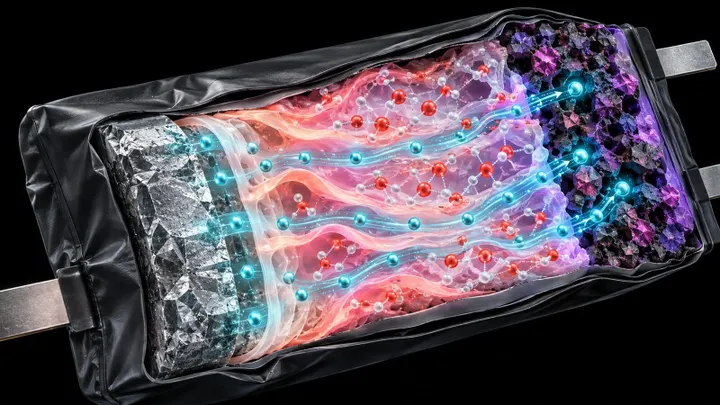

A new open-access study reports a room-temperature recipe for perovskite nanocrystals that costs $2.16 per gram and produced a laboratory solar cell with 19.37% power-conversion efficiency. The striking part is not that an AI “invented” a solar panel. It is that machine learning helped researchers navigate a messy chemical recipe—then the team tested the chosen conditions in real experiments.
Published as an accepted article in press in Nature Communications on October 2, the work targets a stubborn manufacturing problem. Perovskite nanocrystals can absorb and emit light efficiently, but conventional laboratory syntheses often rely on heat, protective atmospheres, expensive solvents and small batches. A promising material is not automatically a practical one if its recipe is too delicate or costly to scale.
The Recipe Has More Knobs Than It Looks
Making nanocrystals is not like mixing two fixed ingredients. Temperature, timing, precursor concentrations, solvent ratios and purification steps can change particle size, crystal structure and defects. Those changes then affect how well charges move through a finished device.
Trying every combination would be slow and expensive. The researchers instead used an AI-assisted optimization framework to learn from earlier experiments and propose informative next conditions. This is closer to a navigator than an autonomous chemist: the model narrows the search, while physical experiments supply the evidence and expose where its predictions fail.
The selected process produced formamidinium lead iodide, or FAPbI3, nanocrystals at room temperature and could run in a continuous-flow system. The authors report producing nearly 13 grams in one hour. That matters because avoiding high-temperature processing can simplify equipment, while flow chemistry offers a plausible route from small tubes to repeatable batches. The reported $2.16-per-gram figure is a production-cost estimate for the nanocrystal material under the study’s assumptions, not the retail price of a finished solar module.
Efficiency Is Only One Gate
Power-conversion efficiency measures how much incoming light energy a solar cell turns into electricity under specified test conditions. The team’s champion small device reached 19.37%. Cells made with material from a 1-liter synthesis run reached 18.87%, with the authors reporting reproducible output. Those results are serious enough to show that the cheaper synthesis did not merely produce colorful particles; it produced material that could function in a device.
But they do not establish commercial readiness. In one laboratory test, an unencapsulated device with a gold top electrode retained nearly 85% of its initial efficiency after 1,000 hours under continuous simulated sunlight at about 40°C while tracking its maximum-power point. That test began at 17.57% efficiency; it was not a durability test of the 19.37% champion cell. That is useful evidence, not a 25-year field test. A bankable solar product must retain performance across large areas, survive heat, light, moisture and repeated temperature cycles, use reproducible manufacturing steps and fit a supply chain that can control lead-containing waste.
The cost comparison includes materials, purification and labor. The authors estimate $30.71 per gram for their batch process and $2.16 when it runs continuously, with much of the additional saving attributed to reduced labor. The comparison also needs boundaries. A per-gram material estimate does not include every later step: coating, electrodes, encapsulation, quality control, yield losses, factory depreciation, installation or decades of operation. Silicon modules are not replaced by winning one line of a laboratory spreadsheet.
Where the AI Contribution Is Real
“AI for materials” can sound like a claim that software replaces scientific judgment. This paper shows a more credible role. Chemistry presents a large search space, and experiments are expensive. The team trained models on an initial experimental set, then ran 45 additional model-guided experiments and used the results to refine its predictions. The analysis identified the ratio of octanoic acid to the formamidinium precursor as a critical control over particle size and uniformity. Researchers still chose the target, built the apparatus, checked the crystals and decided whether the result was physically meaningful.
That division of labor becomes more valuable when several objectives conflict. The best recipe may not maximize efficiency alone. It may balance performance, ingredient cost, reaction temperature, toxicity, stability and batch consistency. An optimization system can expose those trade-offs instead of hiding them behind one headline metric.
The Next Test Is a Bigger Batch
The result is strongest as a manufacturing-method signal: room-temperature synthesis plus guided experimentation can push perovskite nanocrystals toward cheaper, repeatable production. The next evidence should come from scale and durability.
Watch for batch-to-batch variation, device area, long-duration stability under standardized conditions and a factory cost model that makes yield and equipment assumptions explicit. If those numbers hold as production grows, the important breakthrough will not be that AI made a solar cell. It will be that AI helped turn an unruly laboratory recipe into a process engineers can control.
Keep Reading
- This Zinc Battery Gel Makes Water Less Destructive
- These School Buses Run. Their Grid Promise Still Has to Prove Itself.
- Oxygen Gives an Atom-Thin Transistor Its Missing Half
Production note: Vastkind read the accepted paper, including its methods and figure captions. The reported cost and efficiency come from the authors’ laboratory study; Vastkind did not reproduce the synthesis or independently test a device.