Water is both the appeal and the nuisance inside an aqueous zinc battery. It can carry ions without the flammable organic solvents used in many lithium-ion cells. It can also react where it should not, corrode zinc and help the metal grow into needle-like structures that shorten a battery's life.
A peer-reviewed study published October 1 reports a hydrogel electrolyte designed to handle both sides of that problem. Fluorinated groups make water less chemically available, while charged zwitterionic groups steer zinc ions toward the electrode. The strongest evidence is not a single microscopic image: a zinc-manganese-dioxide pouch cell with roughly one amp-hour of capacity operated for more than 700 hours. That is encouraging laboratory evidence, not a grid-scale lifetime guarantee.
In Plain English: An electrolyte is the ion-conducting material between a battery's electrodes. This one is a water-filled polymer network. Some of its molecular groups hold water more tightly, reducing unwanted reactions. Other groups attract and guide zinc ions. The design tries to make water useful for transport without letting it attack the battery as freely.
The Electrolyte Has Two Jobs
When a zinc battery charges, zinc ions gain electrons and plate onto the negative electrode as metal. Ideally, they spread evenly. In practice, local differences can concentrate deposition into protrusions called dendrites. Rough growth raises the chance of failure, while water can drive hydrogen production and other parasitic reactions that consume material.
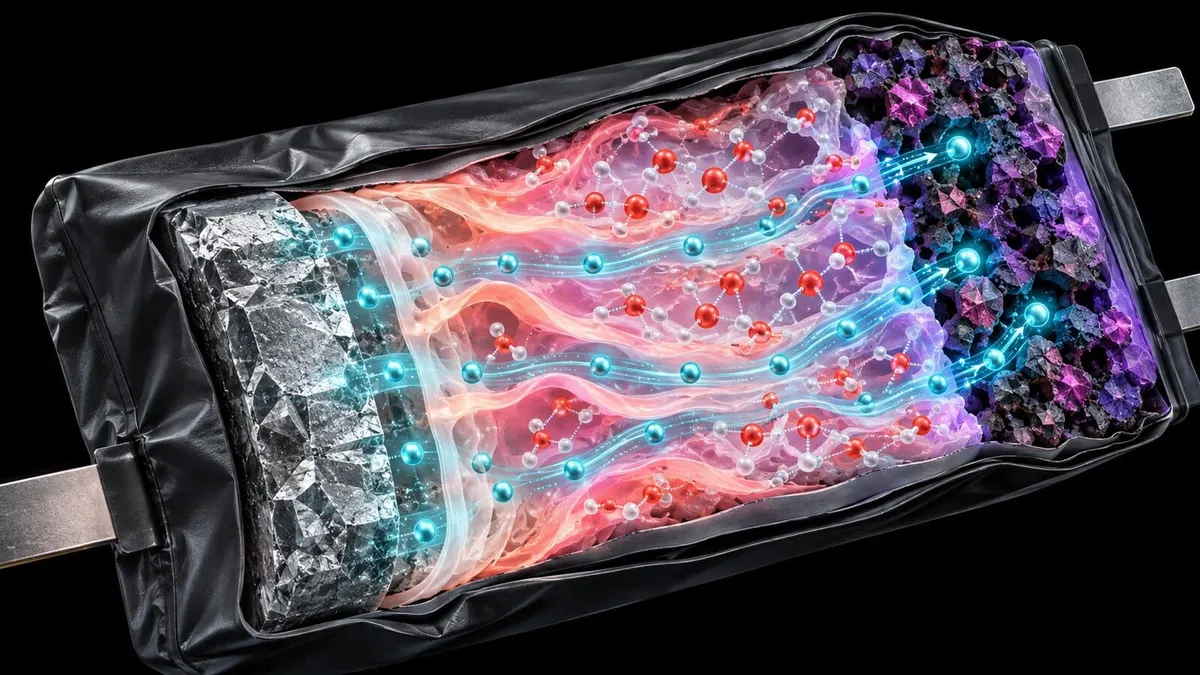
The Nature Communications paper combines two kinds of molecular feature in one hydrogel. Hydrophobic fluoroalkyl groups—written chemically as –CH2CF3—strengthen hydrogen-bonding interactions between hydrophilic parts of the polymer and water. The authors argue that this lowers water activity: fewer water molecules are free to participate in damaging electrode reactions.
Zwitterions perform the second job. A zwitterionic unit carries positive and negative charges while remaining neutral overall. Here, sulfonate and trimethylammonium groups interact with zinc ions and encourage directional transport. The authors report a zinc-ion transference number of 0.76, meaning zinc ions carry a relatively large share of the ionic current in their measurement.
The combined chemistry also promoted an organic-inorganic solid electrolyte interphase on zinc. That sounds contradictory in a water-rich gel, but the idea is familiar from other batteries: a thin reaction layer can be useful if it conducts the desired ions while blocking continued unwanted chemistry.
A Pouch Cell Is a More Demanding Check
Battery papers often begin with symmetric cells—zinc on both sides—to isolate plating and stripping. Under a current density of 5 milliamps per square centimeter and a capacity loading of 5 milliamp-hours per square centimeter, the new electrolyte supported more than 900 hours of that cycling.
The team then placed the material in a zinc-manganese-dioxide pouch cell with capacity around one amp-hour. It operated for more than 700 hours. A pouch is more relevant than a tiny coin-cell demonstration because it requires a larger area, more material and packaging that begins to resemble a practical battery format.
But “one amp-hour” is still small compared with stationary storage modules, which combine many cells and must survive years of changing temperature, partial charge, pauses, maintenance and safety testing. Hours are not the same as cycles, and the public abstract does not turn 700 hours into an operating calendar for a grid asset. Earlier studies have also demonstrated amp-hour-scale zinc pouch cells using different interfaces, so this work should not be read as the first large-format zinc cell.
The Next Scale Test Is Manufacturing
The material's novelty is its molecular coordination: restrain water, direct zinc and build a protective interface at the same time. The next question is whether that balance survives ordinary production. Fluorinated chemistry can complicate cost, processing and environmental assessment. A useful follow-up would disclose material yield, electrolyte thickness, self-discharge, round-trip efficiency, gas formation, low- and high-temperature behavior and performance across many pouch cells rather than selected examples.
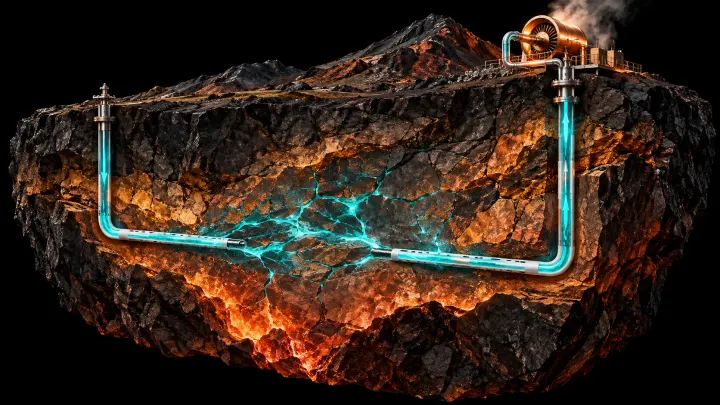
Those measurements matter because a grid battery is an economic system as much as an electrochemical one. Our reporting on electric school buses as possible grid assets showed why available energy must be matched to duty schedules. The same discipline appears in cross-border grids that depend on trust and geothermal projects whose next proof begins with drilling: a promising mechanism becomes infrastructure only after physical performance, cost and coordination survive scale.
For this zinc hydrogel, the decisive next development is not another endurance record in one carefully managed cell. It is a repeatable pilot batch whose energy efficiency, failure distribution and material cost can be compared with established storage alternatives.
Production note: Vastkind reviewed the peer-reviewed publication record, full public abstract and reported methods and performance. We did not build or cycle the cells. The authors declare no competing interests.