A small drone does not need a detailed map of the world to find its way home.
That is the quiet but important claim behind a new Nature paper, "Efficient robot navigation inspired by honeybee learning flights". The researchers describe Bee-Nav, a navigation strategy modeled on how honeybees perform short learning flights near the hive before traveling farther out and returning home.
The result is not a general solution to robot autonomy. It does not make drones magically intelligent. It does not remove the hard problems of wind, glare, weak landmarks, changing environments, or landing at a charging station.
But it does point at something robotics badly needs: autonomy that is cheap enough, light enough, and efficient enough to run on small machines in the physical world.
That matters because many robotics systems are still caught between ambition and hardware reality. High-precision map-based navigation can demand heavy computation, detailed 3D models, and energy budgets that tiny robots simply cannot carry. Bee-Nav asks a sharper question: what if a robot could learn only the part of the world it needs to correct itself?
How Bee-Nav Works
Bee-Nav combines two ideas from insect navigation.
The first is path integration. In plain terms, the robot keeps track of where home should be by adding up its movements: direction, distance, turns, and speed. This lets it estimate a home vector, meaning the direction and distance back to the starting point.
The weakness is drift. Small errors accumulate. Over a long flight, the robot's estimate of home starts to diverge from reality.
The second idea is view memory. Honeybees do not carry a perfect metric map of the environment. They learn what the world looks like near important places, then use those visual cues to correct their course.
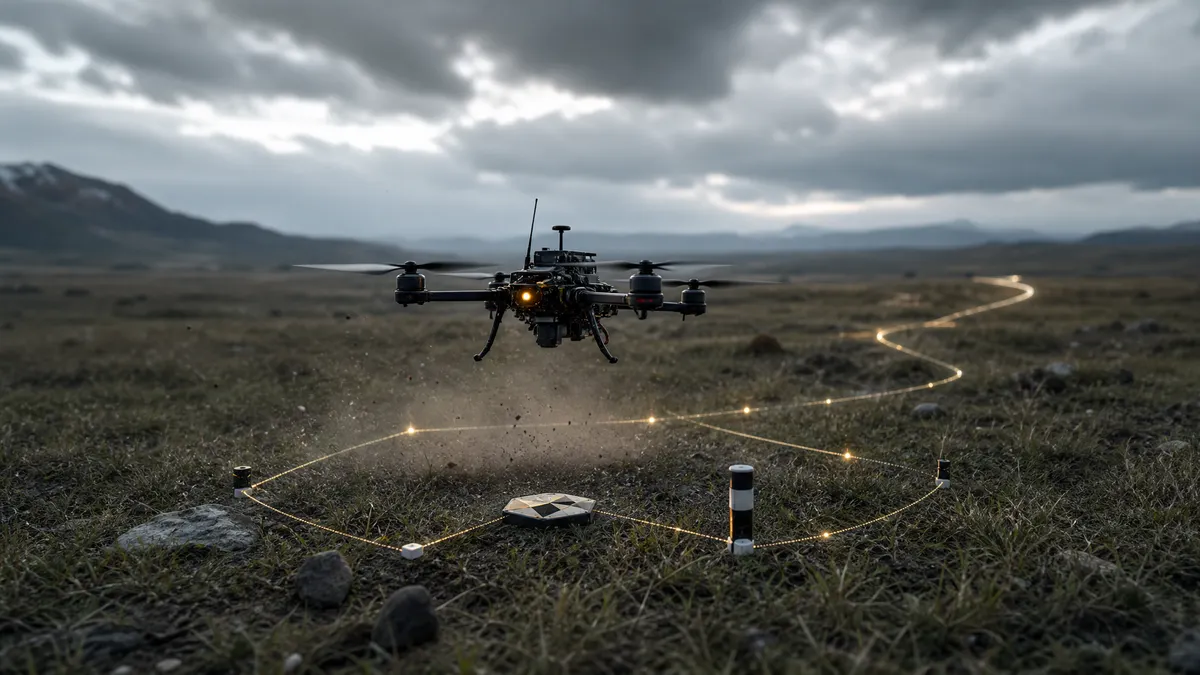
Bee-Nav applies that logic to a drone. Before doing a longer task, the robot performs a short learning flight near home. During that flight, it captures omnidirectional images and uses path integration to label those images with a home vector. A small neural network learns to map visual input directly to the direction and distance home.
After that, the robot can fly far away using path integration, come back along an almost straight route, and use the visual homing network near home to cancel the accumulated drift.
The key is that the robot does not need to learn the entire flight area. It only needs a learned homing area around the home location. If path integration brings it close enough, vision finishes the job.
The Numbers Are the Point
The paper's strongest contribution is not that bees are clever. We already knew that.
The stronger point is that useful navigation can emerge from extremely small learned systems when the task is framed narrowly enough.
In simulations, the researchers found that, for realistic path integration accuracy, the neural network needed training on only about 0.25% to 10% of the total flight area. In one modeled setting based on the team's robot, the learned homing area only needed to cover 3.84% of the total area to capture 99% of return endpoints.
In real-world tests, a small drone used compact neural networks of 3.4 kB and 42.3 kB. Those are tiny by modern AI standards. The drone returned to within 0.5 meters of home in 100% of 30 to 110 meter flights and in 70% of 200 to 600 meter flights under windy conditions, according to the Nature abstract.
That is the sentence robotics people should sit with.
Not because 70% is deployment-ready for every use case. It is not. A system that misses home 30% of the time under difficult conditions still needs serious engineering before it can be trusted in many applications.
But because the memory footprint is so small. The study contrasts this with map-heavy approaches that can require far more memory and compute. Bee-Nav's visual homing networks ran on a Raspberry Pi 4 and may be suitable for even smaller processors.
This is a different kind of robotics progress. It is not more intelligence piled onto more hardware. It is a better task decomposition.
What Bee-Nav Gives Up
The tradeoff is important.
Bee-Nav is not trying to build a complete 3D map. It does not give the robot full knowledge of the environment. It does not let the robot plan optimal routes to arbitrary places. It is built around a simpler promise: go out, do something, come home.
That makes it less general than a full mapping and planning stack.
It may also make it more practical for certain classes of small robot.
A greenhouse drone that monitors crops, a warehouse robot that returns to a dock, a small inspection robot that repeatedly leaves and returns from a base station, or a lightweight swarm system may not need a rich world model for every mission. It may need enough autonomy to travel, correct drift, and reliably return.
That is the design lesson. Generality is expensive. Sometimes the winning robotics system is the one that refuses to solve the grand problem and solves the operational problem instead.
This connects directly to a broader robotics pattern Vastkind has covered before: the field is not limited by impressive demos alone. It is limited by reliability, energy, memory, uptime, and deployment discipline. See The Future of Robotics Will Be Decided by Reliability, Not Robot Theater for the wider frame.
The Physical World Still Pushes Back
Bee-Nav is promising, but the paper is careful about its limits.
The method depends on useful visual landmarks near home. In a visually rich environment, a tiny network can learn enough cues to guide the robot back. In a long corridor full of repeated patterns, a wide-open area without nearby landmarks, or a scene distorted by glare and dynamic objects, the problem gets harder.
The large outdoor tests made this visible. Wind caused camera tilt. Sun glare and changing light hurt visual accuracy. The researchers added objects to the ground as landmarks in the wide-open test area, and the larger attention network was needed because the compact network was not accurate enough there.
That is not a flaw that invalidates the work. It is the point at which the lab result touches reality.
Robotics is always a negotiation with the environment. Floors, light, wind, texture, occlusion, dust, battery limits, sensor noise, and mechanical variation all matter. Any technique that claims to solve autonomy while ignoring those constraints should be treated with suspicion.
Bee-Nav is interesting because it does not pretend the world is clean. It shows that a narrow, biologically inspired strategy can survive real-world tests, while also exposing the conditions where it weakens.
Smaller Models Can Mean Better Robotics
The most useful lesson from Bee-Nav may be cultural.
AI progress is often narrated as a scale story: bigger models, more parameters, more data, more compute. Robotics cannot always afford that logic. A small flying robot has brutally limited mass, power, and processing capacity. Every gram and watt matters.
That forces a different kind of intelligence.
Instead of asking the robot to represent the whole environment, Bee-Nav asks it to learn a functional correction zone. Instead of demanding a full map, it uses a home vector. Instead of treating visual learning as a general perception problem, it turns it into a compact homing problem.
This is not less sophisticated. In many cases, it is more sophisticated, because the design matches the constraint.
That is also why insect-inspired robotics is more than a cute metaphor. Honeybees are not impressive because they are tiny versions of map-making drones. They are impressive because evolution found strategies that work under severe biological constraints.
Robotics should be humble enough to learn from that.
Why This Matters
Bee-Nav matters because it shifts the robotics conversation away from spectacle and toward efficient physical autonomy. If small robots can navigate with tiny neural networks, more useful machines become possible in agriculture, inspection, inventory, and environmental monitoring. The social stakes are practical: cheaper robotics could spread autonomy into workplaces and infrastructure faster than humanoid narratives suggest. But the same efficiency also raises responsibility questions about safety, supervision, failure recovery, and where swarms of low-cost robots should operate.
The Future Is Not a Smarter Map. It Is a Smarter Constraint.
The temptation is to read Bee-Nav as another story about nature inspiring machines.
That is only half right.
The deeper story is that intelligence often comes from choosing the right constraint. Honeybees do not solve navigation by carrying a perfect representation of the world. Bee-Nav does not either. It narrows the problem until a tiny neural network becomes enough.
That approach will not replace map-based navigation everywhere. Cars, delivery robots, warehouse fleets, and humanoid systems will still need richer models, stronger localization, and better planning in many environments. For a related view of how learned robotics is moving beyond handcrafted control, see Large Behavior Models Matter Because They Could Change Robotics' Real Bottleneck.
But for small robots that need to leave a base, perform a task, and come back, Bee-Nav is a serious clue.
The future of robotics may not be won only by machines that understand more of the world.
It may also be won by machines that understand exactly enough.
CTA: For more on physical autonomy beyond the demo stage, read Vastkind's robotics coverage on reliability in robotics and large behavior models.