AI has a power problem, and the answer may be sitting under the ground.
Not in the cinematic sense. Not as a miracle breakthrough. More like a hard industrial fact: if AI data centers need clean electricity that runs through the night, through winter, through low-wind weeks, and through grid congestion, then weather-dependent power is not enough by itself.
That is why enhanced geothermal is becoming one of the most interesting energy stories in the AI buildout.
Fervo Energy says its Project Red enhanced geothermal system in Nevada has operated for more than 600 days on production. The company frames it as the world’s longest-running enhanced geothermal system, with a field-scale dataset showing stable, predictable performance. Project Red averaged roughly 2.1 MW gross output and 1.4 MW net output over the operating period, with the downhole system reportedly requiring zero workovers, remediations, or chemical treatments.
Those numbers are not giant. That is the point.
The important part is not that Project Red solves AI’s power demand. It does not. The important part is that it makes enhanced geothermal feel less like a climate-tech slide and more like an industrial product moving through its proof curve.
AI does not need slogans. It needs uptime.
Why AI Makes Geothermal More Interesting
AI data centers are brutal power customers.
They do not only want cheap electrons. They want reliable electricity, available at large scale, close enough to the right sites, on timelines that match infrastructure deployment. They want power that can support dense compute loads without making every expansion dependent on overloaded grids and long interconnection queues.
That changes the energy ranking.
Solar is cheap, but intermittent. Wind is powerful, but variable. Batteries help, but they add cost and duration limits. Nuclear is firm, but slow and politically heavy. Fusion is exciting, but not yet a near-term procurement answer.
Enhanced geothermal sits in a different position. It offers the possibility of firm, clean power with a drilling and project-development logic that may scale more like industrial infrastructure than like traditional geothermal, which is usually limited by naturally occurring hydrothermal resources.
That is the hook.
If enhanced geothermal can be repeated across more locations, it could become a cleaner firm-power layer for AI campuses, industrial sites, and grid-constrained regions. Not the whole answer. But possibly one of the most practical pieces.
That is why the Project Red data matters more than another power-purchase announcement.
The Real Breakthrough Is Repeatability
Old geothermal depends heavily on finding the right natural conditions: heat, fluid, permeability, and geography in the same place.
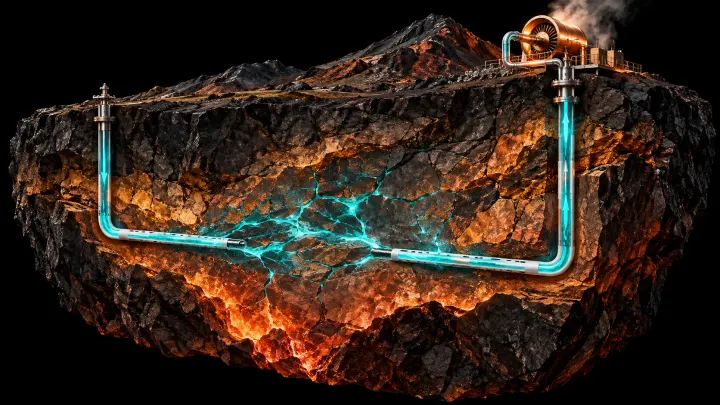
Enhanced geothermal tries to change that equation. The basic idea is to drill into hot rock, create or improve a subsurface flow path, circulate fluid through that rock, bring heat back to the surface, and generate electricity. Fervo’s version uses horizontal drilling, fiber-optic sensing, reservoir analytics, and techniques borrowed partly from the oil and gas world.
That makes the story culturally awkward in a useful way.
The energy transition often talks as if the future is a clean break from the old industrial world. Enhanced geothermal suggests something messier and probably more realistic: some of the tools built for fossil extraction may become tools for carbon-free firm power.
That is not poetic. It is useful.
The big question is whether this can become repeatable. One successful pilot is not a revolution. A standardized development model, lower drilling costs, better reservoir prediction, stable output, and bankable project finance would be.
Project Red is interesting because it points toward that transition. Fervo itself says the pilot was designed as a learning platform, not a production-optimized system. That means the project’s value is partly in the data: how the reservoir behaves, how wells perform over time, what breaks, what does not, and how future systems can be designed with less uncertainty.
For AI infrastructure, that is exactly the kind of knowledge that matters. Data centers are not buying dreams. They are buying capacity, availability, and risk reduction.
Why This Matters
AI is turning electricity into strategic infrastructure. If compute demand keeps rising, the bottleneck will not be only chips, models, or cloud contracts, but where reliable power can actually be delivered. Enhanced geothermal matters because it offers a possible bridge between clean energy ambition and firm industrial demand. The stakes are larger than data centers: the same technology could shape how grids handle electrification, manufacturing, and energy security.
The AI Power Stack Will Not Be One Technology
The temptation is to crown a winner.
That is usually lazy.
AI power will not be solved by one source. It will be a stack: solar where cheap land and transmission make sense, wind where resource quality is strong, batteries and demand response where flexibility is needed, nuclear where politics and licensing can work, geothermal where subsurface conditions and drilling economics fit, and possibly fusion later if the technology finally crosses into commercial reality.
Geothermal’s advantage is that it fits the missing category: clean firm power that does not depend on the weather.
That makes it especially valuable as solar and wind grow. A grid with huge renewable penetration does not only need more generation. It needs more controllable, reliable, low-carbon capacity that can stabilize the system when the weather does not cooperate.
This is why the AI angle matters. AI data centers may become anchor customers for technologies that the broader grid also needs. A hyperscaler willing to pay for clean firm power can help pull geothermal down the cost curve faster than public climate policy alone.
That is the optimistic version.
The harder version is that AI could also consume scarce clean power, stress local grids, and turn climate infrastructure into a private compute moat. That tension should not be smoothed over. If geothermal becomes valuable because AI needs it, the public question becomes who benefits from that buildout: everyone connected to a cleaner, firmer grid, or only the companies that can afford premium power deals?
The Risk Is Not That Geothermal Is Boring
The risk is that people mistake boring for easy.
Enhanced geothermal still has real constraints. Drilling is expensive. Subsurface conditions vary. Reservoir behavior is hard to model. Induced seismicity concerns have to be handled seriously. Water systems, permitting, transmission, local acceptance, and project finance all matter.
Project Red is a good signal. It is not a blank check.
The correct reading is disciplined optimism. Enhanced geothermal has moved beyond pure theory, but it still has to prove cost, speed, replication, and scale. The gap between a successful pilot and a broad infrastructure category is large.
That is also what makes the story worth writing now.
Energy breakthroughs often fail not because the physics is impossible, but because the deployment system is harder than expected. Geothermal’s next test is not only whether the rock is hot enough. It is whether the industry can build projects repeatedly, finance them sanely, connect them to demand, and prove that clean firm power can be delivered without becoming another bespoke infrastructure headache.
The Future of AI May Depend on Less Glamorous Energy
There is something almost funny about the contrast.
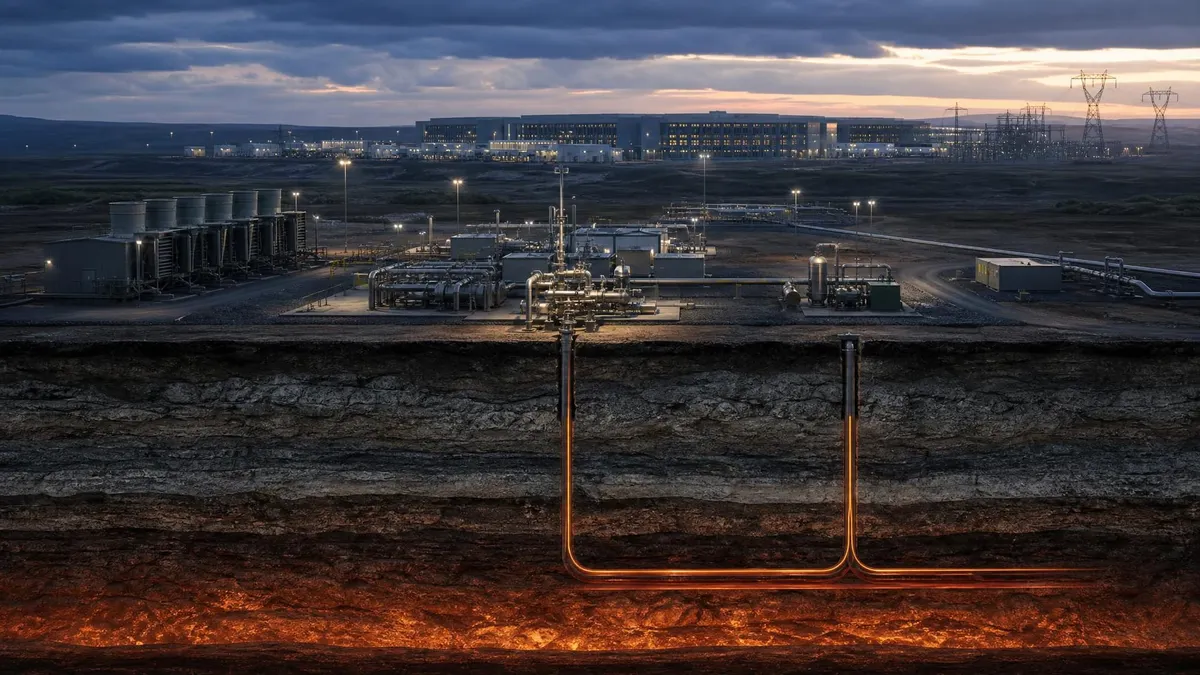
AI sells itself as weightless intelligence: models, agents, synthetic media, autonomous software, invisible computation. But underneath that abstraction are transformers, substations, cooling systems, land, water, permits, wires, turbines, wells, and heat.
The future of intelligence is becoming physical.
That is why geothermal deserves attention. It is not glamorous in the way fusion is glamorous. It does not have the same heroic mythology. It is drilling, data, heat flow, maintenance, and industrial patience.
But that may be exactly why it matters.
The AI economy is learning an old lesson: software scales until it hits the physical world. Enhanced geothermal is one of the clearest signs that the next phase of AI infrastructure will be built not only in chip fabs and data centers, but in the deep geology beneath them.
The smartest energy bet in the AI era may not be the flashiest one.
It may be hot rock that works.
CTA: Read next: Enhanced Geothermal Systems: Why Firm Clean Power Could Become AI’s Most Underrated Energy Bet and AI Data Center Power: Fusion, Geothermal, and SMRs in the Race to Run AI.
Read next: For the larger AI infrastructure picture, see Vastkind's Compute hub, why grid transformers can become the bottleneck, and how data centers are pulling fusion, geothermal, and SMRs into the same race.