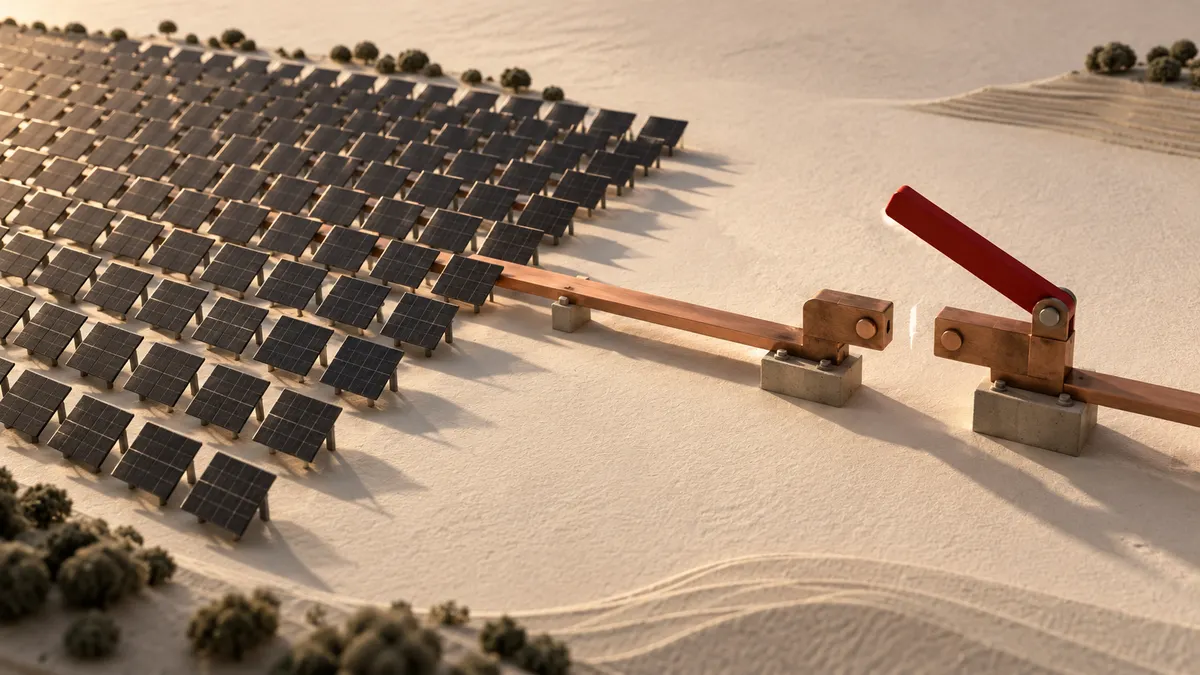
You can finish installing a solar field long before the full project enters commercial service. The missing work is difficult to photograph: proving that a new electrical plant behaves properly alongside everything already connected to the grid.
Horsham’s Renewable Energy Park makes that distinction visible. On September 3, its owner SEC announced the first grid connection and the move into commissioning and energisation. That establishes a new stage of work. The announcement does not establish first exported electricity.
Four states that a finished-looking project can occupy
| Stage | What the public record establishes |
|---|---|
| Panels installed | November 26, 2025: all 212,296 panels installed. The announcement already anticipated operation in 2027. |
| First connection | September 3, 2026: grid connection announced; commissioning and energisation beginning. |
| Capability being demonstrated | SEC identifies hot commissioning and hold-point testing as the next preparation stages. Published completion of those tests is not established here. |
| Complete project operating | Commercial operation remains expected in 2027. Battery arrival and installation are planned for later in 2026. |
This is a record of different milestones, not a four-step clock with equal intervals. The time between panel installation and connection is not, by itself, evidence of delay: the earlier announcement already allowed for a later operating date.
What a hold point actually holds
Australia’s market operator sets out the general logic in its January 2026 commissioning guideline. A plant can be capped at an agreed output or number of operating units until testing and reporting are accepted. The checks concern controller settings and power-system security; some compare measurements with simulations.
There is no universal sequence of 25%, 50% and 100% output. The number and placement of hold points depend on the plant and its potential impact. AEMO allows some low-impact plants to have only the final hold point at full output. That guidance does not reveal Horsham’s individual test schedule.
Think of the installed plant and its simulation as two accounts of the same machine. Before relying on the real one, engineers need to understand where their accounts agree and where a setting or assumption needs attention. An aerial photograph cannot answer that question.
VicGrid’s completion process describes agreed procedures, test results and validated models, with performance reviewed at successive hold points. The applicant provides evidence; review establishes whether progression is acceptable. Monitoring continues after connection is complete.
The battery changes when electricity can be delivered
SEC’s project description combines a 119 MW solar farm with a 100 MW, two-hour battery through a shared connection point. It lists an A$370 million investment and forecasts around 242,000 MWh of annual generation once operational. Those are project specifications and a forecast, not measured output from the completed park.
At its advertised rating, 100 MW for two hours corresponds to 200 MWh. That is a calculation from the specification, not a measurement of usable energy. It also does not mean the battery can sustain full output all night. It must hold enough charge when the electricity is needed.
For comparison, our geothermal project ledger follows generation designed to draw on underground heat. Storage and generation contribute different capabilities. Putting them under the same renewable-energy headline can conceal what each piece is meant to do.
A better question than “is it built?”
Ask what the newest evidence changes. Installed equipment answers a construction question. Connection answers an integration question. Accepted tests establish operating capability under the relevant conditions. Commercial service is another milestone again.
For Horsham, commissioning results, battery installation and commercial operation would each establish a different part of the park’s capability. The distinction matters because an installed solar field, a connected plant and a dependable source of electricity are not the same achievement.
That is the question running through When does a breakthrough become useful?: which surrounding pieces have to work before an impressive component becomes something people can rely on?
Source-based analysis; no site inspection.