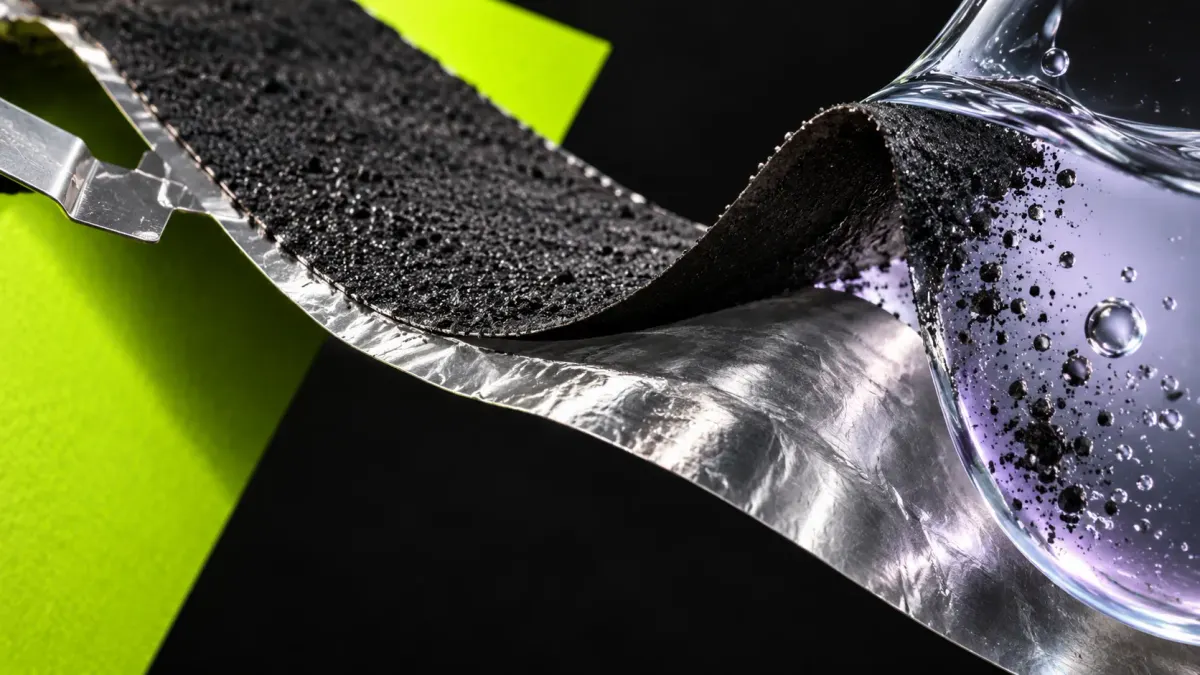
After taking apart their test cells, researchers stirred the positive electrodes in water. In five minutes, the coatings separated from the metal foil beneath them. The conventional-binder comparison used two hours in an organic solvent.
The difference was the glue. A team led by researchers at UC San Diego designed a binder that keeps electrode particles attached during charging and discharging, yet allows a much simpler separation step afterward. Their peer-reviewed study, published October 9 in an accepted early version by Nature Communications, connects two problems usually considered at opposite ends of a battery's life: how to make its layers stay together, and how to take them apart.
Water does not finish the recycling job. The recovered material still goes through drying and high-temperature regeneration. But changing what holds the electrode together changes where the difficult work begins.
A small ingredient with two jobs
An electrode is not simply a slab of active material. Particles that store charge and conductive additives must form a coherent coating on a metal current collector. The binder holds that mixture in place while the cell operates.
A common cathode binder, polyvinylidene fluoride, or PVDF, is processed with the organic solvent NMP. Its chemical durability is useful inside a cell and awkward when the electrode needs to be separated for recycling.
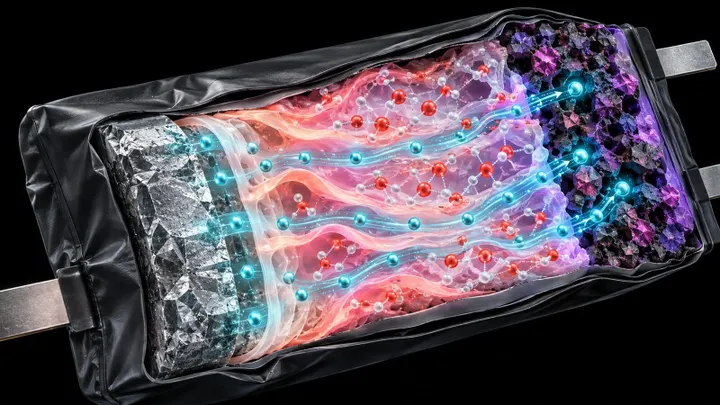
The team's alternative combines polyacrylic acid and carboxymethyl cellulose, linked with citric acid. Called PCC, the network uses several kinds of bonding to grip particles and metal foil while remaining compatible with water-based electrode processing. Simply making the network tighter is not enough: the paper finds that excessive crosslinking can obstruct electrolyte penetration and lithium-ion transport.
Water processing also does not mean a water-filled battery. The finished test cells used a conventional organic electrolyte. The useful property is a binder that can tolerate that operating environment but release material under a different recycling process. As with the gel used to control water in a zinc battery, the surrounding chemistry matters as much as the ingredient's name.
The pouch-cell result is encouraging, not a factory verdict
In a single-layer pouch cell pairing graphite with lithium iron phosphate, or LFP, the new binder supported 1,600 cycles with 76.4% of the initial capacity remaining. That test ran at roughly room temperature and a C/3 rate, a nominal three-hour charge or discharge rate. It is not a forecast of an electric car's service life.
Adding layers exposed a harder test. At 700 cycles, the multilayer pouch retained 74.5% of its starting capacity, compared with 83.5% for the single-layer version at the same point. The authors attribute the gap to effects across the stack, including pressure and electrolyte gradients. The material's promise survives that comparison; the scale-up problem does too.
Five minutes in water is only the separation step
The recycling experiment used electrodes from cells cycled 100 times. PCC-based coatings were separated in deionized water; the PVDF cathode comparison used NMP. The recovered powders then needed further processing before they could be tested again.
For LFP, that included adding lithium and heating the material at 540°C and then 650°C. Recovered graphite was heated to 1,000°C. The study therefore demonstrates easier delamination followed by regeneration, not a battery recycled with water alone.
Nor does restored electrochemical performance establish that every gram was recovered. The methods explicitly say the experiment did not determine a quantitative mass-based recovery yield. The environmental and cost advantages come from a scenario-based life-cycle comparison, not measurements from a commercial recycling plant.
The researchers still need to scale production and optimize the binder for different chemistries. The advance is nevertheless concrete: a battery's end-of-life behavior can be designed into the material that holds it together. Recycling is not only a better process for dismantling yesterday's cell. It can start with a different glue in tomorrow's electrode.
Study context: The work received support from an ECS Toyota Young Investigator Fellowship. Authors Jiao Lin and Zheng Chen disclose a related patent application. The accepted paper and its supplementary information provide the methods and additional cell tests.
Read next: Why a falling battery-incident ratio is not the same as a falling incident count.