An AI accelerator can spend substantial energy moving data rather than transforming it. A photonic chip called FLARE attacks that traffic problem by placing sensing, short-lived activity, longer-lived parameters and computation inside the same network of artificial neurons. The researchers built 7,378 neurons on one chip and used a ten-core system to adapt a small racing drone to a new environment.
The work is a laboratory architecture, not a general-purpose replacement for GPUs. Its value is conceptual and physical: it shows that light-based neurons can hold more than one kind of memory while signals cascade through a multilayer task.
In Plain English: A conventional computer repeatedly carries numbers between a processor and separate memory. FLARE gives each photonic neuron a fast, temporary response and a slower stored setting. Light can then be sensed, processed and passed forward without every intermediate result taking a round trip through external digital memory.
Data Movement Is the Hidden Work
Modern neural networks keep learned weights and intermediate activations in memory. Moving those values through wires and converting between digital electronics and analog signals costs time and energy. Photonic computing promises fast, parallel operations using light, but many optical systems still depend on external memory to store inputs, weights or results. The light may calculate quickly while the surrounding electronics shuttle data.
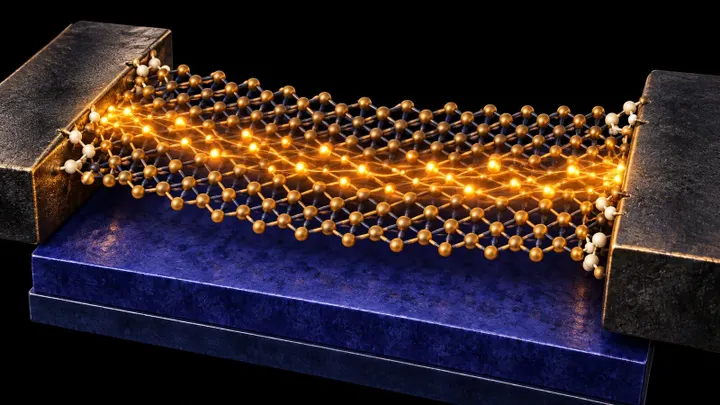
FLARE—described in the Nature Sensors research paper—combines photonic and electronic effects inside a reconfigurable neuron. An optoelectronic feedback path retains a long-term state for 7.45 seconds. A faster optical response preserves gigahertz-scale short-term dynamics. Those timescales play different roles: the slower state can hold a programmed parameter, while the fast state carries changing signals through a computation.
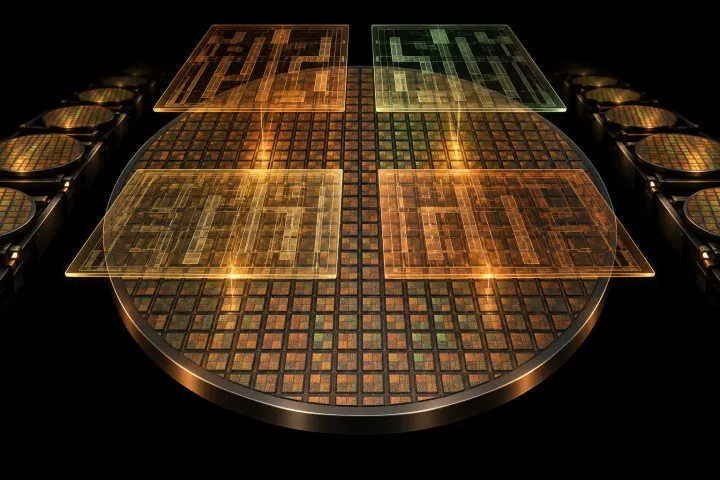
The monolithic chip contains 7,378 neurons arranged across multiple cores. The team cascaded them into a deep nonlinear network, meaning the output of one layer becomes the input of another rather than every layer being read back into a separate computer.
The Drone Test Connects Sensing to Adaptation
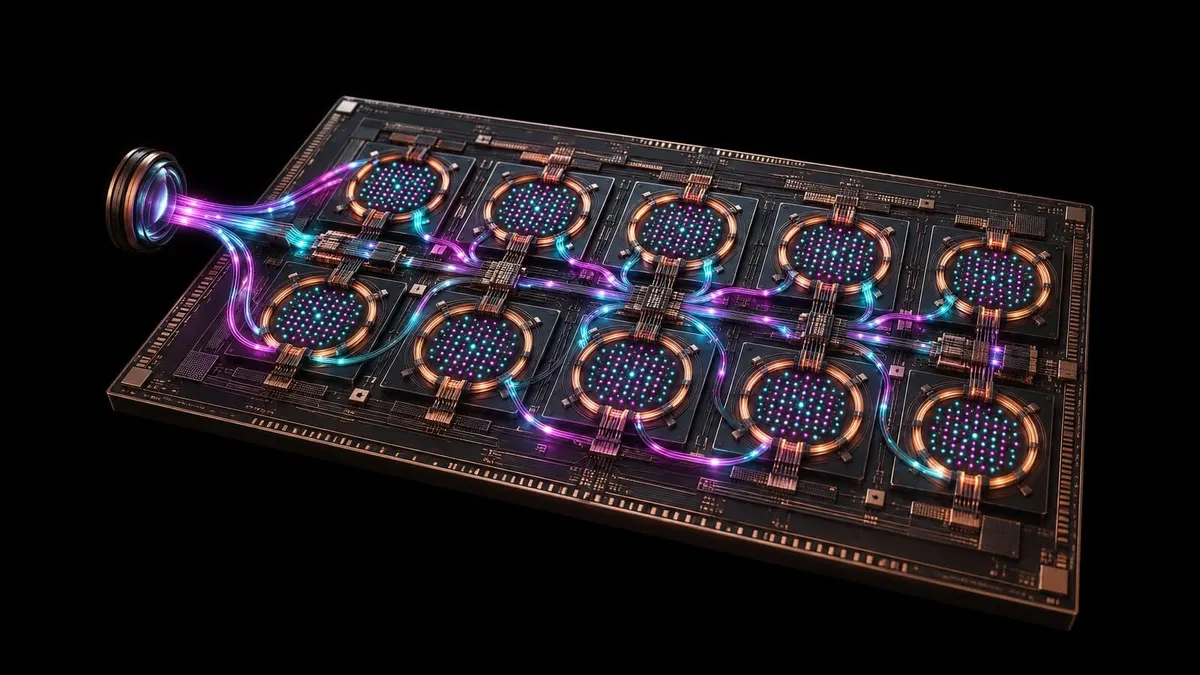
The researchers assembled ten FLARE cores for an end-to-end machine-vision task. A racing drone had to sense an environment, process visual information and adapt onboard when conditions changed. The paper reports a system-level energy cost of 61.87 attojoules per operation.
That tiny number needs careful framing. An “operation” is a hardware-level measure inside this particular architecture, not the energy required for the whole drone, camera, control stack or training process. It cannot be compared casually with a GPU benchmark that counts a different operation, precision or workload. The more durable result is that the same physical network handled sensing, memory and transformation during a closed experimental task.
A research briefing published October 2 highlights the central idea: dissolving the boundary between memory and processing can reduce transfers, while integrating the sensor can remove another journey. The architecture is brain-inspired in organization, not a miniature biological brain. Its neurons are engineered devices with selected timescales, not cells with the flexibility, chemistry or learning processes of nervous tissue.
The Next Test Is Repeatable System Performance
FLARE still faces the standard questions for unconventional computing. A useful accelerator needs stable programming, manufacturing yield, error tolerance, precision and interfaces to the rest of a system. Long-term retention of 7.45 seconds is enough for the demonstrated adaptive task, but it is not nonvolatile storage. A deployed product would need to show how states are refreshed, how temperature and device variation affect results and how many layers can be cascaded before noise overwhelms the signal.
The team provides source data for the main figures, including the end-to-end machine-vision experiment. Independent replication and a transparent comparison against electronic accelerators on the same complete workload would make the efficiency claim more informative. So would tests that include converters, control electronics and memory programming rather than isolating the photonic core.
Vastkind’s recent oxygen-doped transistor analysis separates a strong device from a manufacturable circuit. MIT’s soft nanodevices show another way physical dynamics can create short-lived memory. CXMT’s memory-production claim shows why scale and yield eventually matter more than a single best sample.
FLARE’s next decisive demonstration is therefore not a larger neuron count alone. It is a reproducible application in which the integrated sensing-and-memory design wins on total energy, latency and accuracy after every surrounding component is counted.
Production note: Vastkind reviewed the publication record, abstract, figures, data-availability statement and the October 2 Nature Sensors research briefing. The full article is subscription content; we did not reconstruct claims beyond the accessible record or independently benchmark the chip.