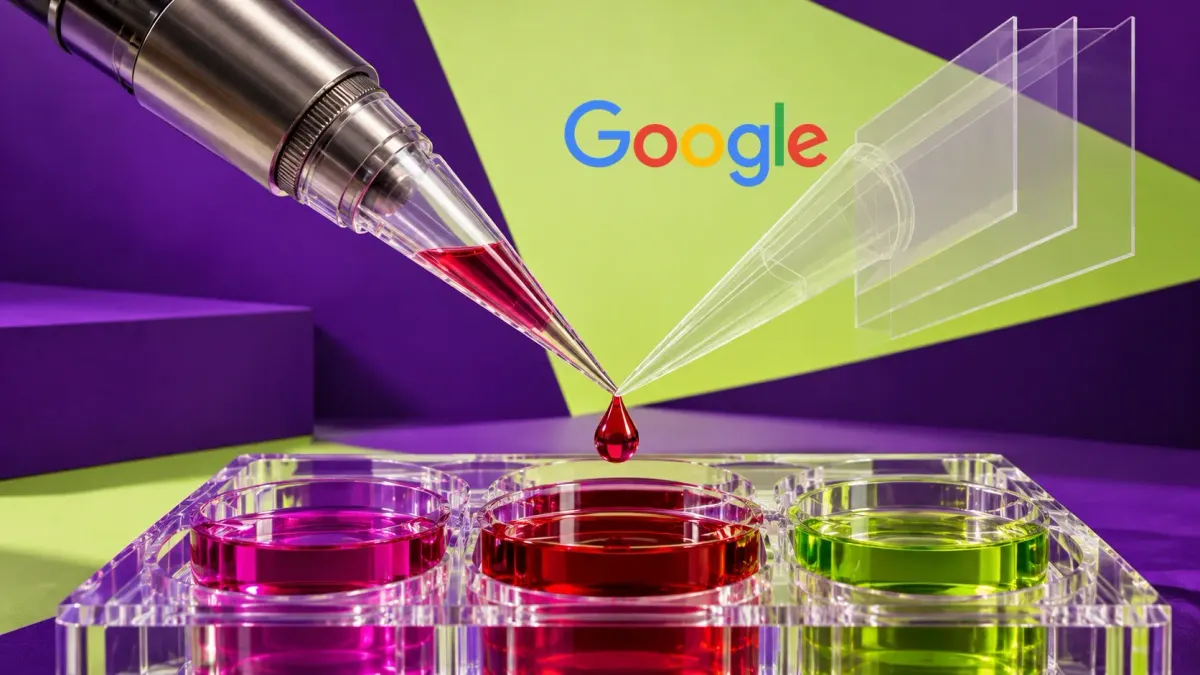
Eight pipette tips needed 72 millimeters of space. The laboratory trough was only 71.2 millimeters long. An AI agent had proposed lowering them all into it anyway.
In Google's VERID research, that mistake stopped at a virtual rehearsal. Software rejected the movement before it reached the robot, and the agent changed its plan. The gap was less than a millimeter. The distinction was between code a computer could run and an action the equipment could actually perform.
Google described the system in an October 16 research update. Its technical report tests VERID with colored dye and water. These are demonstrations of laboratory execution and troubleshooting, not experiments proving a new biological discovery or a treatment.
A rehearsal starts with the lab as it is now
VERID maintains a digital twin: a software model of the work area that persists as the experiment changes. It records where containers sit, their capacities, the liquid volumes being tracked, available pipette tips and instrument status.
Before a proposed block of commands reaches the equipment, the controller copies that current state and runs the plan against the copy. It can check whether a container would overflow, whether a supply would run out or whether the proposed movement fits the geometry. Before dispatch, the commands are checked against the live state again.
This is bookkeeping with physical consequences, not a complete simulation of every liquid's behavior. A valid instruction can still be wrong for the particular lab in front of it. A plate may have a lid on it. A well may already be empty. A robot's next action depends on what earlier actions have changed.
That persistent record also helps after a failure. In one reported experiment, a plate-reader problem arrived after the liquid handling was finished. The agent could continue with the already prepared plate rather than pipetting everything again. Recovering from a fault did not have to mean repeating the physical work.
The simulation caught the collision, not every bad measurement
The narrow-trough experiment exposed another problem after the geometry check had done its job. One pipetting channel appeared to produce weaker readings than the others.
The agent designed a comparison that changed which tips had previously mixed the concentrated dye. The apparent weakness moved with that assignment. The initially suspicious channel was not the problem: dye left on the walls of the mixing tips was being carried into later measurements. The dry tip provided the cleaner baseline.
That distinction matters. A virtual run can reject a movement that does not fit a container. It cannot automatically anticipate a liquid-handling effect missing from its model. The physical experiment, its controls and its recorded history still have to reveal those errors.
The researchers call this case supervised diagnosis. A human operator guided which limitations to accept and which to investigate; the agent worked through the selected problems. In another case, the agent noticed faulty dilution, but a person used synchronized video and logs to identify dye stratification and tips pressing against the well floor.
Connecting a robot is only the first layer
Our earlier account of Claude's laboratory work and its bubble problem examined the connection between AI and scientific equipment. VERID addresses a more specific question: what must sit between a proposed command and the moving machine? Its answer combines a lasting state record, a virtual test and evidence from the real run.
The demonstrations come from the system's developers. They do not establish reliability across other laboratories, and the technical report is not presented here as independently replicated or confirmed by peer review. Google also says people authorize and review designs, verify protocols and supervise robot runs. The broader autonomous laboratory remains a research goal.
As with an AI deciding when a robot arm should stop, the useful advance is not simply producing another instruction. It is making the instruction answer to the machine's current state. VERID's rehearsal can catch the impossible move; the experiment still has to expose what the rehearsal did not know.