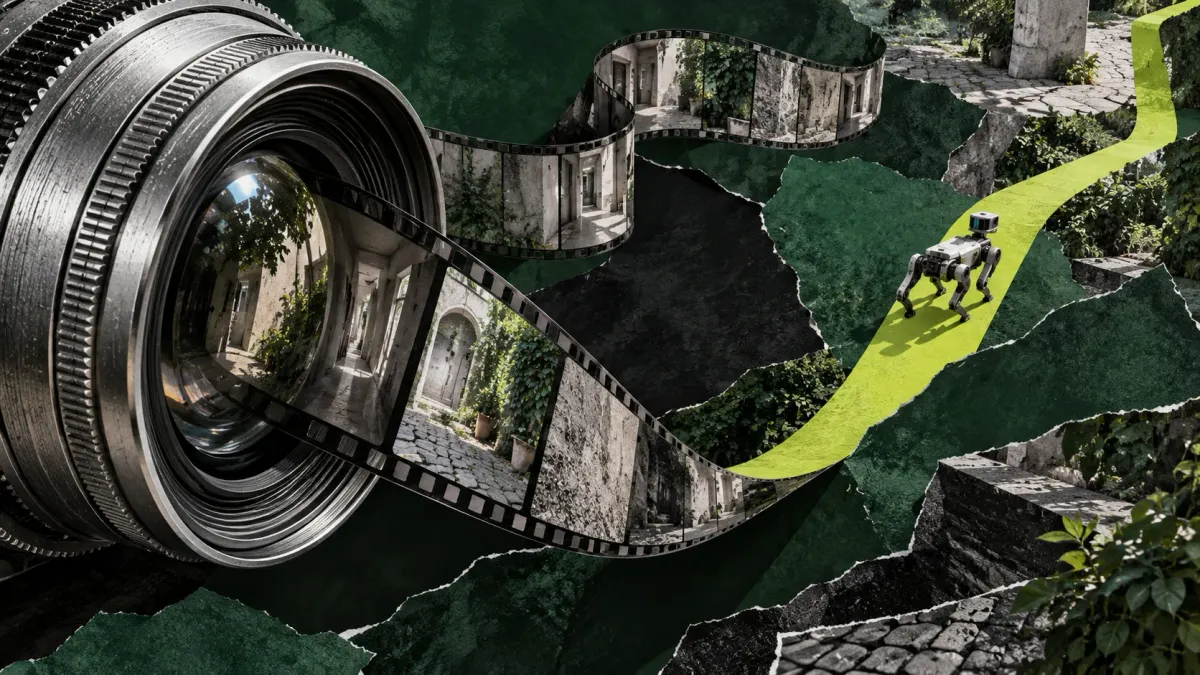
A robot approaching a cluttered passage can sketch several ways through it. The expensive part is deciding which one is worth taking. One approach generates the camera images the robot might see along each route, then judges those imagined futures. That can turn a useful question about the next few steps into a costly video-generation problem.
LiteNWM, a preprint submitted on October 8 and listed on arXiv on October 9, tests a more economical alternative. It predicts compact visual features rather than future pictures. The researchers report better goal-reaching results than a simpler navigation policy in a small real-robot study. Their timing results also expose an important tradeoff: looking ahead became cheaper, not free.
Keep the useful future, skip the film
The system starts with camera observations and an image of the destination. An existing navigation policy proposes candidate paths. LiteNWM then estimates the visual representations that would result from following those paths and uses a learned scoring system to choose among them.
These representations are numerical features, not pictures a person can watch. The robot still uses camera images to perceive its surroundings; it avoids turning every predicted future back into pixels. It also shares the encoding of the current scene across candidates and predicts several future horizons together.
That distinction matters when the computation has to travel with the robot. A beautifully rendered prediction is not necessarily a better basis for choosing a short route. The useful target is information that helps discriminate between possible actions.
There is a family resemblance to Bee-Nav's narrow approach to visual homing: make the computational task smaller without discarding what the job actually needs. The methods solve different problems. Bee-Nav learns how to return home; LiteNWM evaluates proposed local paths toward a visual goal.
Thirty attempts, not a reliability rating
The researchers tested a Unitree Go2 EDU in three settings: an open indoor area, a cluttered indoor area and an outdoor courtyard. Each method received ten trials per setting. LiteNWM reached the goal in 25 of 30 trials, compared with 13 of 30 for the NoMaD policy alone.
Reaching the goal had a defined meaning. The robot had to enter a one-meter radius, see the appropriate target and face within 60 degrees of the required orientation before a collision, corrective intervention or abnormal termination. Passing briefly through the target did not count.
The result is promising because it measures completed navigation on a physical machine, not just the appearance of a generated scene. It remains the authors' test across three settings, however. Five LiteNWM attempts still failed. These are not independent field measurements or evidence of dependable unattended operation.
The longer-route demonstrations also used a pre-mapped sequence of intermediate goal images. They should not be read as a robot independently discovering an arbitrary long route through an unfamiliar place.
Cheaper than video, slower than simply choosing
On the robot's Jetson Orin computer, LiteNWM averaged 2.228 seconds per completed planning call across 311 calls. NoMaD alone averaged 0.651 seconds across 302 calls. Both measurements exclude robot movement and model initialization. The extra foresight still costs time compared with choosing a path without that evaluator.
The image-generating comparison was much more expensive: NoMaD with the smaller Navigation World Model averaged about 235 seconds per planning call, even with fewer diffusion steps. But that number came from only two exploratory runs and 22 calls. Those runs were excluded from the 30-trial success comparison. It is a useful indication of the computational burden, not a matched claim that the entire journey became a hundred times faster.
This is the practical distinction in the paper. A predictor can be too expensive to use repeatedly, while a cheap policy can make worse choices. LiteNWM seeks a workable middle ground. Larger tests would need to show how that compromise holds up as routes, obstacles and conditions change.
Navigation also has goals beyond arrival. As research on quieter robot movement illustrates, a successful route can still disturb the people sharing it. Predicting the right future depends on defining what a good trip is.
LiteNWM's useful idea is not that robots need less understanding. It is that an imagined future should earn its computational cost by improving a decision. For choosing the next path, the relevant features may matter more than a movie of what comes next.