The most interesting robotics event of 2026 did not happen in a lab.
It happened on a road.
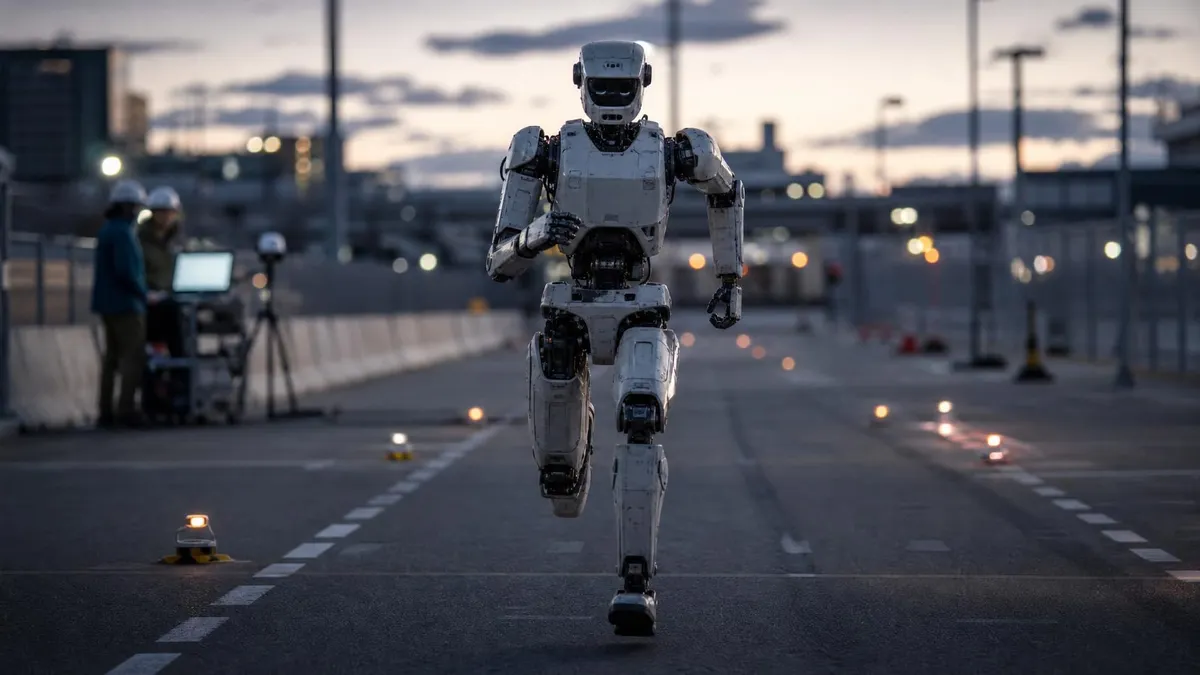
The 2026 Beijing Humanoid Robot Half Marathon looked, at first glance, like spectacle: humanoid machines running alongside humans, industrial ambition dressed up as a public race. That is the easy version of the story. It is also the least useful one.
The real story is that robotics is starting to be judged by the things demos usually hide: endurance, navigation, battery management, thermal stability, terrain changes, sensor fusion, mechanical wear, recovery from mistakes, and whether the whole system can keep working when the environment refuses to behave.
That is why the race matters.
According to IDC’s analysis, the 2026 event drew more than 100 teams and marked a shift from basic mobility toward system-level validation. IDC noted that 38% of participating teams used fully autonomous navigation and argued that competition is moving toward real-world deployment capability and value delivery.
That is the correct lens. Not “robots can run now.” More like: robots are finally being tested in ways that reveal whether they can survive reality.
The Race Was a Benchmark in Disguise
A half marathon sounds like a stunt until you look at what it forces a robot to prove.
A humanoid has to balance through thousands of steps. It has to maintain joint control under repeated load. It has to handle heat, vibration, uneven surfaces, turns, slope changes, sensor noise, and imperfect localization. It has to make decisions without falling apart every time the world varies slightly from training conditions.
That is not just athleticism. It is operational stress.
Most robot demos are short. They happen in controlled settings. The camera sees the successful take, not the failed attempts, resets, safety handlers, battery swaps, and hidden constraints around the scene. A long public course changes the evaluation. It makes the robot prove continuity.
Continuity is where robotics becomes serious.
A robot that can perform one impressive motion is interesting. A robot that can keep functioning through a long sequence of messy physical conditions is much closer to being useful.
That is why the marathon is a better symbol than another polished humanoid video. It asks a more adult question: can the machine keep going?
Autonomy Is Moving From Feature to Threshold
IDC’s most important detail was not speed. It was autonomy.
If 38% of teams used fully autonomous navigation, that means the race is no longer only about remote-controlled machines performing a public routine. It is becoming a test of perception, planning, and action under changing conditions.
That matters because autonomy is where humanoid robotics stops being a puppet show.
A remotely operated humanoid can be impressive, but it does not yet prove economic value. It still depends on human attention. It shifts labor rather than replacing or augmenting it in a scalable way. Real deployment needs robots that can perceive their surroundings, choose actions, recover from instability, and continue working without constant human correction.
This is also where robotics becomes harder to govern. A robot that moves autonomously through public or industrial space is not just a machine. It is a physical actor. If it fails, it can hit something, block something, damage equipment, injure someone, or create a chain reaction in a workflow.
That is why autonomy cannot be measured only by whether the robot reaches the finish line. It has to be measured by how it behaves under uncertainty.
The future of humanoid robotics will not be decided by the best single demo. It will be decided by failure recovery.
Physical AI Needs More Than a Brain
The phrase “physical AI” is everywhere now, and it is useful if we do not let it become marketing fog.
NVIDIA’s 2026 robotics push, summarized by StockTitan, centered on simulation frameworks, world models, Isaac Lab, GR00T models, and partnerships tied to industrial robot fleets. The important point is not one model name. It is the stack.
Robots need more than intelligence. They need a training pipeline. They need simulation. They need hardware-software co-design. They need data from failures. They need ways to validate behavior before deployment. They need infrastructure around the robot, not just a more impressive robot body.
This is the same pattern we see in broader AI: the breakthrough is not only the model. It is the system around the model.
For robotics, that system has to touch the physical world. A simulated policy has to transfer. A perception model has to work with lighting changes, dust, occlusion, vibration, and cheap sensors. A walking controller has to deal with friction, worn parts, and imperfect floors.
This is why humanoids are so hard. They are not only AI problems. They are physics problems with software inside.
That also explains why the strongest robotics companies may not be the ones with the most viral humanoid. They may be the ones with the best data flywheel, simulation discipline, failure analysis, and deployment support.
Why This Matters
Humanoid robots matter because they could move AI from screens into labor, care, logistics, manufacturing, and public space. But that only happens if robots become reliable enough to trust, not merely impressive enough to share. The Beijing race is useful because it reveals the unglamorous constraints that decide deployment: batteries, heat, navigation, balance, recovery, and maintenance. If robotics becomes a real industry, it will be built on those constraints first.
The Humanoid Form Is Still on Trial
There is a deeper question beneath the race: do humanoids actually make sense?
The answer is not obvious. Human-shaped robots are attractive because the world is designed around human bodies. Doors, stairs, shelves, tools, and workspaces assume arms, legs, hands, eyes, and roughly human proportions. A humanoid that can use existing environments has a theoretical advantage.
But the form factor is expensive. It is mechanically complex. It is harder to stabilize, harder to cool, and harder to maintain than many specialized machines. In warehouses, factories, and hospitals, a non-humanoid robot may often be cheaper, safer, and better.
That means the humanoid race should not be read as proof that the humanoid form has won.
It should be read as a test of whether the form can earn its cost.
This is where the conversation gets more interesting than “robots are coming.” The real question is where embodiment is worth it. A humanoid may make sense in environments built for humans, especially where redesigning the environment is too expensive. It may make less sense where purpose-built automation can do the job more efficiently.
That is the commercial filter. Not whether the robot looks futuristic. Whether the body pays for itself.
From Demo Culture to Deployment Culture
Robotics has been trapped in demo culture for years.
A robot walks. A robot dances. A robot picks up an object. A robot folds a shirt, slowly, once, under ideal conditions. The clip goes viral. Everyone declares a new era. Then the machine disappears back into the lab.
Deployment culture is different.
It asks uglier questions:
- How often does it fail?
- How long does it run between interventions?
- What does maintenance cost?
- Can it recover without human rescue?
- Can it operate around people safely?
- Does it create more work than it removes?
- Who is accountable when it behaves unpredictably?
Those questions are less cinematic. They are also the questions that matter.
This is why the robotics future may arrive more quietly than people expect. Not as a sudden wave of humanoids in homes, but as a gradual expansion of embodied systems into narrow workflows where uptime, safety, and return on investment can be measured.
That connects directly to the broader question of whether we are heading toward a robot society. The answer is probably yes, but not because robots become charming companions overnight. It happens when machines become dependable enough to earn permanent roles inside ordinary systems.
It also connects to the rise of large behavior models for robots. The smarter the robot policy becomes, the more important evaluation becomes. A learned behavior system is only useful if it survives contact with the world outside the training environment.
The Real Robotics Race Has Barely Started
The Beijing half marathon was not the finish line. It was an early stress test.
That is what makes it exciting.
Robotics is entering the phase where progress becomes less theatrical and more operational. The next breakthroughs may not look like a robot doing a backflip. They may look like a robot that can work for six hours without intervention, navigate a crowded warehouse without freezing, swap tasks without a full engineering reset, and fail in ways humans can predict and manage.
That is the threshold between machines that impress us and machines we build around.
Humanoid robots do not need to become human to matter. They need to become reliable.
And for the first time, the industry is starting to be judged by that harder standard.
CTA: Read next: Robot Society: Are We Heading Toward a World Built With Machines? and Large Behavior Models: Why Atlas Walking and Grasping With One Policy Matters.