OpenAI says one of its internal reasoning models has produced a proof that disproves a long-standing conjecture in discrete geometry.
The easy reading is that AI has solved a hard math problem. That is true, if the proof survives wider mathematical scrutiny.
The harder reading is more important: AI is beginning to cross from explaining human knowledge into producing candidate knowledge of its own.
That is a different kind of event. It does not mean AI replaces mathematicians. It means research institutions now need to decide how machine-generated discoveries are checked, credited, trusted, and turned into science.
What OpenAI says happened
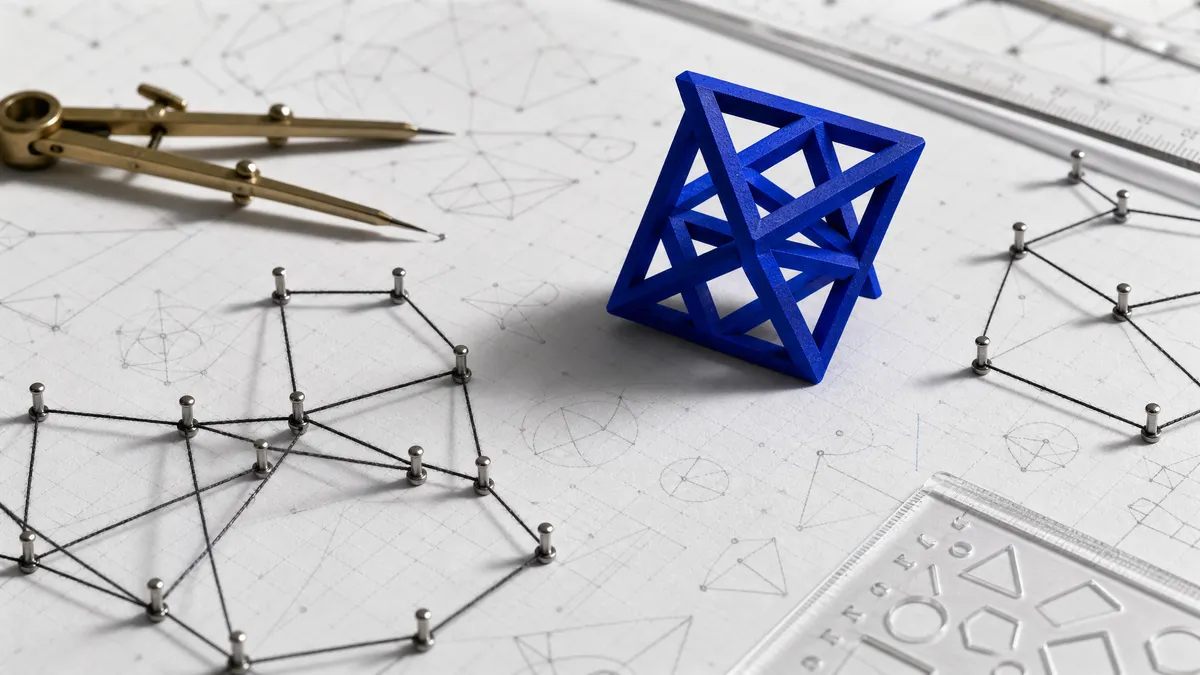
The problem is the planar unit distance problem, first posed by Paul Erdős in 1946. The question is simple to state: if you place a set of points in a plane, how many pairs of points can be exactly one unit apart?
For decades, mathematicians believed that square-grid-like constructions were close to optimal. In OpenAI's announcement, the company says an internal model found an infinite family of examples that gives a polynomial improvement over that expectation.
OpenAI also says the proof was checked by external mathematicians, who prepared a companion paper explaining the argument and its significance. The company published both a proof document and companion remarks.
The technical detail matters. But the public story should not get trapped inside the geometry.
The result is not just that a model found a clever answer. OpenAI says the proof came from a general-purpose reasoning model, not a system trained only for this problem or hand-built as a mathematical search engine.
That distinction is the actual hinge.
Why the math matters less than the role change
Most AI progress stories are still framed around assistance.
AI writes code. AI summarizes documents. AI generates images. AI drafts emails. AI searches files. AI helps scientists read papers faster or propose candidate molecules.
Those are powerful uses, but they keep the machine in a familiar role. It speeds up human work. It reduces friction. It expands output.
A verified mathematical proof is different because it can add something to the stock of knowledge. If the result holds, the model did not merely repackage what humans already knew. It produced a construction that changes what the field can say about an open problem.
That is why this story belongs next to earlier Vastkind pieces on agentic AI and delegated power and AI in scientific literature. The issue is not only capability. It is institutional absorption.
A research system built around human authors, peer reviewers, journals, conferences, labs, grants, citations, and reputations now has to handle output from systems that do not fit those roles cleanly.
Who gets credit? Who is responsible if a proof is wrong? How much human checking is enough? Which AI-generated results deserve publication? How do journals distinguish genuine discovery from machine-produced noise?
Those questions matter because discovery is not just an act of finding. It is a social process for deciding what counts as knowledge.
Mathematics is the cleanest testbed for AI discovery
Mathematics is one of the safest places for this boundary shift to appear first.
A proof can be checked. A false step can be found. The community has tools for verification, even if the process is slow and demanding. The object under review is not a patient, a market, a bridge, or a public policy.
That makes math unusually well suited to testing whether AI reasoning can produce something original.
It also makes the result easy to overread.
A geometry proof does not mean AI can reliably discover drugs, run clinical science, forecast economies, or resolve policy tradeoffs. Those domains have noisy evidence, hidden variables, changing incentives, ethical constraints, and real-world consequences that do not reduce neatly to proof validity.
But mathematics gives a clean signal. If a model can generate a result that expert mathematicians can check and accept, then the question changes.
The question is no longer only whether AI can imitate expertise. It is whether AI can create work that expertise must evaluate.
That is a stronger position.
It also connects to the broader problem with AI benchmarks. Benchmarks test performance inside predefined tasks. A new mathematical construction tests whether a model can move outside a known answer key and still produce something durable.
That is much closer to what people actually mean when they talk about scientific discovery.
The evidence boundary matters
This is where the claim needs discipline.
The proof is not settled just because OpenAI announced it. It is stronger than a product demo because OpenAI released technical documents and says external mathematicians checked the result. But broader acceptance still depends on mathematical review beyond the announcement cycle.
There are also process questions OpenAI's public post does not fully answer.
How was the problem selected? How many attempts failed? What prompts, scaffolds, filters, or human evaluation steps shaped the model's path? How much of the final result came directly from the model, and how much came from humans deciding what to test, preserve, rewrite, or publish?
Those questions do not invalidate the story. They define it.
AI discovery will not arrive as a clean movie scene where a model prints truth and humans applaud. It will arrive through messy workflows: machine search, human taste, expert checking, institutional caution, publication politics, and replication.
The mature position is not skepticism for sport. It is boundary-setting.
OpenAI appears to have a serious result. The right response is to take it seriously without converting it into mythology.
Why This Matters
If AI can produce candidate knowledge, the bottleneck moves.
The scarce resource is no longer only model capability. It becomes verification capacity: expert time, peer review bandwidth, proof checking, replication, and institutional trust.
A lab with powerful models may generate more hypotheses, proofs, molecules, designs, or strategies than human institutions can responsibly evaluate. That sounds like abundance, but unmanaged abundance creates a new kind of scarcity.
The world may not be short of ideas. It may be short of trusted ways to separate discovery from debris.
That is the real shift. AI does not have to replace researchers to change research. It only has to produce enough plausible work that human experts become the bottleneck between output and accepted knowledge.
What comes next for research institutions
The next phase is not simply better models. It is better research plumbing.
Mathematics will need norms for AI-generated proofs: disclosure, authorship, verification, journals, citation, and credit. Scientific fields will need stricter versions of the same machinery because their evidence is less clean.
Universities and labs may also split into two functions that used to be more tightly coupled. One function generates candidate insight. The other validates it.
AI pushes those apart.
That changes power. Organizations with the best models may flood the frontier with plausible discoveries. Organizations with the best human experts may become gatekeepers of validity. Journals, conferences, and reviewers may have to process work that comes from systems with no professional reputation and no personal accountability.
This is why the OpenAI geometry story is bigger than geometry.
It is a preview of research after the tool metaphor breaks.
The old question was: can AI help humans think?
The new question is: what happens when AI starts producing things that humans have to decide whether to know?
For readers tracking this shift, the next useful step is Vastkind's guide to AI in scientific literature, because the future of discovery will depend as much on verification systems as on model intelligence.