Google has introduced Gemini Omni, a new model family that begins with video generation and editing. The first release, Gemini Omni Flash, is rolling out through the Gemini app, Google Flow and YouTube Shorts.
The easy reading is that Google has launched another AI video generator.
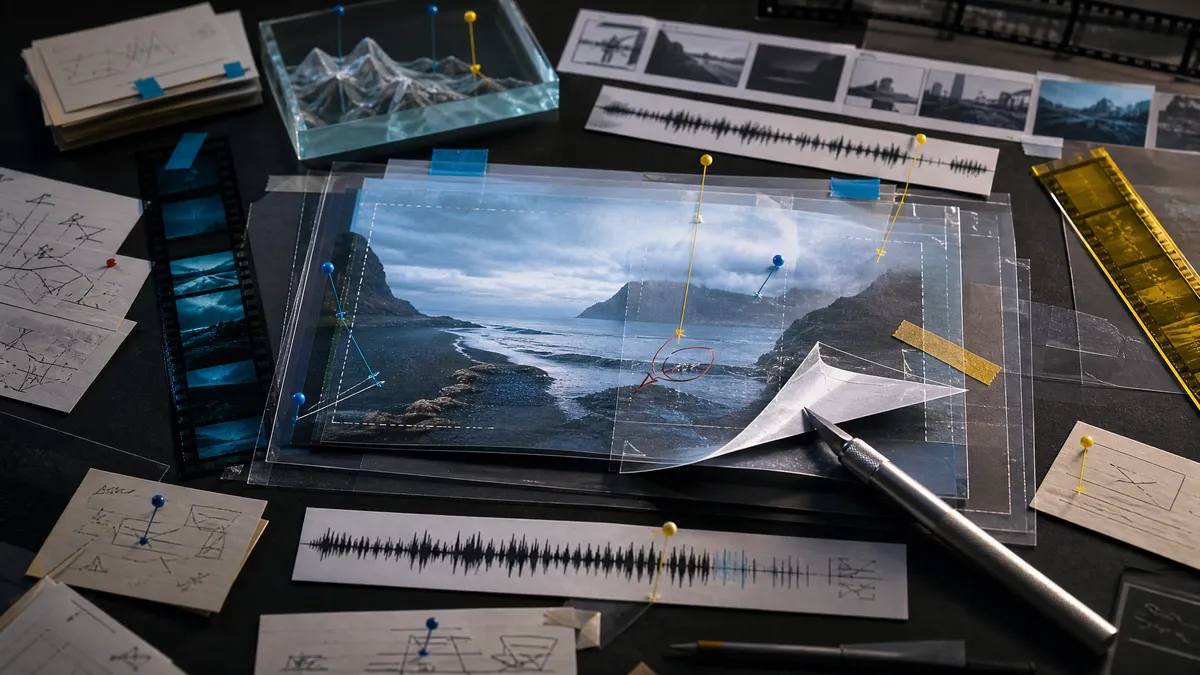
The stronger reading is that Google is trying to turn video into an editable interface. Gemini Omni is not only about making a clip from a prompt. It is about taking text, images, audio and video as references, then changing a scene through conversation without starting over each time.
That changes the creative problem. The bottleneck moves from production skill to direction, taste, verification and judgment.
What Gemini Omni Actually Does
Gemini Omni is Google’s attempt to join generative video with Gemini’s broader multimodal reasoning system.
Google describes the model as one that can “create anything from any input,” starting with video. In practice, the first public version matters because it accepts text, image, audio and video inputs, then outputs high-resolution video with audio. The model card says Gemini Omni Flash has native multimodal support for text, vision, video and audio.
That is the important product shape. A user can begin with a video, add an image as a reference, use music as a timing cue, then ask the model to change the camera angle, remove an object or alter the scene.
Older AI video tools were often judged by first output: did the prompt make a convincing clip? Gemini Omni points toward a different standard: can the user keep working with the clip?
That sounds small. It is not.
Creative software becomes powerful when it supports revision. A generated image or video is useful once. An editable scene becomes a working surface.
The Misread Is “Better AI Video”
Most coverage will treat Gemini Omni as a quality race against OpenAI, Runway, Pika, Midjourney Video, or whatever model looks best in a demo reel.
That race matters, but it is not the deepest shift. The deeper shift is control.
A creator does not only need a beautiful clip. They need to make the same character behave differently, change the camera without breaking the scene, preserve continuity across edits, match audio timing, remove something specific, keep text legible, and avoid rebuilding the entire piece from scratch after every change.
This is where AI video starts to look less like a magic generator and more like an interface for synthetic scenes.
Vastkind has already argued that AI video is changing Hollywood first as workflow, not as art. Gemini Omni strengthens that point, but moves it closer to everyday creation. If these tools work inside Gemini, Flow and YouTube Shorts, the workflow does not stay confined to studios. It moves toward creators, educators, marketers, small teams and eventually anyone who needs moving images without a production crew.
The question becomes less “Can AI make video?”
It becomes “Can people direct video the way they now edit text?”
Why Conversational Editing Matters
Conversational editing changes the unit of creative work.
In traditional video production, every change has a cost. A new angle, object, background, lighting setup, actor movement or reshoot can require people, time, equipment and coordination. In conventional software, the cost is lower, but the user still needs tool fluency. They need timelines, masks, keyframes, layers, plugins and exports.
Gemini Omni compresses that into instructions.
“Make the violin invisible.”
“Transport the violinist to the image environment.”
“Change the camera angle to be over the violinist’s shoulder.”
Those examples are product demos, not proof of universal reliability. But they show the interface direction. The user is no longer only prompting a finished artifact. The user is negotiating with a scene.
That distinction matters for work. A marketing team can explore five visual treatments without commissioning five shoots. A teacher can turn a rough concept into a visual explainer. A YouTube creator can alter a scene after seeing how it plays. A product team can sketch motion without a full animation pipeline.
The new scarce skill is not pressing the right software buttons. It is knowing what should change, what should stay, and when the output is good enough to carry meaning.
Gemini Omni Is Also a World-Model Signal
Google frames Gemini Omni around “world understanding,” physics and real-world knowledge. That language should be handled carefully.
A model that produces a plausible marble rolling down a track is not the same as a scientific simulator. A model that makes fluid or gravity look convincing is not proving that it understands physics in the human or engineering sense. Google’s own model card says Gemini Omni Flash still struggles with complete consistency through edits, complex motion and perfectly accurate text.
That caveat is not a footnote. It is the boundary of the story.
Still, the direction is important. Video editing becomes more powerful when the system can maintain objects, motion, identity and context across instructions. If a model can hold enough of a scene together, a user can treat it as a manipulable world rather than a disposable clip.
This is why Gemini Omni sits near the same frontier as Genie 3 and promptable world models, but it should not be read as the same thing. Genie-style systems point toward interactive environments. Gemini Omni is closer to a creative editing layer. One asks what happens when AI can generate worlds. The other asks what happens when people can revise visual reality as a conversation.
Both shift attention from static output to controllable environments.
Why This Matters
Gemini Omni matters because it changes where creative leverage sits.
For creators, it lowers the cost of first drafts and variations. That helps small teams, but it also floods every platform with more synthetic visual material. The advantage will not go to the person who can generate the most clips. It will go to the person or organization that can choose, refine, verify and package the right ones.
For creative workers, the tool pressure is obvious. Some production tasks become cheaper. Some junior execution work becomes less protected. But higher-level direction, story logic, taste, rights awareness and brand judgment become more valuable. The labor shift is not simply replacement. It is a redistribution of where human judgment enters the pipeline.
For platforms, the stakes are trust and volume. Gemini Omni arrives alongside Google’s expanded use of SynthID and C2PA Content Credentials. Google says content created or edited with Omni in Gemini, Flow or YouTube includes imperceptible SynthID watermarking and C2PA credentials, with verification expanding through Gemini, Search and Chrome.
That is not a nice add-on. It is a sign that generative media cannot scale without provenance.
If anyone can revise video by conversation, viewers need better ways to know whether something was captured, edited, generated or assembled from references. Vastkind’s deeper concern here is the same one behind the weakening of proof in the deepfake era: synthetic media does not only create fake things. It weakens confidence in real things.
The Evidence Boundary
Gemini Omni should not be overread.
The current public evidence is mostly Google’s own announcement, product page and model card. We do not yet have broad independent evaluation, production-scale case studies or reliable comparisons across hard use cases. The model card itself acknowledges limits around edit consistency, complex motion and accurate text rendering.
That means the sober claim is not: Gemini Omni has solved video.
The sober claim is: Google is packaging AI video as an editable multimodal interface, and that is the more important direction to watch.
This also means the article should not become a fan note for Google. Omni is part of a larger convergence that Vastkind has tracked before: AI frontiers are merging across language, images, video, audio, agents and tools. Gemini Omni is one concrete product expression of that convergence.
The product may disappoint in edge cases. The direction still matters.
The Real Shift Is From Making To Directing
The phrase “AI video generator” is already too small.
If Gemini Omni works as Google describes, the tool is not only generating video. It is turning video into something closer to a document, a workspace or a scene file that can be revised through language.
That is why the creative question changes.
The old question was: who can make the image?
The new question is: who can direct the system, judge the result, prove the source and decide what should exist?
That is a harder question than the demo suggests. It is also the reason Gemini Omni is worth watching.
The future of AI video will not be decided only by which model makes the prettiest five-second clip. It will be decided by which systems let people revise scenes reliably, preserve meaning across edits, and keep enough provenance intact that viewers can still tell what they are looking at.
That is the real story. Video is becoming conversational software.
Get the Vastkind Briefing for weekly judgment on frontier technology, what changed, why it matters, and what most coverage missed.