Orbital data centers sound like an idea designed to be mocked.
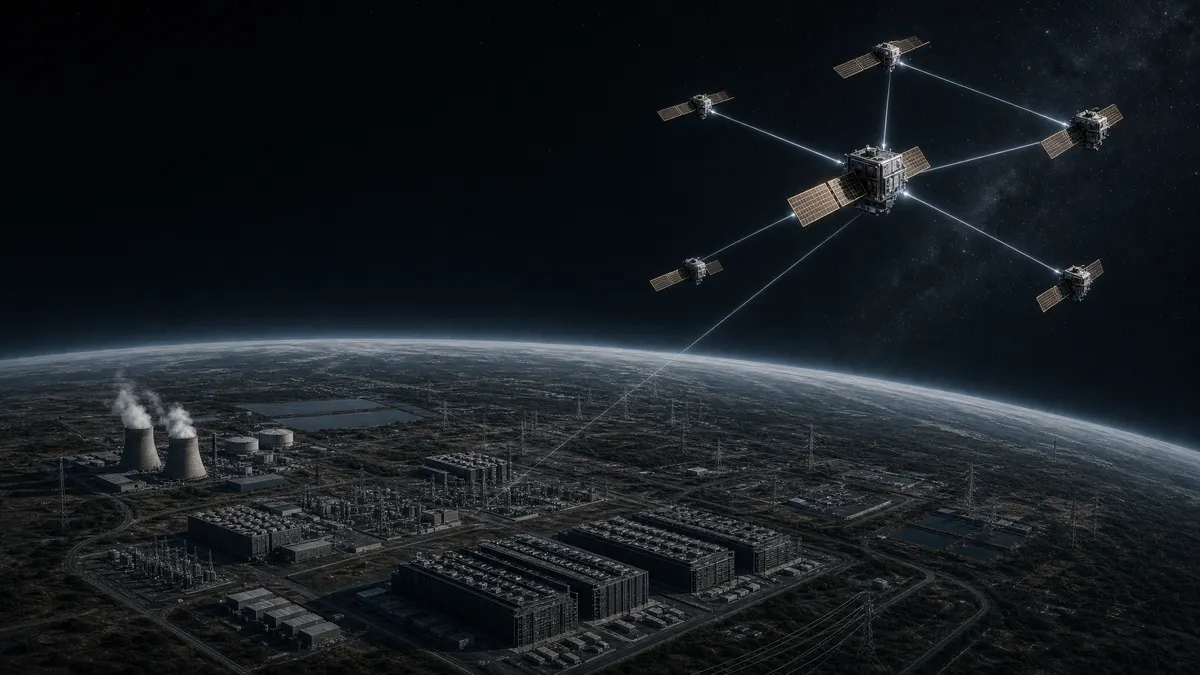
Put AI chips on satellites. Fly them through low Earth orbit. Use sunlight instead of terrestrial power plants. Link the satellites together with lasers. Route computation back to Earth.
The easy reading is that this is science fiction with a cloud-computing budget. The harder reading is more useful: orbital data centers are a sign that AI compute is running into the politics of power, water, land, cooling, grid capacity, and local permission on Earth.
That does not make space-based AI compute inevitable. It does make it revealing.
AI infrastructure is no longer only a story about better chips or larger cloud regions. It is becoming a geography problem. Where can the industry find enough power? Where can it cool the machines? Where can it get land, grid access, permits, and public tolerance fast enough to keep scaling?
Orbital data centers are one attempted answer. Not a solved answer. Not a clean answer. But an answer that shows how hard the terrestrial bottleneck has become.
Why orbital data centers are suddenly being taken seriously
The concept has moved from fringe speculation into serious research and regulatory filings.
Google's Project Suncatcher is the cleanest technical signal. The idea is to build compact constellations of solar-powered satellites carrying Google TPUs, connected by free-space optical links. In the right orbit, Google argues, solar panels can be up to eight times more productive than on Earth and can produce power nearly continuously.
That matters because AI compute is becoming less constrained by software imagination and more constrained by physical supply. Chips need memory. Memory needs power. Data centers need cooling, transformers, substations, land, and interconnection. Vastkind's foundation guide on compute infrastructure explains that stack in detail. Orbital compute is an attempt to move part of that stack into a different physical regime.
Google is not only writing a concept note. Planet says it will build and operate two prototype satellites for Project Suncatcher, targeting launch by early 2027. The mission is meant to test Google's TPUs in the space environment and test whether two spacecraft can work together with high-bandwidth cross-link communications.
The same trend is visible in more aggressive form elsewhere. SpaceNews reported that SpaceX filed plans with the Federal Communications Commission for an orbital data-center constellation of up to one million satellites. Blue Origin has also filed plans for Project Sunrise, a proposed in-space computing system of up to 51,600 satellites.
Those numbers should not be read as near-term deployment forecasts. They are filings, not finished infrastructure. But they show that the idea is no longer just a thought experiment from a startup white paper.
The more important question is why this idea is becoming attractive at all.
The problem they are trying to escape on Earth
AI data centers are becoming politically visible because they consume resources people can feel.
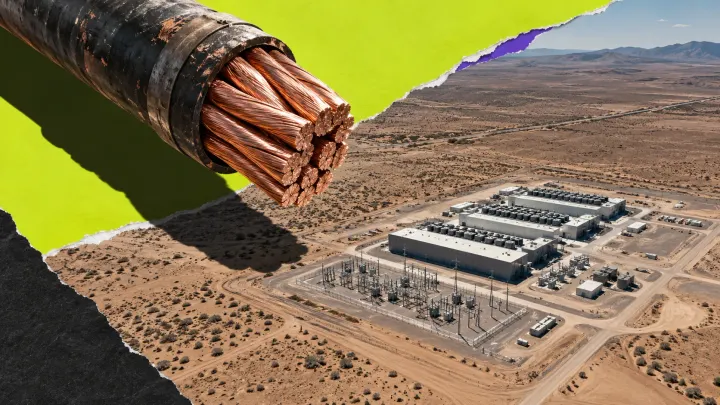
A terrestrial data center is not just a building full of servers. It is a claim on electricity, land, water systems, local transmission capacity, transformers, permitting timelines, and sometimes residential electricity politics. The larger AI becomes, the harder it is for that claim to stay invisible.
That is the context most space-data-center coverage underplays. The story is not only that solar power is abundant in orbit. The story is that power on Earth is increasingly contested.
Communities notice when hyperscale data centers compete for water or ask for major grid upgrades. Regulators notice when electricity demand from data centers starts affecting ratepayers. Utilities notice when cloud and AI companies want firm capacity faster than transmission and generation can be built. Local officials notice when economic development promises collide with land use, noise, water, tax incentives, and public resistance.
This is why AI data center power has become a strategic issue rather than a utility footnote. The industry can buy chips quickly. It cannot always buy substations, grid interconnection, clean firm power, cooling capacity, and local consent on the same timeline.
Orbital data centers are interesting because they promise to route around some of that friction.
In orbit, there is no local town board in the terrestrial sense. There is no municipal water fight. There is no direct competition for a specific neighborhood's grid capacity. A dawn-dusk sun-synchronous orbit can offer long periods of sunlight. Optical intersatellite links can connect compute nodes without digging fiber trenches.
That is the seductive version.
The sober version is that the constraints do not disappear. They change form.
How a space-based AI data center would work
A space-based AI data center is not one giant server farm floating above Earth.
The more plausible design is a constellation of smaller compute satellites. Each satellite carries solar power collection, compute hardware, thermal systems, communications, and control systems. The satellites fly in carefully coordinated orbits, ideally with enough sunlight to keep power generation steady. Optical links move data between satellites. Ground links connect the orbital cluster back to terrestrial users and networks.
Google's Suncatcher concept points toward this model. Its research focuses on high-bandwidth optical links, tight satellite formations, orbital dynamics, and radiation tolerance for TPUs. Google says its bench-scale demonstrator achieved 800 gigabits per second each way, or 1.6 terabits per second total, using a single transceiver pair.
That number is important because modern AI workloads are not isolated calculations on one chip. Large-scale machine learning depends on moving data between many accelerators. If satellites cannot communicate fast enough and reliably enough, an orbital compute cluster becomes a collection of expensive isolated machines rather than a useful data center.
The orbital design also tries to exploit a real advantage: sunlight. In certain orbits, solar collection can be far more consistent than on the ground. That reduces the need for massive terrestrial power procurement and may reduce some battery requirements compared with Earth-based solar.
But this is where the article has to stay honest. Abundant sunlight is not the same as cheap usable compute.
The system still has to launch mass into orbit. It has to reject heat. It has to survive radiation. It has to maintain precise formations. It has to communicate with Earth. It has to handle failures without a technician walking into a server hall. It has to deorbit hardware responsibly. It has to make economic sense against increasingly optimized terrestrial data centers.
That is a brutal checklist.
The physics make the idea harder than it sounds
Space is cold, but that does not mean AI chips are easy to cool in orbit.
This is one of the most common shallow readings of orbital data centers. People hear "space" and imagine a natural refrigerator. The problem is that space is a vacuum. On Earth, data centers can use air, water, liquid cooling loops, cooling towers, chillers, and surrounding infrastructure to move heat away from dense computing equipment. In orbit, heat has to be transported and radiated away.
AI accelerators generate intense heat in a small physical area. That heat still needs a path out of the chip, through the spacecraft, and into radiators that can reject it as infrared energy. Radiators add mass. Mass raises launch cost. Larger structures complicate deployment, pointing, vibration, and reliability.
Nature's coverage of AI data hubs in space makes this skepticism explicit. Researchers cited there do not dismiss the idea outright, but they do caution that thermal management is likely to be harder than the simple "space is cold" story suggests.
Radiation is another constraint. Google's early TPU radiation tests are encouraging, but testing chips is not the same as proving a full operational system. Memory, interconnects, power electronics, communications hardware, and software recovery all have to behave under orbital conditions for years.
Launch economics matter just as much. Google argues that if launch prices fall below roughly $200 per kilogram by the mid-2030s, the cost of launching and operating space-based data centers could become roughly comparable to the reported energy costs of equivalent terrestrial data centers on a per-kilowatt-year basis.
That is a meaningful analysis, but it is still conditional. It depends on future launch costs, future hardware density, future reliability, future replacement cycles, and future workload needs.
The honest conclusion is not that orbital data centers are impossible. The honest conclusion is that they are not a shortcut around engineering difficulty.
They are a swap: fewer terrestrial constraints, more orbital constraints.
Orbit is not empty land
The governance problem may be as important as the engineering problem.
If orbital compute stayed small, it would be a technical curiosity. If it scales into tens of thousands, hundreds of thousands, or even a million satellites, it becomes infrastructure with public consequences.
Low Earth orbit is already crowded compared with the pre-megaconstellation era. More satellites mean more tracking burden, more collision-avoidance complexity, more debris risk, more pressure on regulators, and more concern from astronomers whose observations are affected by bright satellite constellations.
Companies can promise deorbiting plans, debris mitigation, and astronomy coordination. Those promises matter. They are not the same as proof that a massive new compute layer in orbit can scale cleanly.
There is also a jurisdictional question. A data center on Earth sits inside a national, state, local, and utility governance framework. That framework can be slow and messy, but it is legible. Orbital infrastructure crosses communications regulation, space traffic coordination, national security, spectrum management, launch licensing, and international norms.
Moving compute off Earth may reduce one kind of local conflict. It may create another kind of shared-domain conflict.
This is the part of the story that should make executives cautious. If orbital data centers ever work, they will not only be cloud infrastructure. They will become space infrastructure, communications infrastructure, and strategic infrastructure at the same time.
That gives launch providers and satellite operators new leverage in the AI stack.
Today, the AI infrastructure race is often described through chips, cloud platforms, power contracts, and data center campuses. Orbital compute would add another layer: who controls the launch capacity, orbital slots, intersatellite links, space operations, and regulatory relationships needed to keep compute alive above Earth.
The control point moves.
Why this matters
Orbital data centers matter because they expose what AI has become.
If AI were still mostly a software race, nobody would be seriously discussing compute constellations. The reason this idea keeps returning is that AI now needs industrial capacity: power, hardware, cooling, land, fiber, grid connections, capital, and political permission.
That changes who gains leverage.
Cloud providers gain leverage when they control data centers and accelerators. Energy companies gain leverage when power becomes scarce. Utilities gain leverage when interconnection queues become a bottleneck. Local governments gain leverage when permits and community acceptance slow projects down. Launch providers could gain leverage if orbit becomes even a partial compute option.
The point is not that SpaceX, Google, Blue Origin, or any other company has already solved the orbital data-center model. They have not.
The point is that AI compute is searching for physical escape routes.
Some routes run through geothermal power, nuclear agreements, transmission upgrades, chip efficiency, and better model utilization. Orbital compute is the strangest route, but it belongs to the same map.
That map tells us the real story: intelligence at scale is not weightless. It has to live somewhere.
The grounded takeaway
Orbital data centers are not inevitable.
They may remain too expensive, too fragile, too difficult to cool, too hard to maintain, or too politically complicated to become major AI infrastructure. The biggest current evidence is still prototypes, filings, research analysis, and strategic positioning, not operating hyperscale compute in orbit.
But dismissing the idea as pure fantasy misses the signal.
AI companies are looking at space because Earth is becoming harder to scale on. Power is not just purchased. It is permitted, transmitted, cooled, negotiated, and politically defended. Land is not just acquired. It is contested. Infrastructure is not just built. It is accepted or resisted by institutions and communities.
Orbital data centers are best understood as a stress test for the AI buildout.
If they fail, they still show how severe the terrestrial bottleneck has become. If they work even partially, they change the geography of compute and give space operators a new role in the AI economy.
Either way, the lesson is the same: the future of AI will not be decided only inside models.
It will be decided by the places that can power them.
Read next: Start with What Is Compute Infrastructure? to understand the full stack behind AI, then read AI Data Center Power for the terrestrial energy race this orbital push is trying to route around.