
Compute infrastructure is the stack that turns AI ambition into usable capacity.
The easy reading is that AI compute means GPUs. That is too narrow. GPUs matter, but they are only one layer in a system that also includes high bandwidth memory, advanced packaging, servers, networking, storage, cooling, data centers, power contracts, grid interconnection, transformers, software utilization, and capital.
AI is becoming physical. Not because models stopped being software, but because software at this scale depends on hardware, electricity, land, supply chains, and infrastructure that cannot be conjured by a product launch.
That is the compute story now.
What Compute Infrastructure Actually Means
Compute infrastructure is the full system that converts chips, memory, energy, buildings, networks, and software into AI capacity.
A model does not run on a press release. It runs on accelerators inside servers, connected through networks, fed by memory, cooled by physical systems, powered by substations and grid equipment, and scheduled through cloud platforms or private clusters.
That makes compute different from ordinary software infrastructure.
A web app can often scale by renting more cloud capacity. Frontier AI and large-scale inference need specialized capacity that depends on scarce hardware and constrained physical sites. The bottleneck may be a GPU. It may be high bandwidth memory. It may be advanced packaging. It may be power. It may be transformers. It may be cooling. It may be the wait for grid interconnection.
The word compute hides all of that.
A better definition is simple: compute infrastructure is the industrial stack that lets AI systems train, run, and scale.
Why AI Turned Compute Into a Physical Stack
AI made compute visible because modern models are expensive to train and increasingly expensive to serve.
Training large models requires dense clusters of accelerators. Inference requires capacity every time users, companies, agents, or applications call the model. As AI moves from demos into products, workflows, and enterprise systems, demand shifts from one-time training runs to continuous operation.
That changes the constraint.
The question is not only whether a lab can train a powerful model. The question is whether the model can be served reliably, cheaply, quickly, and widely enough to become infrastructure.
That depends on more than chips.
A server needs memory bandwidth to feed the accelerator. Racks need networking to move data between machines. Data centers need power distribution and cooling. Utilities need generation and grid capacity. Builders need land, permits, transformers, switchgear, labor, and capital. Cloud providers need utilization high enough to justify the cost.
AI compute is therefore not a single object. It is a chain.
And the chain is only as strong as the layer that runs out first.
The Core Layers of AI Compute
The most visible layer is the accelerator: GPUs, custom AI chips, and other processors designed for machine learning workloads.
But accelerators do not work alone. They need memory close enough and fast enough to keep the chip fed. That is why high bandwidth memory has become a strategic constraint. If the chip waits for data, raw processing power is wasted.
They also need advanced packaging. Modern AI hardware increasingly depends on putting chips, memory, and interconnects together in ways that are difficult to manufacture at scale.
Then comes the server layer: boards, racks, storage, networking, power distribution, and management systems. A cluster is not just a pile of chips. It is a coordinated machine.
Above that sits orchestration software. This layer schedules jobs, allocates capacity, handles failures, improves utilization, and decides whether expensive hardware is sitting idle or producing value.
Below everything sits the physical site.
The data center needs land, cooling, fiber, water or other thermal strategies, electrical gear, grid access, backup systems, and long-term power arrangements. In some markets, those constraints now matter as much as chip supply.
This is why high bandwidth memory and grid transformers both belong in the same compute conversation. They are different layers of the same stack.
Why Data Centers and Power Now Matter as Much as GPUs
A GPU that cannot be powered, cooled, connected, or installed is not usable compute.
That is why AI data centers have become a central part of the AI race. The facility is no longer a background cost. It is where hardware, electricity, cooling, grid access, and capital meet.
The U.S. Department of Energy has warned that domestic data center electricity use is projected to double or triple by 2028. Deloitte's 2025 infrastructure analysis describes planned AI data center projects moving from hundreds of megawatts toward gigawatt-scale requirements, with grid stress and interconnection delays becoming major constraints.
Those numbers matter because the grid does not move at software speed.
Power plants take time. Transmission takes time. Transformers take time. Permitting takes time. Interconnection queues take time. Even when a company has the money to build an AI campus, it may not have timely access to the electrical infrastructure needed to operate it.
That creates a new kind of AI bottleneck.
In the old software world, scale often meant more servers. In the AI infrastructure world, scale may mean negotiating power contracts, securing transformers, building substations, choosing cooling systems, and persuading regulators that the local grid can handle the load.
This is why AI data center power has become part of the AI story, not a separate energy footnote.
How Bottlenecks Move Through the Stack
Compute bottlenecks move.
At one moment, the limiting factor may be GPU supply. At another, it may be HBM. Then advanced packaging. Then rack integration. Then transformers. Then grid interconnection. Then cooling. Then capital cost. Then utilization.
That is what makes compute infrastructure hard to read from the outside.
A company may announce a massive AI investment, but the real question is where the binding constraint sits. Can it obtain the chips? Can it get enough memory? Can the chips be packaged? Can the servers be delivered? Can the data center power them? Can the grid connect them? Can workloads use them efficiently enough to justify the spend?
The answer can change quarter by quarter.
This also explains why vertical integration keeps becoming more attractive. If compute is a stack of constraints, companies want more control over more layers. That is the logic behind efforts to control chips, data centers, power, software, and deployment channels together. Vastkind covered that pattern in Terafab and the AI Chip Empire.
The deeper point is not that every company will build the whole stack.
It is that the companies with fewer dependencies may move faster when the next bottleneck appears.
Why Compute Infrastructure Is Becoming Strategic Power
Compute shapes who can build, deploy, price, and control AI.
A lab with model talent but limited compute depends on cloud providers, investors, or partners. A startup with a clever product depends on inference pricing. A government that wants sovereign AI capacity needs hardware, energy, data centers, and supply chains. A cloud provider with scarce capacity can decide who gets access, when, and at what price.
That is why compute is becoming political and economic power.
It affects export controls. It affects energy planning. It affects startup competition. It affects cloud margins. It affects which countries can train or host advanced models. It affects whether AI becomes broadly available or concentrated inside a few infrastructure owners.
This is not only about the biggest models.
Even smaller models and agentic systems depend on available inference capacity. If AI agents begin operating inside workflows, as Vastkind explained in What Is Agentic AI?, then compute capacity becomes part of everyday institutional operations. The more AI is used, the more the physical stack matters.
That is the shift. Compute is no longer only a technical input. It is leverage.
More Compute Is Not Always Better
More compute can make models stronger, but it does not automatically make systems useful.
A model can burn enormous resources and still fail at the task a user needs. A data center can hold expensive hardware and still suffer from low utilization. A company can buy capacity and still lack the software, data, workflows, or distribution to turn it into value.
Efficiency matters. Utilization matters. Memory bandwidth matters. Task design matters. Deployment economics matter.
That is why the best compute analysis does not ask only how much capacity exists. It asks what kind of capacity exists, where it sits, who controls it, what it costs, and whether it is matched to real workloads.
AI does not need infinite compute for every problem. It needs the right compute, in the right place, at the right cost, with the right software layer around it.
What Remains Uncertain
The compute buildout is real. The exact path is not.
Demand forecasts vary widely. Some assume AI use keeps expanding rapidly across consumer products, enterprise software, agents, science, finance, media, robotics, and national infrastructure. Others assume efficiency gains, smaller models, model routing, specialized chips, and better software will reduce pressure on the stack.
Both can be true in different places.
Efficiency may reduce the cost of a single task while increasing total demand by making AI useful in more workflows. New chips may relieve one bottleneck while creating another in memory, packaging, or power. Grid investment may unlock one region while another faces delays.
The biggest uncertainty is not whether compute infrastructure matters. It does.
The uncertainty is which layer becomes decisive next.
Why This Matters
Compute infrastructure matters because it decides how much AI can leave the demo stage and enter the world.
Models get the attention. Compute decides the scale. Chips, memory, power, cooling, land, grids, capital, and software utilization decide who can build, who can deploy, who can afford inference, and who becomes dependent on someone else's stack.
That is why compute has become one of the most important frontiers in AI.
Not because chips are glamorous.
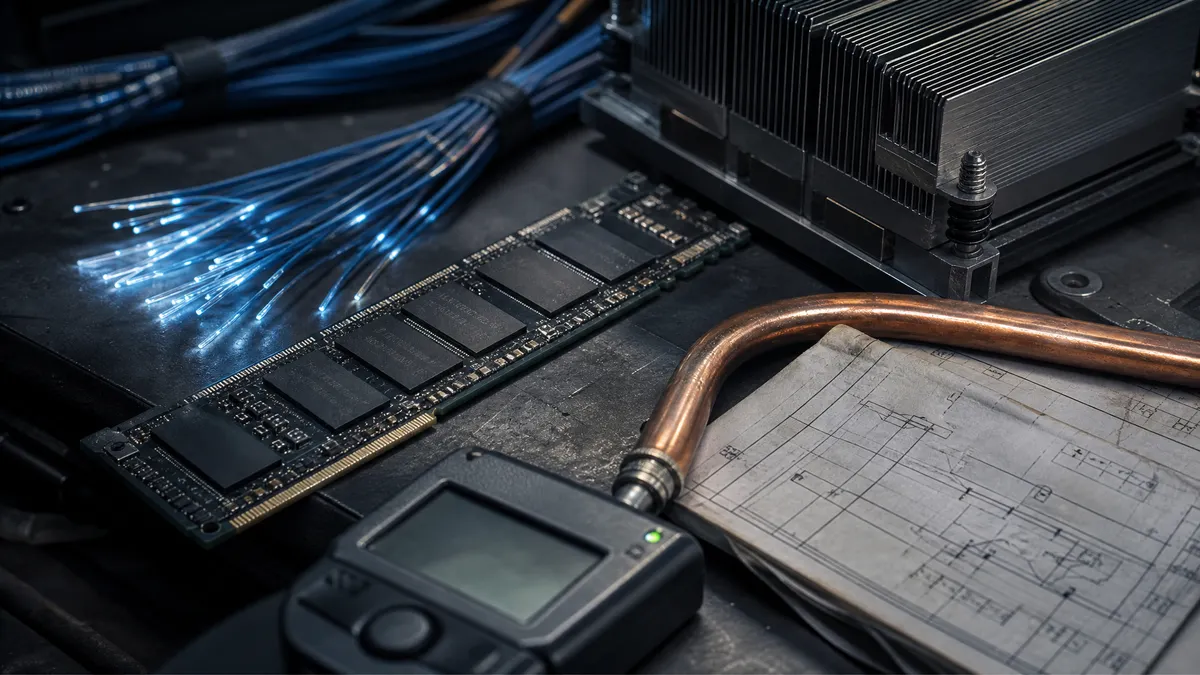
Because the future of AI is now constrained by physical things: memory modules, transformers, substations, fiber, cooling pipes, interconnection queues, and power contracts.
The AI race is not just a race for better models.
It is a race to build the stack those models require.
Read Next
Start with the Vastkind Compute hub for the broader cluster.
Then read AI's Grid Bottleneck Is Transformers for the electrical constraint, High Bandwidth Memory: Why HBM Is Deciding the AI Supply War for the memory bottleneck, and AI Chip Sales Matter Because Compute Is Becoming Political Power for the geopolitical layer.
For weekly orientation, get The Vastkind Briefing.