
Every few years, “free energy” returns wearing better clothes.
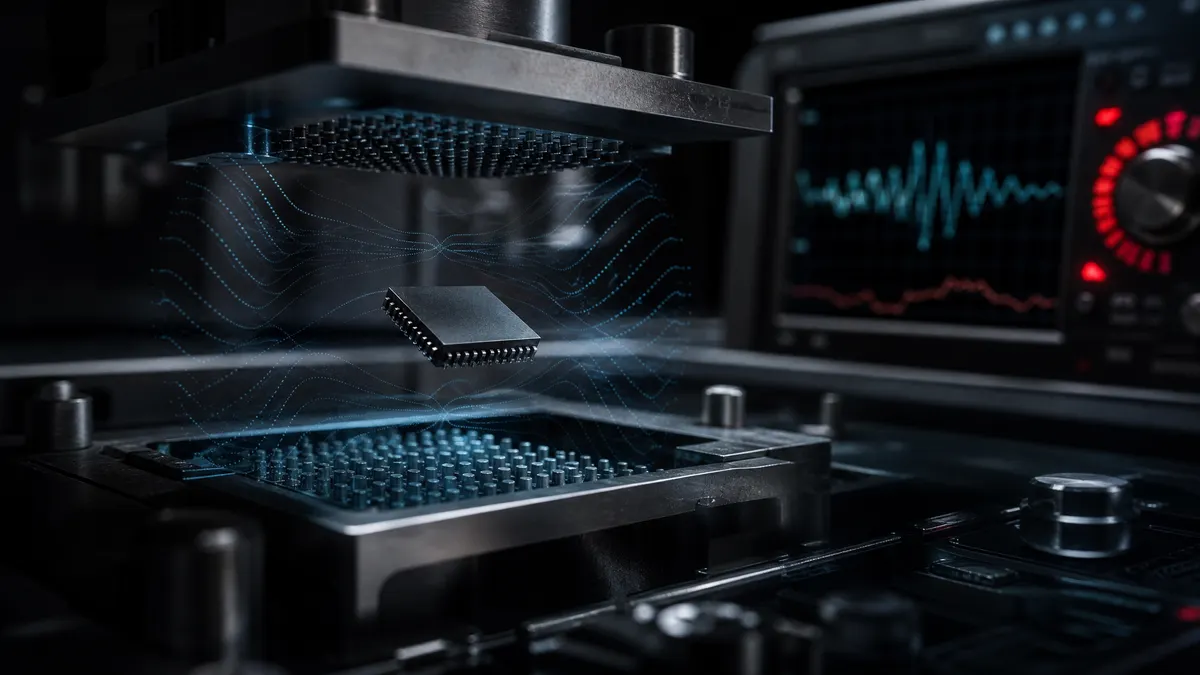
This time the clothes are quantum. Casimir Inc., a Houston company founded by former NASA advanced propulsion researcher Harold “Sonny” White, says it is developing a semiconductor chip called MicroSparc that can harvest continuous electrical power from quantum vacuum fields. The company describes the device as battery-free, cord-free, and able to generate 1.5 volts at 25 microamps from a 5mm by 5mm chip.
That is not enough to power a house. It is not even close. But if the claim is real, it would still matter. Ultra-low-power sensors, embedded devices, tire pressure monitors, wearables, remote infrastructure, and small autonomous systems all live in the world where tiny, persistent power can be valuable.
The problem is that the language around the claim runs far ahead of the evidence. Casimir’s own site calls MicroSparc “the world’s first unlimited power supply.” Its press release says the company raised $12 million to commercialize “the world’s first quantum vacuum energy source.” The Debrief framed the announcement around a chip that allegedly draws power from the quantum vacuum.
That word allegedly is doing a lot of work.
The real physics underneath the claim
The Casimir effect is not fringe physics. It is a real, experimentally observed quantum phenomenon. In simple terms, two closely spaced conductive plates in a vacuum experience an attractive force because the allowed electromagnetic field modes between them differ from those outside them.
That does not mean empty space is a fuel tank.
The important distinction is between observing a force and extracting continuous net energy. A conventional Casimir setup can perform work as plates move together. But once they collapse, the system has changed. To reset it, energy must be put back in. That reset cost is exactly why the Casimir effect has never become a simple route to endless usable power.
Casimir Inc. claims its custom cavity design changes the problem. The company says MicroSparc uses engineered Casimir cavity structures and stationary microscale geometries to produce persistent electrical power without batteries, cords, or charging. Its stated first-generation output is tiny but concrete: 1.5 volts at 25 microamps.
That number is actually one of the more serious parts of the announcement. It places the first use case in a plausible category: ultra-low-power electronics. But it also makes the “unlimited power” rhetoric look reckless. A 25 microamp chip is not an energy revolution yet. It is a measurement claim that needs independent replication.
The dangerous jump from Casimir effect to energy source
This is where the story needs discipline.
There are three separate claims that should not be blended together:
- The Casimir effect exists.
- A specific chip can produce measurable electrical output.
- That output comes from quantum vacuum energy in a way that can scale into practical power systems.
The first claim is established physics. The second is an engineering claim. The third is the world-changing claim.
Most media coverage collapses them into one emotional package. That is how a legitimate quantum phenomenon becomes a “free energy” headline.
The central question is not whether quantum vacuum fields are real. The central question is whether MicroSparc produces reproducible net electrical power under controlled conditions, for long durations, with all conventional energy sources and measurement artifacts ruled out.
That means boring details matter more than visionary language:
- What is the full power curve over time?
- How long has the output been sustained?
- What controls were used?
- What thermal, chemical, electrostatic, mechanical, RF, and fabrication-related effects were excluded?
- Who has reproduced the result independently?
- Does the claimed mechanism survive expert review outside the company’s own circle?
Until those questions are answered publicly, the right posture is neither dismissal nor belief. It is containment.
Why the MicroSparc numbers matter
Casimir says MicroSparc measures 5mm by 5mm and produces 1.5 volts at 25 microamps. That is roughly 37.5 microwatts before accounting for real-world load behavior and system losses.
That is small, but not meaningless.
There are real markets where small persistent power has value. Sensors buried in infrastructure. Devices that are expensive to access. Tire pressure systems. Industrial monitors. Remote beacons. Medical or environmental devices where battery replacement creates cost, waste, or risk.
If MicroSparc can reliably produce even microwatt-scale power without fuel, sunlight, thermal gradients, vibration, RF harvesting, chemical depletion, or hidden stored energy, it would be remarkable.
But the scaling claims are the weak point. Moving from microwatts to consumer electronics, electric vehicles, homes, or commercial infrastructure is not a straight line. It is not enough to say chips can be stacked. Every scaling pathway runs into materials, manufacturing, heat, reliability, cost, packaging, and verification constraints.
This is why Vastkind has treated energy breakthroughs carefully before. In Extropic and the TSU, the interesting question was not whether thermodynamic computing sounded elegant. It was whether a physical architecture could become useful infrastructure. In Geothermal AI Power Play, the point was not novelty theater. It was whether a technology could deliver firm power in the real world.
MicroSparc deserves the same standard.
Not “could this change everything?”
First: does it work?
Why This Matters
Energy claims shape investment, public imagination, and policy before the evidence is settled. A real quantum vacuum power source would be extraordinary, especially for small persistent electronics. But exaggerated “unlimited power” language can blur the line between frontier physics and old free-energy mythology. The stakes are high because the future needs better energy, but it also needs better skepticism.
The paper is not the product
Casimir points to a peer-reviewed Physical Review Research paper titled “Emergent Quantization from a Dynamic Vacuum” as part of the theoretical foundation. That matters, but it should not be confused with independent validation of a commercial chip.
A peer-reviewed theoretical or modeling paper can support a framework. It can show that a concept deserves attention. It can make a proposal more serious than a pitch deck.
It does not automatically prove that a device produces net usable power.
This distinction is especially important in areas like quantum energy, advanced propulsion, and vacuum physics, where legitimate mathematics can sit uncomfortably close to speculative engineering. The more dramatic the application, the more carefully the evidence has to be separated.
A serious article should not sneer at the science. The quantum vacuum is not empty. Casimir forces are real. Nanoscale fabrication can create strange and useful physical effects. The future of quantum technology will almost certainly include devices that exploit phenomena ordinary intuition does not handle well.
But “not intuitive” is not the same as “free energy.”
And “peer-reviewed foundation” is not the same as “commercially verified power source.”
The best-case and worst-case readings
The best-case reading is genuinely interesting.
Casimir may have found a way to engineer nanoscale structures that produce persistent ultra-low-power output through a mechanism that is not yet broadly accepted but can be measured, replicated, and eventually manufactured. If so, the first impact would probably not be cities or cars. It would be battery replacement in specific low-power devices.
That would still be valuable.
The worst-case reading is familiar.
A real quantum effect is being used to wrap an extraordinary energy claim in scientific legitimacy before the key replication evidence is public. Investors, media, and readers hear “Casimir effect” and “Physical Review Research” and mentally upgrade the claim before the engineering proof has earned it.
The most likely near-term reality sits between those poles: something has been measured, the company believes it has a pathway, but the public evidence is not yet strong enough to support the scale of the rhetoric.
That is not a reason to ignore the story. It is the reason to cover it carefully.
What would make this credible
The next step is not another press release.
The next step is independent replication by a respected lab with a full experimental protocol. The device should be tested under controlled conditions, with transparent load measurements, shielding, thermal monitoring, long-duration output data, and comparison against identical inactive structures.
The company should publish enough data for serious physicists and electrical engineers to evaluate whether the output is real, whether it is continuous, and whether the proposed mechanism is necessary to explain it.
If the result survives that, the conversation changes.
Until then, MicroSparc belongs in a narrow category: potentially important, not yet proven, and surrounded by language that makes skepticism mandatory.
The old dream in a new chip
The dream behind this claim is ancient in technological terms: power without fuel, without decay, without dependence on weather, wires, mining, grids, or replacement cycles. Every energy system carries a burden. Batteries degrade. Solar depends on light. Wind depends on weather. Nuclear depends on regulation, fuel, and public trust. Geothermal depends on geology and drilling. Fusion still depends on engineering maturity.
A chip that simply draws persistent power from the quantum vacuum would cut across all of that.
That is why people want to believe it.
It is also why the claim has to be treated so harshly.
The more beautiful an energy promise sounds, the more aggressively it must be measured. Not because the future should be small, but because real breakthroughs deserve protection from exaggerated ones.
MicroSparc may turn out to be a remarkable low-power device. It may turn out to be a measurement controversy. It may become another entry in the long archive of quantum-flavored energy claims that could not survive independent scrutiny.
For now, the only honest position is this:
The physics is real. The product claim is unproven. The marketing is too hot. The story is worth watching.
CTA: For more grounded coverage of frontier energy systems and quantum technology, explore Vastkind’s Energy and Quantum coverage.