
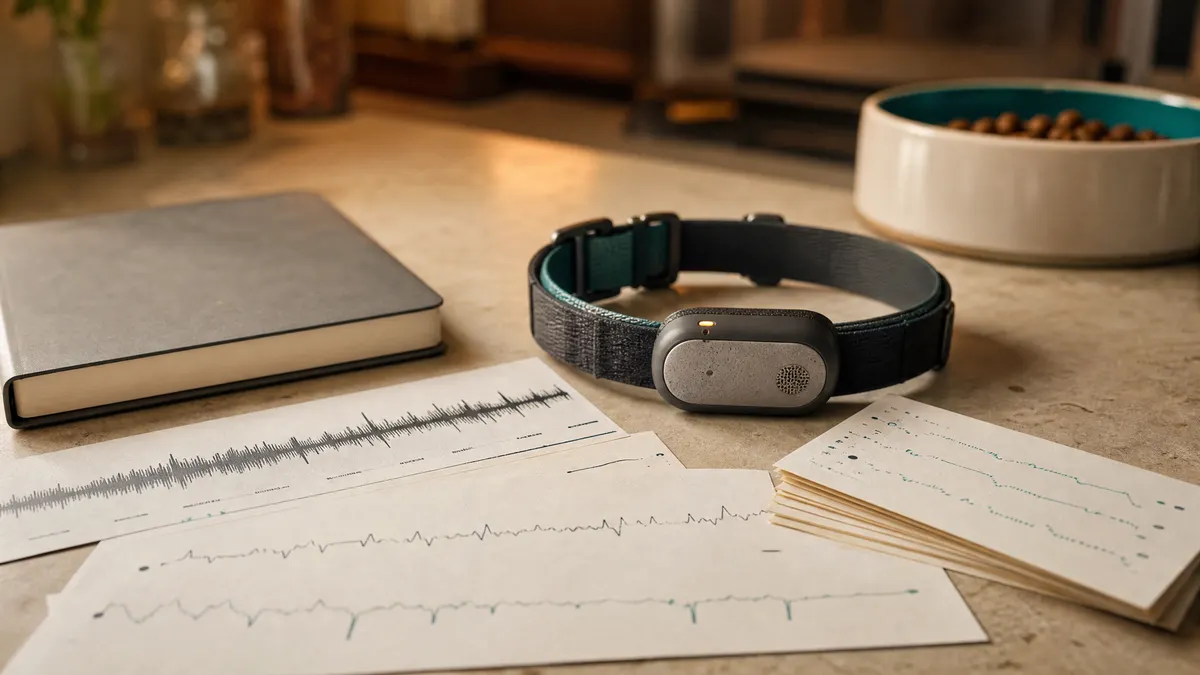
A new kind of AI dog collar is being framed as a step toward understanding what dogs feel and need.
The easy reading is that we are getting closer to a pet translator. The harder reading is more important: animal AI is moving from research archives into ordinary homes, where collars can collect continuous sound, motion, visual, and physiological signals from individual animals.
That does not prove AI understands dogs. It changes the evidence problem around dogs.
Sarama, an interspecies communication startup, describes itself as an AI research lab whose first instrument is a dog collar. On its site, the company says animal communication has been bottlenecked by data, not by AI. Its thesis is that no bark means the same thing across all dogs in all contexts, so the useful path is multimodal, longitudinal, naturalistic data from large numbers of animals living normal lives.
That is a serious claim. It is also a claim that needs a hard boundary. A collar can measure more of a dog's life than a lab recording can. It can build a better baseline for one animal. It can detect patterns that humans miss.
But measurement is not translation.
The easy story is translation. The harder story is measurement.
The phrase "dog translator" makes the technology sound like a dictionary. Bark in, English sentence out. Hungry. Scared. In pain. Happy.
That is not how serious animal AI works.
Sarama's own research framing rejects a universal bark-to-English lookup. The company says its system looks for per-dog vocal repertoires using segmentation, acoustic embeddings, and clustering. It pairs sound with other signals: movement, visual features, physiological proxies, routine, and owner feedback treated as a soft and biased prior.
That distinction matters because the collar is not trying to prove that every dog shares one fixed bark vocabulary. It is trying to model one animal's patterns over time.
A bark at 8 a.m. by the door does not mean the same thing as a bark at 2 a.m. after restless sleep. A whine from a puppy recovering from surgery does not carry the same evidential weight as the same sound from a healthy adult dog during play. A model that sees sound, posture, activity, sleep, respiration proxies, and routine can make a richer inference than a model that only hears a clip.
That is still inference. It is not direct access to the dog's mind.
This is where the headline should slow down. AI may be getting better at measuring dogs. Whether it understands them depends on whether its categories match the animal's lived state, not just the human label attached to a signal.
What Sarama is actually claiming
Sarama's public site makes two claims that should be kept separate.
The first is a research claim: animal communication needs multimodal, individual, longitudinal data. That claim fits the direction of modern bioacoustics. Researchers studying whales, dolphins, birds, and other animals have been limited by sparse recordings, difficult labeling, and weak context. More data with better context can reveal structure that short clips miss.
The second is a product-facing claim: the collar can detect or infer states such as mood, stress, pain, respiratory condition, sleep, and activity. Sarama's site lists performance-style percentages across several categories, including mood, stress, pain, respiratory, sleep, and activity.
Those numbers should be treated as company-reported. Vastkind did not find independent peer-reviewed validation for Sarama's consumer collar claims in the sources gathered for this article. Search results and company-adjacent posts also mention claims around very high accuracy, large annotated bark datasets, and illness detection. Those remain company-reported unless Sarama or outside researchers publish auditable validation.
That does not make the work meaningless. It means the right question changes.
The question is not: "Can this collar translate my dog?"
The question is: "Can this collar produce reliable, useful, bounded evidence about one dog's changing behavior without overclaiming medical or emotional certainty?"
That is a much harder standard. It requires validation against veterinarians, observed behavior, controlled labels, longitudinal health records, and real-world false positives. It also requires proof that the device helps owners act better, not just feel closer to a dashboard.
No pet owner should treat an AI collar as veterinary advice. A collar signal may be useful as a prompt to observe, record, or contact a veterinarian. It should not become a diagnosis machine.
Why dogs change the data problem
Dogs are not the most exotic animal communication problem. They are the most domestic one.
Whale and dolphin projects have scientific advantages: long-term field research, identified individuals, acoustic archives, and species whose vocal behavior is central to social life. But they also face brutal collection constraints. Researchers need boats, underwater gear, permits, tags, hydrophones, and years of fieldwork.
Dogs create a different data engine. They already live with humans. They wear collars. They sleep, eat, play, panic, recover, age, and get sick in environments full of context. A device on a dog can collect repeated measurements across ordinary life, not just exceptional lab or field moments.
That is why Sarama is a signal even if its product claims remain unproven. The collar moves animal AI from archived recordings into the home.
This shift resembles the move from occasional clinic measurements to continuous wearables in human health. The old record is episodic: a vet visit, a note from an owner, a phone video, a few lab values. The new record can be continuous: sleep disruption, reduced movement, changed bark clusters, altered breathing proxies, and routine deviations.
Continuous data can surface patterns earlier. It can also produce anxiety, false alarms, and misplaced authority. A model can make a family more attentive. It can also turn a dog into a stream of alerts that humans overinterpret.
The dog cannot contest the label.
That is the moral pressure point in animal AI. A non-speaking animal becomes more legible through sensors, but humans still decide what the signal means, when to act on it, and who benefits from the record.
What whale and dolphin AI already showed
The broader field has already moved past the simple fantasy of instant translation.
Earth Species Project introduced NatureLM-audio in November 2024 as an audio-language foundation model for bioacoustics. The model was trained on animal sound archives alongside speech and music data. The team reports state-of-the-art performance on several zero-shot bioacoustic benchmark tasks and says the model can support tasks such as species classification, detection, call-type prediction, life-stage prediction, captioning, and some transfer to unseen species or tasks.
That is powerful. It is also not the same as decoding animal language. NatureLM-audio is better understood as a general-purpose bioacoustic analysis tool. It helps researchers query, classify, detect, and annotate animal sounds across taxa. It can reduce the labor of finding patterns in huge archives.
Google's DolphinGemma, announced on April 14, 2025, is narrower and more field-specific. Google says it built a roughly 400 million parameter model with the Wild Dolphin Project and Georgia Tech, trained on decades of Atlantic spotted dolphin audio and video linked to individual dolphins, life histories, and observed behavior. The model learns patterns in dolphin vocalization sequences and can generate dolphin-like sound sequences. It is designed to run on Pixel phones used in field systems.
Again, the important word is pattern. DolphinGemma may help researchers identify recurring sequences and support experimental interaction systems such as CHAT, but Google does not prove that it has translated dolphin society into English.
Project CETI and MIT's sperm whale work adds another boundary. In a Nature Communications paper published on May 7, 2024, researchers analyzed 8,719 sperm whale codas from Eastern Caribbean sperm whales. They found contextual and combinatorial structure in codas, including features described as rhythm, tempo, rubato, and ornamentation. Project CETI describes this as a proposed sperm whale phonetic alphabet.
But the paper and Project CETI also keep the key limit visible: the communicative function of many codas remains unknown.
That sentence should govern the whole animal AI conversation.
AI can find structure before humans know meaning. It can reveal categories, sequences, repetitions, and context effects. It can make animal behavior more analyzable. It can expand the map.
The map is not the animal.
Where the evidence boundary sits
An AI dog collar has to clear a different bar than a research model.
A research model can be useful if it helps scientists find structure, reduce annotation labor, or generate new hypotheses. Its output can be provisional because the audience is trained to treat it as a tool.
A consumer collar lives in a home. Its outputs may shape how a person treats an animal. If it says a dog is stressed, the owner may change routines. If it flags pain or respiratory risk, the owner may panic, delay care, or rush to a vet. If it produces a long-term behavior record, that record could affect insurance, custody disputes, shelter decisions, or breeder claims.
Some law already shows why this matters. New York has required courts to consider the best interest of a companion animal when awarding possession in divorce or separation proceedings. That is enough to show the direction without overstating a broader legal trend.
That legal context does not mean courts will use AI collar data. It means society is already moving pets out of the pure-property box in some settings. Once an animal has a continuous behavioral record, someone will eventually ask whether that record says where the animal is calmer, safer, more active, or more distressed.
That can help. It can also mislead.
A collar may detect that a dog sleeps better in one household than another. But sleep can reflect many things: age, medication, noise, weather, illness, anxiety, exercise, room temperature, and sampling error. A model output can look objective while hiding fragile assumptions.
This is the familiar AI measurement trap. A score gains authority because it is numeric, not because it captures the thing people care about.
Vastkind has made the same point in its coverage of AI benchmarks and real-world meaning: measurement can be useful while still missing the target. The same caution applies when the target is a dog rather than a model.
Why This Matters
Animal AI is not only a pet-tech story. It changes who gets to speak for animals.
Today, most companion-animal interpretation is informal. Owners read posture, appetite, sound, routine, and temperament. Veterinarians add medical training, physical exams, diagnostics, and longitudinal clinical judgment. Trainers, shelters, breeders, insurers, courts, and platforms may all make claims about an animal's behavior.
A collar inserts a new actor into that chain: the model vendor.
The vendor decides which signals matter, which labels appear in the app, how uncertainty is displayed, whether raw data stays local, how owner feedback is weighted, and whether performance claims are audited. The owner sees a simplified output. The animal supplies the data but cannot consent, explain, appeal, or correct the label.
That does not make the technology bad. It makes the design choices unusually consequential.
A good AI collar could help owners notice pain earlier, share cleaner logs with veterinarians, and reduce crude myths about dog behavior. It could make invisible changes visible, especially for animals that mask pain or communicate subtly.
A bad one could sell emotional certainty from weak proxies. It could train owners to trust an app over direct observation. It could turn normal variation into alerts. It could create a market where intimacy with an animal becomes mediated through subscription analytics.
The difference will not come from the word "AI." It will come from validation, restraint, privacy design, veterinary boundaries, and how honestly the product represents uncertainty.
This is also why home robotics and domestic AI safety belong in the same conversation. When machines enter intimate spaces, the standard cannot be only whether the system works in a demo. The standard is whether it behaves safely around bodies, routines, families, and dependent beings. That is the same practical pressure behind Vastkind's analysis of domestic humanoid robot safety standards.
The takeaway: better measurement is not the same as understanding
Sarama's collar is interesting because it rejects the weakest version of the dog-translator fantasy.
The company's better argument is that animal meaning is contextual, causal, individual, and multimodal. That is the right direction. A dog's vocalization should be read beside movement, sleep, routine, environment, and history. One dog's baseline matters more than a universal bark chart.
But that better argument raises the standard of proof.
If animal AI becomes a continuous model of non-speaking minds, then its claims need more than charming demos and impressive percentages. They need independent validation, clear uncertainty, privacy discipline, welfare-first design, and sharp limits around medical interpretation.
The future of animal AI may not look like a translator at all. It may look like a long-term evidence system: part acoustic model, part wearable, part behavior diary, part decision aid.
That could make humans better caretakers.
It could also make animals easier to score without making them better understood.
The honest answer is that an AI dog collar can probably measure dogs better than humans could with memory alone. Whether that becomes understanding depends on what the system does when the signal is ambiguous, the stakes are emotional, and the animal cannot speak back.
Read deeper
If this piece was useful, continue with Vastkind's guide to AI benchmarks and what they miss in real life, then read AI IQ measurement and why one number fails intelligence. For the broader workflow question behind sensor-driven systems, see what agentic AI is and where it breaks.
Sources
- Sarama AI, "Interspecies Communication Lab," accessed May 23, 2026: https://www.sarama.ai/
- Sarama consumer site, accessed May 23, 2026: https://www.withsarama.com/
- Earth Species Project, "Introducing NatureLM-audio," November 11, 2024: https://earthspecies.org/2024/11/11/introducing-naturelm-audio-an-audio-language-foundation-model-for-bioacoustics/
- Robinson et al., "NatureLM-audio: an Audio-Language Foundation Model for Bioacoustics," arXiv, accessed May 23, 2026: https://arxiv.org/html/2411.07186v2
- Google, "DolphinGemma: How Google AI is helping decode dolphin communication," April 14, 2025: https://blog.google/innovation-and-ai/products/dolphingemma/
- Sharma et al., "Contextual and combinatorial structure in sperm whale vocalisations," Nature Communications, May 7, 2024: https://www.nature.com/articles/s41467-024-47221-8
- Project CETI, "Sperm Whale Phonetic Alphabet Proposed for the First Time," May 7, 2024: https://www.projectceti.org/blog-posts/sperm-whale-phonetic-alphabet-proposed-for-the-first-time
- MIT News, "Exploring the mysterious alphabet of sperm whales," May 7, 2024: https://news.mit.edu/2024/csail-ceti-explores-sperm-whale-alphabet-0507