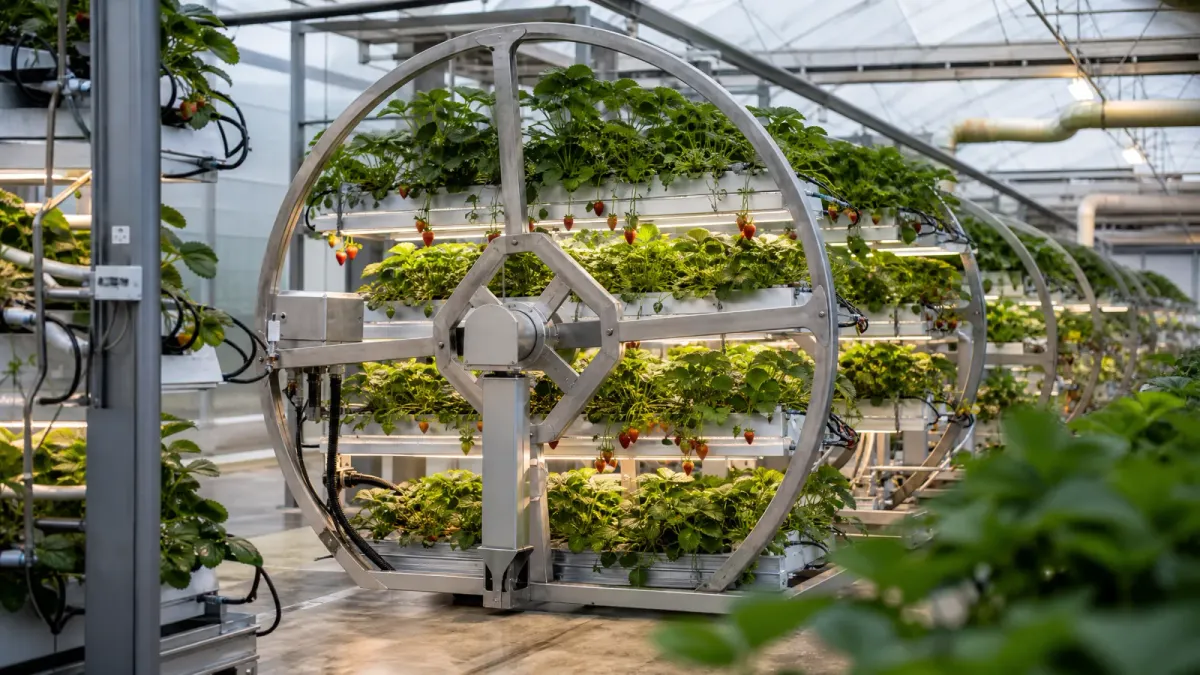
Dyson Farming is growing strawberries in a 26-acre glasshouse in Lincolnshire with rotating vertical racks, sensors, LED lighting, climate control, supplementary CO2, robotic harvesters, and energy from nearby anaerobic digesters.
The easy reading is that this is a clever way to grow premium fruit out of season.
The harder reading is more important: controlled environment agriculture is turning parts of farming into engineered infrastructure. The farm is no longer just land, labor, weather, and crop knowledge. It is becoming a machine made from electricity, software, water loops, sensor feedback, carbon dioxide, robotics, and capital.
That does not make it automatically better. It makes it more revealing.
The easy story is strawberries. The real story is control.
Dyson's own strawberry page describes a production system built around its Hybrid Vertical Growing System, or HVGS. The company says the system delivers 2.5 times the growing space in the same footprint by placing strawberry plants on slowly rotating wheels, giving plants access to natural sunlight at different points in the day and supplementing that light with LEDs.
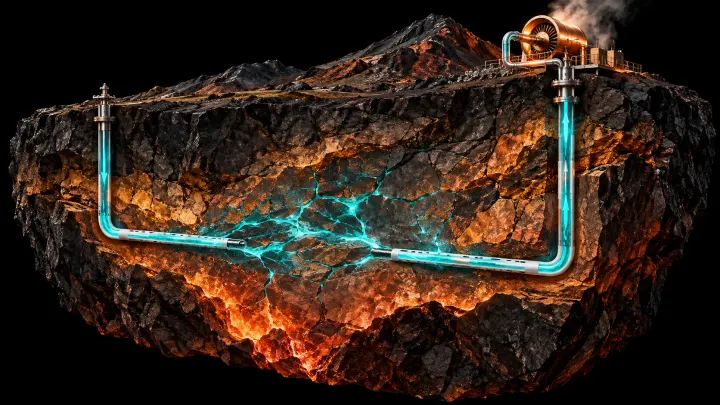
The company also describes AI-powered decision support, smart sensors, robotic harvesters, UV and nanobubble treatments, climate-control systems, supplementary CO2 dosing, and an anaerobic digestion plant that provides electricity and heat to the glasshouse.
That stack matters because it changes what a farm is optimizing.
A field farm optimizes around soil, weather, timing, water, pests, labor, land, and logistics. A controlled environment farm tries to move more of those variables inside a managed system. Temperature becomes an input. Light becomes a programmable cost. CO2 becomes a managed growth factor. Water becomes a recirculated loop. Labor becomes supervision, picking, maintenance, and exception handling.
The appeal is obvious. You can produce more consistently. You can reduce exposure to bad weather. You can grow closer to consumers. You can reduce some water use. You can potentially produce outside the traditional season.
But the tradeoff is just as obvious. The farm starts to depend on engineering uptime.
When food production moves indoors, it does not become frictionless. It changes which constraints matter.
How Dyson's strawberry machine works
The Dyson system is useful because it makes the mechanism visible.
According to Dyson, its Lincolnshire glasshouse is home to 1,225,000 strawberry plants and produces more than 1,250 tonnes of British strawberries. Trade coverage from Vertical Farm Daily describes the HVGS as a large custom-built rotating structure, with wheels that move plants through the greenhouse so each plant can receive natural light while LEDs fill the gap when needed.
That is not just vertical farming as a stacked shelf. It is a mechanical answer to a biological problem.
Plants need light, but dense planting creates shadow. If you simply stack crops, upper layers can starve lower layers of usable light. Dyson's approach tries to keep the density benefit while rotating plants through better light exposure. The system then uses sensors to monitor conditions such as CO2, humidity, temperature, and photosynthetically active radiation, the slice of light plants can use for photosynthesis.
This is where the farm starts to look less like a place and more like a control problem.
A grower is no longer only asking whether the crop has enough sun today. The system is asking how much useful light reaches the canopy, when artificial light is worth the electricity cost, how humidity affects disease risk, how CO2 changes growth, and how water can be captured and reused.
That is the real shift. Controlled environment agriculture turns farming into a continuous negotiation between biology and operations.
It also explains why this story belongs next to robotics and energy, not just agriculture. A strawberry rack that rotates through a greenhouse is not a humanoid robot, but it is still automation entering the physical world. For the broader reliability test behind robotics deployment, see The Future of Robotics Will Be Decided by Reliability, Not Robot Theater.
The hard limit is energy, not imagination
The most important boundary on controlled environment agriculture is energy.
A global meta-analysis summarized by GLASE, an academic-industry lighting and systems group linked to Cornell research, found the basic pattern clearly: controlled environment agriculture tends to produce higher yields and use less water per kilogram, but it often has higher cumulative energy demand and higher global warming potential than field production.
That is the tradeoff most shiny vertical-farming coverage softens.
A farm can save land and water while increasing electricity demand. It can reduce some transport exposure while adding lighting, heating, ventilation, cooling, pumps, sensors, materials, maintenance, and controls. It can make local food production more resilient while making food prices more dependent on power costs and capital equipment.
The University of Surrey reached a similar tension in a 2026 study summary on vertical farming and UK food security. The study found that vertical farms can dramatically increase lettuce yield and reduce water use, but that greenhouse gas emissions remained higher than field farming even under renewable electricity assumptions. The point is not that vertical farming fails. The point is that its environmental case depends on the whole system, not the marketing image.
Dyson's anaerobic digestion loop is therefore not a decorative sustainability detail. It is central to the model. The company says its AD plant turns farm-grown energy crops and glasshouse waste into energy, then delivers electricity and heat to the glasshouse. Waste from the process becomes digestate used as fertilizer on fields.
That is exactly the kind of coupling controlled environment agriculture will need if it wants to scale credibly: food production tied to local energy, heat, waste, and water systems.
But that also means the farm becomes more infrastructure-heavy. The winner is not simply the grower with the best crop. It may be the operator with the best energy integration, financing, maintenance capacity, sensors, procurement, and distribution.
This is similar to the lesson now appearing in AI infrastructure. Once a technology becomes energy-hungry, the decisive question shifts from software or product promise to physical capacity. Vastkind has covered that same energy constraint in AI Data Center Power Demand Is Turning Utilities Into Compute Infrastructure. The crop is different. The pattern is familiar.
Why This Matters
Controlled environment agriculture matters because food security is becoming a systems problem.
Climate volatility puts pressure on field production. Water stress changes where crops can be grown reliably. Labor shortages make repetitive agricultural work harder to staff. Consumers still expect year-round supply. Retailers still want consistency. Governments want domestic resilience, especially after supply shocks.
A machine farm offers one answer: bring more of production under control.
But control has a price.
If farming becomes more engineered, it may also become more concentrated. Smaller farms may struggle to compete with operators that can finance glasshouses, automation, energy systems, sensor networks, and skilled technical teams. Agricultural knowledge does not disappear, but it gets fused with operations engineering.
That changes who has leverage.
The future farmer may need to understand crops, but also power contracts, maintenance schedules, sensor calibration, climate-control software, food safety data, and robot uptime. The future food company may look less like a farm and more like a hybrid of grower, utility customer, manufacturer, and logistics operator.
That is not inherently bad. It can improve resilience. It can reduce some waste. It can support local production of high-value crops outside normal seasons. It can make supply more predictable.
But the social question becomes sharper: if food production depends on expensive engineered environments, who owns the environments?
A field can be fragile. A machine can be fragile too. It just fails differently.
The future of farming will be uneven
Dyson's strawberry system should not be read as the future of all agriculture.
That would be hype.
Premium strawberries are a better candidate for controlled systems than wheat, rice, corn, or other low-margin staple crops. High-value, perishable, quality-sensitive produce gives the technology more room to justify its cost. A rotating strawberry rig does not mean staple food will move indoors at mass scale.
The better conclusion is narrower and more useful.
Controlled environment agriculture will expand where four conditions line up: high crop value, strong demand for consistency, pressure from climate or seasonality, and access to reliable energy. Strawberries can fit that pattern. Leafy greens can fit it in some markets. Certain herbs, seedlings, and specialized crops can fit it too.
The evidence boundary is important. Dyson's 2.5x claim is company-reported. The full economics are not public. The net carbon impact depends on energy source, materials, transport, yield, crop loss, and system lifetime. The labor impact depends on how robotic harvesting and automation are actually deployed.
So the article is not that Dyson solved farming.
The article is that Dyson shows where one serious branch of farming is going: toward controlled environments where biology is managed by machines, energy systems, sensors, and capital.
That future will not replace fields. It will sit beside them, compete with them, and in some crops outperform them.
The farm is not disappearing.
But in more places, it is becoming something you operate.
CTA: Read next: Flexible Solar Cells: Why Energy Is Escaping the Solar Farm for another example of infrastructure changing shape around energy constraints.