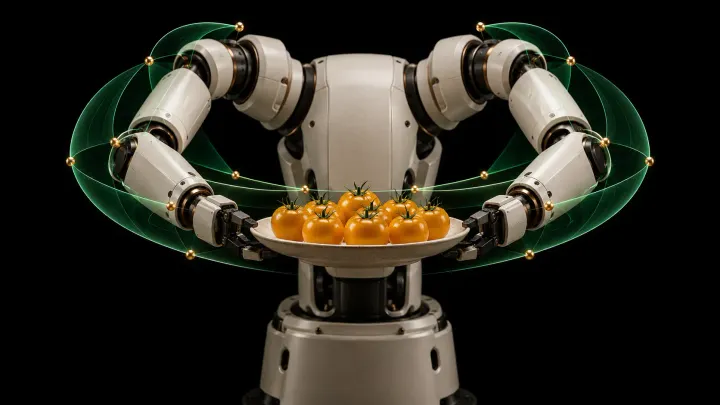
A robot spent every day—including weekends—checking whether tiny worms were still moving. The result was not a longer life for the worms. It was evidence that miniTower, a machine built to automate Caenorhabditis elegans lifespan tests, could reproduce the important difference between two strains without a person repeatedly moving and counting dishes.
That distinction is the story. A lifespan assay is one of biology's most familiar tools for testing conditions that might affect aging. Automating it could let researchers examine more conditions with less repetitive work. But the new, peer-reviewed study validates a method on worms; it does not identify a longevity treatment, and it says nothing direct about extending human life.
In Plain English: Researchers often judge whether a worm is alive by watching for movement. miniTower stores Petri dishes, carries each one to cameras, controls the light, compares images and returns the dish. It automates the observation loop. The scientific question was whether all that movement, light and vibration would quietly change the very lifespan the robot was meant to measure.
The Robot Has to Avoid Becoming the Experiment
C. elegans is roughly one millimeter long, transparent and short-lived. Those traits make it useful for screening biological ideas before anyone considers larger animals. They also make lifespan work repetitive: plates must be inspected again and again, while lethargic older worms are harder to classify by eye.
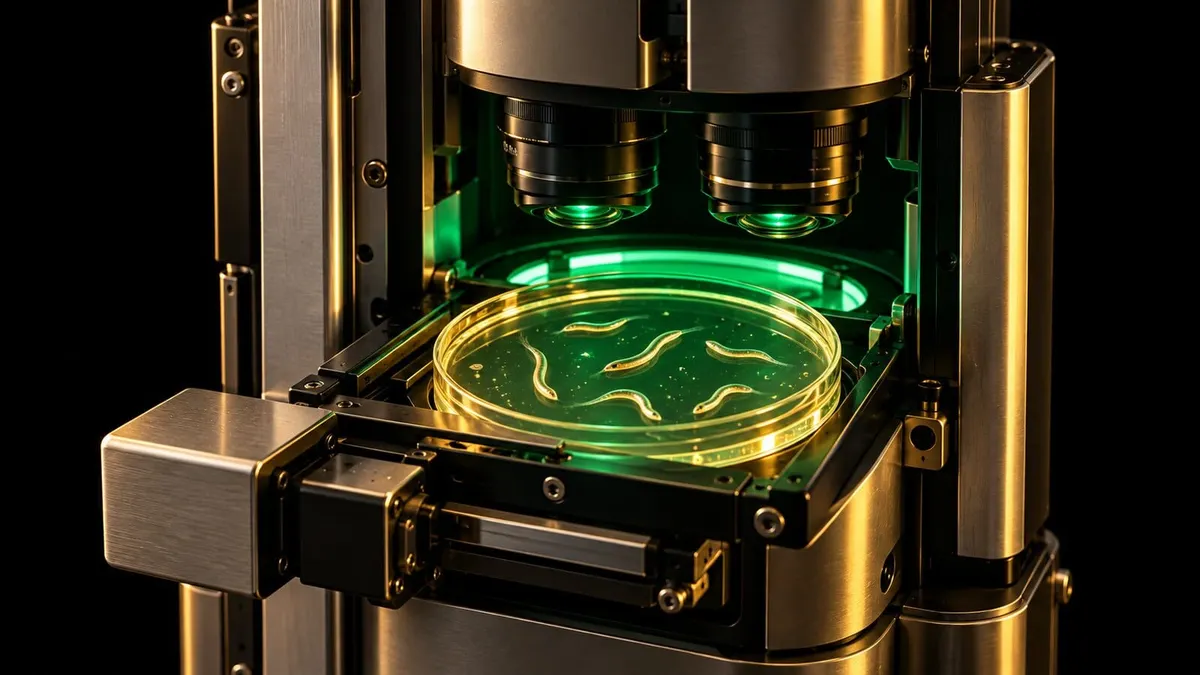
The accepted Scientific Reports paper, published online as an Article in Press, describes a vertical storage system designed to fit inside an incubator. Two cassettes hold nine pallets each; every pallet carries two standard Petri dishes, for a maximum of 36 dishes. An elevator and magnetic gripper move each pallet to an inspection head with two cameras and a controlled backlight.
The backlight is not cosmetic. Worms can respond to illumination, temperature, vibration and mechanical stimulation. If a robot exposes one plate to more light or jolts it more often, apparent automation could create a biological confound. miniTower calibrates the illumination for each dish, monitors temperature and humidity, and returns the plate after imaging.
Its software then looks for motion. Early in life, that is straightforward. Later, a worm may barely move. The system compares images from one day with the next and treats a worm that has not moved over 24 hours as dead. That rule turns a vague visual judgment into a repeatable criterion, but it also means contamination or poor visibility can become classification errors rather than merely inconvenient plates.
A Small Validation With the Right Question
The researchers compared manual and automated assays under the same conditions: ten worms per plate, two strains, three replicates and a temperature of 20 degrees Celsius. Wild-type N2 worms served as the ordinary-moving group; unc-1 mutants were chosen because their low motility makes life-versus-death detection harder.
In the manual runs, median survival ranged from 14 to 17 days for N2 and from 9 to 12 days for unc-1. Automated runs preserved the statistically significant strain difference and produced 14- to 15-day medians in two N2 replicates, although a third automated replicate fell to 11 days. The authors report greater variability in the automated experiments and point to long-running plate contamination as one source of detection error.
That is not a perfect one-number equivalence test. It is a bounded validation showing that the robot preserved the comparison it was supposed to detect under this setup. The machine also completed daily acquisition through weekends without human supervision. It did not prove that every strain, treatment, laboratory or plate condition will transfer cleanly.
Throughput Is Useful Only if the Measurements Hold
At its current resolution—about 30 micrometers per pixel—the system can detect adult worms but not larvae. It still needs technicians to prepare and load plates. Standard 55-millimeter dishes carry only 10 to 15 worms each, so larger studies require multiple plates and careful handling of missing or contaminated data.
Those limits explain what comes next. A useful follow-up would run more than two strains, introduce candidate interventions, publish error rates against blinded human scoring and test whether different laboratories can obtain comparable results. Healthspan measures, which track how well an animal functions rather than only when it dies, would make the robot more informative if its five-frame-per-second imaging can quantify movement consistently.
This is a quieter kind of robotics result than a humanoid demo. The machine's value lies in doing the same constrained job on schedule while proving that its own activity does not distort the outcome. That connects to Vastkind's earlier look at a robot that recovers when an optical experiment drifts, the gap between a clean demonstration and robots working in public spaces, and evidence that old cells leave measurable chemical patterns.
The next result worth watching is therefore not how many plates miniTower can hold. It is whether independent laboratories can use it to detect subtle intervention effects without increasing biological or measurement noise.
Production note: Vastkind reviewed the complete accepted manuscript and its methods, results and limitations. We did not operate miniTower or reproduce the lifespan assays.