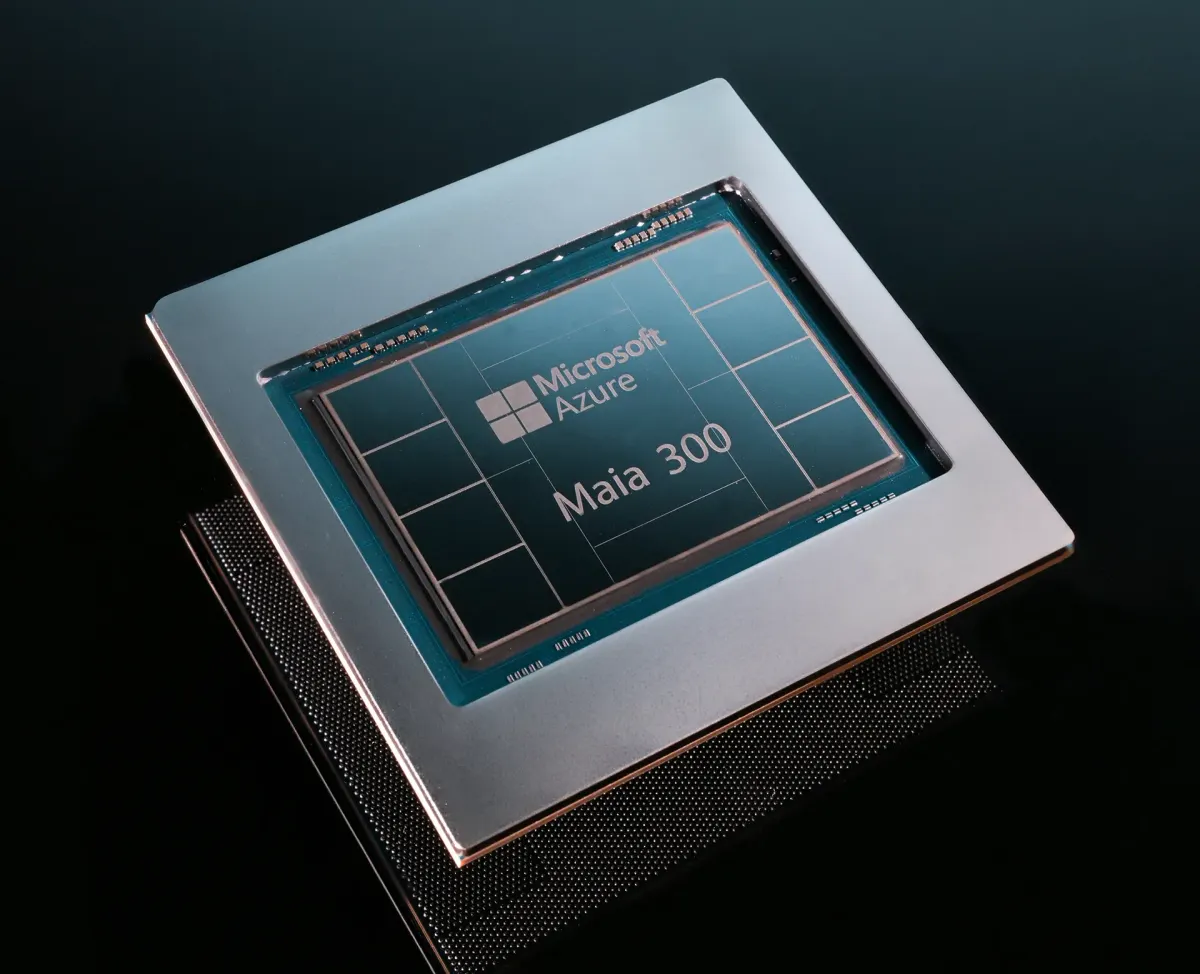
Microsoft is putting twice as many AI accelerators into its next rack: 96 instead of 48. Its headline claim is bigger still. The full Maia 300 system, announced on October 12, is supposed to produce up to seven times the AI output of a Maia 200 rack.
That is a claim about a whole system producing tokens, the pieces of text a model generates. It is not a sevenfold speedup for one chip or one conversation. Microsoft plans to begin Maia 300 production deployments in 2027; it says the older Maia 200 is already serving workloads including Microsoft Copilot.
The interesting part is how Microsoft wants to fill those extra chips with useful work. Adding arithmetic is only one part of answering an AI request. Supplying the data can be the harder job.
Reading a prompt and writing an answer are different jobs
A language model first processes the input, a stage called prefill, then generates an answer token by token, called decode. NVIDIA's serving documentation explains why separating them can help: processing a long new prompt can otherwise interrupt work on answers already being generated. The two stages also need different balances of calculation and memory access.
A useful analogy is a kitchen that separates preparation from plating. More cooks do not solve every delay if each dish still waits for ingredients to travel across the room. In an AI system, placing work and moving its stored context matter alongside the processor doing the calculation.
Microsoft's Maia 300 architecture description puts memory close to the compute regions that use it and gives software explicit control over where data goes. Each accelerator has 288 gigabytes of high-bandwidth memory and a stated peak memory bandwidth of 18 terabytes per second. Capacity is how much fits; bandwidth is how quickly it can be supplied. Our HBM explainer covers why that distinction matters.
The rack also lets prompt-processing workers hand stored context directly to answer-generating workers over a shared network. That separation is not a Microsoft invention: NVIDIA Dynamo supports it on GPUs too. The competition is over how well the pieces work together.
The rack has a power budget, not just a chip count
Microsoft specifies a 167-kilowatt envelope for the 96-accelerator rack. Faster memory, data placement, networking and cooling all sit inside the system-level design. The comparison is therefore broader than replacing one processor with a faster successor.
Nor can the sevenfold claim be divided by two to discover the improvement per chip. Changing the number of accelerators also changes how a workload can be distributed. Without matched tests, that arithmetic would create a measurement Microsoft has not supplied.
A separate claim concerns electricity: Microsoft expects 40% more tokens per megawatt than leading GPU-based systems. The announcement does not identify those competing systems or provide a reproducible workload comparison. It is an efficiency expectation, not a demonstrated 40% cut in a customer's electricity bill or subscription price.
More output is not the same as less waiting
The DistServe research presented at OSDI in 2024 offers a better way to think about the result. It evaluates how many requests a system can serve while meeting targets for the first token and the pace of subsequent tokens. A machine can produce more text overall and still miss the response times an application needs.
That research did not test Maia. It supplies the missing question for any rack-throughput headline: how much of the extra output arrives soon enough to be useful? Microsoft has disclosed a concrete design for moving less data and coordinating more chips, but not the matched measurements needed to settle that comparison.
For a cloud provider, the useful unit is neither an isolated chip nor an unqualified token count. It is an answer delivered on time within the site's power budget. Maia 300 is Microsoft's attempt to engineer the whole route to that answer.