NVIDIA’s Factory Operations Blueprint is easy to read as another industrial AI product launch.
That reading is too small. The more important signal is that the factories building AI infrastructure are starting to become the places where agentic AI is deployed, tested and operationalized first.
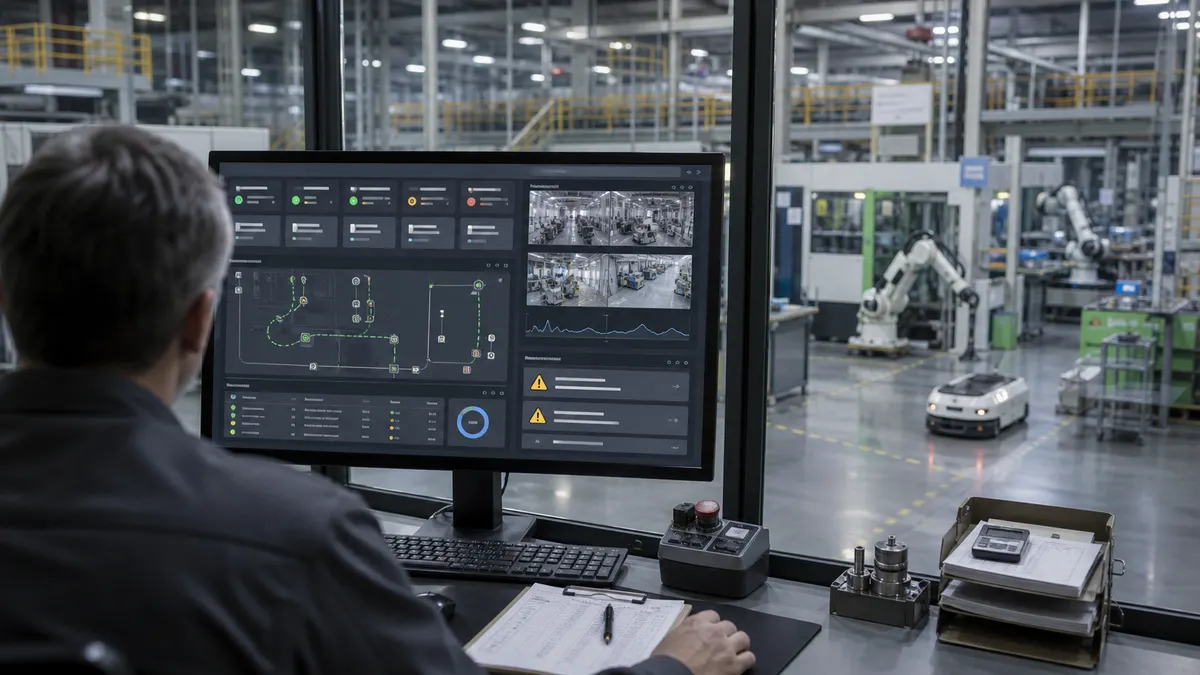
NVIDIA calls the system FOX, a reference design for factory manager agents that connect machine signals, inspection cameras, work instructions, robot fleets, quality systems and operational alerts into one coordinated layer. The claim is not just that software can monitor a plant. It is that AI agents can begin to route factory work across machines, people, robots and digital systems.
That matters because factories are not abstract software environments. They are places with production lines, yield targets, downtime costs, safety procedures, sensor feeds, maintenance logs and workers whose day is shaped by the systems that assign, verify and escalate work.
The question is not whether NVIDIA has invented autonomous manufacturing overnight. It has not. The question is why agentic AI is moving toward the factory as one of its first hard deployment surfaces.
What NVIDIA’s Factory Operations Blueprint actually does
NVIDIA’s Factory Operations Blueprint is a reference design for building autonomous factory manager agents.
In NVIDIA’s framing, FOX gives manufacturers a way to connect existing factory systems with specialized AI agents. Those agents can support quality control, material transport, worker safety, standard operating procedure checks, visual inspection, maintenance alerts and machine coordination.
The important detail is the architecture. FOX is not presented as one narrow inspection model or one robot-control tool. It is a coordination layer. It sits between factory data sources, machine signals, applications, robots and human operators, then uses agent workflows to decide what needs attention.
NVIDIA says the blueprint uses its NemoClaw agent system, the AI-Q Blueprint, Nemotron open models and DGX Station optimization. It also points to Metropolis video-search and summarization tools for visual inspection and Omniverse-style digital twins for factory and AI-infrastructure planning.
That stack shows the direction of travel. The model is not the product by itself. The product is the operating layer around the model: tools, permissions, memory, observability, skill execution and interfaces that plant teams can use.
If you want the broader foundation, Vastkind’s guide to what agentic AI actually means explains why agents matter only when they can use tools, act through permissions and leave records of what they did.
Why Taiwan’s AI factories are the important context
The FOX announcement becomes more interesting when placed beside NVIDIA’s Taiwan ecosystem story.
In a separate announcement about Taiwan’s AI infrastructure ecosystem, NVIDIA described the island’s manufacturing base as central to the global AI buildout. The company said more than 500 ecosystem partners are involved and that more than 1 million MGX rack components for Vera Rubin infrastructure are coming together across 25 factory sites.
Those factories are not only building the physical systems that AI companies need. NVIDIA says partners including Foxconn, Pegatron, Wistron and Advantech are also applying accelerated computing, simulation, AI agents and physical AI inside their own operations.
That creates a feedback loop. The factories that produce AI servers, racks and components also become early sites for the software methods that may later manage more physical work.
This is why the story should not be reduced to a chip supply-chain update. It is also a deployment story. AI capacity depends on chips, memory, power, cooling, racks and factories, as Vastkind’s compute infrastructure guide explains. But those same factories are now being treated as AI operating environments.
The hardware supply chain is becoming a software testbed.
How a factory manager agent changes plant operations
A factory manager agent changes the plant by placing software between operational signals and human decisions.
In a conventional factory, information is often split across manufacturing execution systems, quality tools, maintenance systems, worker instructions, cameras, sensors and local operator knowledge. Managers may need to inspect dashboards, call supervisors, compare logs and trace a defect across machines or shifts.
A factory agent tries to compress that loop. It can ingest machine data, surface anomalies, call a visual inspection workflow, check a standard operating procedure, query a maintenance record and recommend an escalation.
That does not make the agent a plant manager in the human sense. It makes it a routing and reasoning layer for the plant’s information flows.
The distinction matters. If a system only summarizes a dashboard, it is analytics. If it can call tools, connect specialized agents, compare evidence and push work toward people or machines, it starts to become operational software.
NVIDIA’s named examples point in that direction. Foxconn’s MoMClaw is described as connecting sensors, machine signals and digital systems with hundreds of specialized agents through a natural-language interface. Pegatron, Advantech and Wistron are described as applying agents to material transport, visual inspection, SOP guidance, energy management, surface-mount operations and synthetic defect data.
Those examples are still vendor and deployer claims. They do not prove that FOX will generalize across manufacturing. But they show the work category NVIDIA is targeting: not only seeing the factory, but coordinating it.
The new factory stack: agents, robots, digital twins and synthetic data
The factory stack NVIDIA is assembling is broader than a chatbot for plant managers.
It joins several layers that were often discussed separately:
- factory manager agents that coordinate signals and workflows
- video agents that inspect cameras, procedures and events
- robot systems that move materials or interact with work cells
- digital twins that simulate factory layouts, power and production flows
- synthetic data systems that generate rare defect examples for inspection models
- local or controlled runtime systems that route models, skills and permissions
Each layer solves a different bottleneck. Inspection models help identify visible defects. Robot fleets move goods or parts. Digital twins test layout and energy changes before crews modify the plant. Synthetic data helps train models on defects that do not occur often enough in real footage. Agent systems connect those pieces into a workflow.
This is where NVIDIA’s older physical AI push becomes relevant. Its Isaac and GR00T work is about the robotics-training stack, not just the robot model. FOX applies a similar platform logic to factory operations. The object is not one humanoid machine. The object is the coordinated factory.
A plant does not become autonomous because it has one clever model. It becomes more software-mediated when more of its decisions are routed through models, agents, simulations and machine interfaces.
That is a different kind of automation from replacing one task with one robot. It is automation at the coordination layer.
Why the productivity claims need an evidence boundary
The productivity numbers around FOX should be treated as claims or projections, not independently audited outcomes.
NVIDIA says Foxconn projects 80 percent faster root-cause analysis, 15 percent higher labor productivity and 10 percent lower machine failure rates. Those figures are useful because they show where deployers expect value: faster diagnosis, fewer machine problems and more output per worker-hour.
They are not the same as public, independent proof.
The evidence boundary is important for three reasons. First, the production scale, duration and maturity of these deployments are not fully public. A pilot, a controlled rollout and a long-running multi-site operating system are different things.
Second, the numbers come from companies with direct commercial interest in the result. NVIDIA benefits if the market sees factories as a natural home for its agent, simulation, robotics and compute stack. Manufacturing partners benefit if they appear to be leading the AI infrastructure buildout.
Third, factory performance is shaped by many variables outside the AI system. Product mix, process maturity, worker training, supplier quality, energy conditions and management practice can all affect root-cause analysis, downtime and productivity.
The right posture is neither dismissal nor hype. FOX may be meaningful without the headline metrics being fully proven. The stronger claim is architectural: NVIDIA is trying to define the factory coordination stack for agentic AI.
What this changes for workers, managers and vendors
Factory agents shift leverage toward whoever controls the coordination layer.
For plant managers, the upside is clear. A well-designed agent system could reduce the time spent chasing disconnected data. It could surface root causes faster, coordinate maintenance, flag procedure failures and give managers a better view of production risk.
For workers, the effect is more mixed. AI-guided SOP checks, camera-based inspection and workflow agents can reduce ambiguity and catch problems earlier. They can also make work more monitored, scored and routed by software that workers may not fully see or challenge.
For vendors, the opportunity is larger than selling one factory app. If FOX-like systems become central to operations, the vendor’s stack can sit close to plant decisions: what gets inspected, which alert matters, when a robot moves, how defects are classified and which process gets escalated.
That is why agentic AI governance becomes practical inside factories. The control question is not philosophical. It is whether the system has limits, audit trails, operator override, clear liability, cybersecurity boundaries and records of which agent recommended or triggered which action.
Vastkind’s piece on agentic AI governance is the right companion question here. Once agents can act across tools and systems, governance becomes the architecture that decides what authority software actually has.
Why This Matters
Factories are becoming one of the first places where agentic AI has to survive contact with physical reality.
Office agents can fail by sending the wrong email, misreading a spreadsheet or updating the wrong record. Those failures can be serious. Factory agents operate closer to machines, production schedules, safety procedures, defect rates, energy use and worker monitoring.
That makes the factory a harder test. It exposes whether agent systems can handle messy sensor data, incomplete context, competing priorities and the need for human override. It also exposes whether vendors can build systems that operators trust instead of systems that only executives admire.
The larger consequence is strategic. AI infrastructure is beginning to operate on itself. The factories assembling racks and servers are also becoming sites where agents, digital twins, synthetic data and robots coordinate production.
If that loop works, manufacturing becomes a proving ground for agentic AI. If it fails, it will show where autonomy breaks: not in a demo, but in the gap between a model’s recommendation and a factory’s real constraints.
What to watch next
The next question is whether FOX remains a named NVIDIA blueprint or becomes a repeatable operating pattern across factories.
Watch for three things.
First, evidence quality. The market needs more than projected productivity gains. It needs clearer deployment scope, duration, failure cases and independent evaluation of downtime, yield, safety and labor effects.
Second, control design. The important details will be permissions, audit logs, override paths, model-routing controls, data boundaries and cybersecurity posture. Factory agents cannot be trusted only because they appear inside a polished operations interface.
Third, worker impact. The most consequential factory AI systems may not look like humanoid robots. They may look like SOP verification, dispatching, visual inspection, performance scoring and root-cause analysis quietly moving into one software-mediated layer.
That is the real reason NVIDIA’s Factory Operations Blueprint matters. It is not just a new industrial AI announcement. It is a sign that agentic AI is searching for a serious deployment layer, and the factories building the AI era may be among the first places where that layer becomes real.
To deepen the concept, start with Vastkind’s guide to agentic AI and then follow the physical constraints through compute infrastructure.